Blog Articles
Harvard Checked My Book. Well, Almost
 Anatoly Yasinsky · physicist, qigong master, yoga therapist
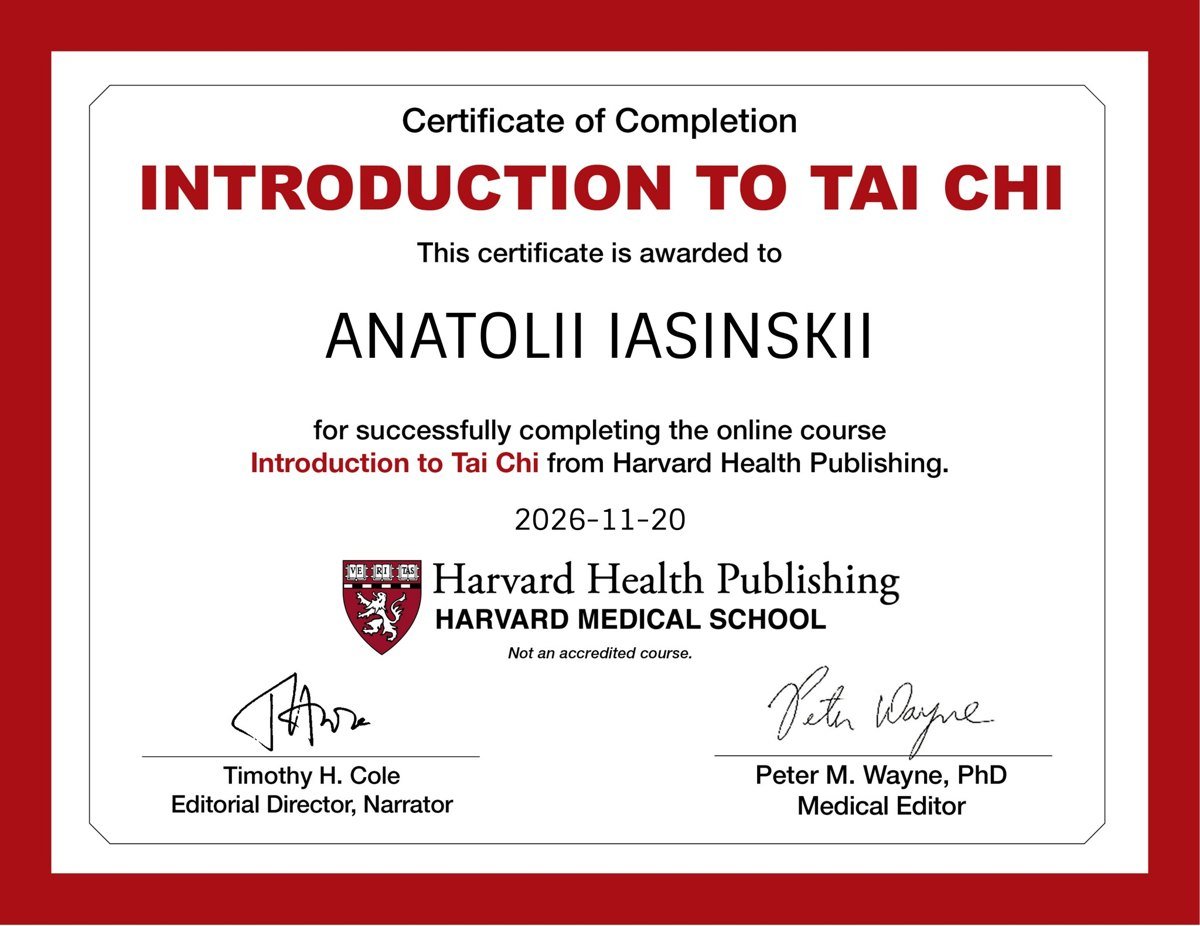
Twenty-five years of practice, a certificate from Beijing Sport University, one of the first qigong instructor credentials issued in Russia, and a book of my own. And here I am again, back at a virtual school desk. In November I completed the online course “An Introduction to Tai Chi” by Harvard Health Publishing, the publishing arm of Harvard Medical School 🎓
Why? Every author should check their watch against others from time to time. If your book is about a practice studied at one of the best-known medical schools in the world, it would be a shame not to look at what they teach there. And, while you are at it, to check whether you wrote anything unscientific over two hundred and thirty-five pages. Spoiler: I didn’t 😊
What the course is
The course is presented by physician and TV journalist Mallika Marshall. Its medical editor is Peter Wayne, a Harvard Medical School researcher and author of “The Harvard Medical School Guide to Tai Chi”. Seven sections: what tai chi is, its health benefits, nine standing exercises, six traditional elements of the form, five chair exercises, how to fit the practice into your life, and a summary. A quiz after each section, a certificate at the end.
The certificate honestly says in small print “Not an accredited course”. It is not a diploma, just confirmation that you made it to the end. I did 😄 At times the quizzes felt like a school trivia game, but the course is made for a broad audience, including older people who have never done anything like this. For them, that bar is just fine.
The main thing: the principles match
The most important conclusion for me: the principles I describe in my book and the principles of the Harvard course match almost word for word.
We move slowly, with attention directed inward rather than outward. The course calls this meditation in motion. The spine is upright but not rigid. The joints stay soft and are never locked out, neither the elbows nor the knees. The knee is always over the foot. Before stepping, we shift our weight fully onto the supporting leg, and only then does the free leg start to move. Movement comes from the center and the legs, not from the arms. Breathing is low, into the belly. Tension is always followed by relaxation. And no competition, neither with the person next to you nor with your twenty-year-old self.
The course even has a “70 percent rule”: never go beyond 70 percent of your effort and range of motion, and with the spine, no more than 50. My book makes the same point less catchily: in strength exercises, keep tension at 50-60 percent of your maximum, because the goal is health, not winning a contest for the deepest twist.
Tai chi and qigong: an equals sign with Harvard’s seal
People often ask me how tai chi differs from qigong. My answer: in terms of principles, hardly at all. It was nice to find a separate lesson in the course, “Qigong vs Tai Chi”, with the same conclusion. These practices have more similarities than differences, many people consider tai chi a form of qigong, and most tai chi practitioners include qigong in their training. So I will keep putting an equals sign between them with a clear conscience 😉
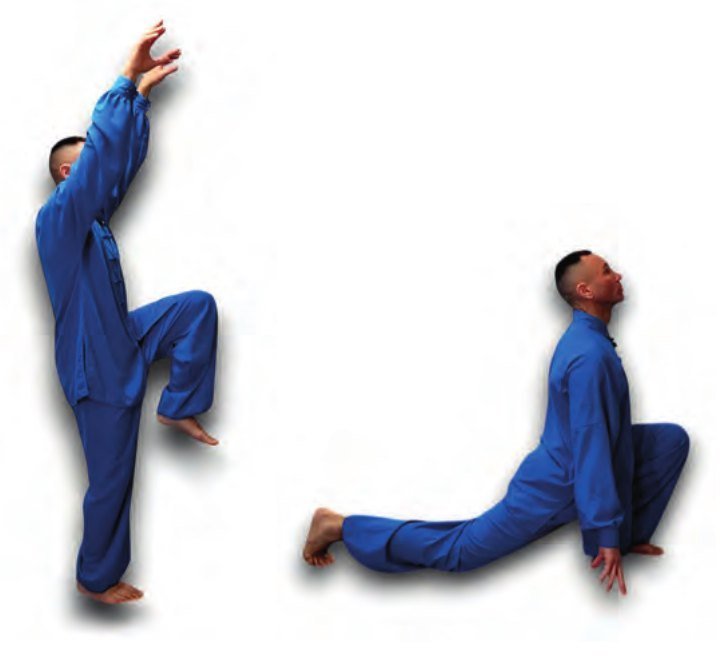
The one thing my book really does not have is tai chi stepping, where the form moves forward with steps, a turn of the waist and a push, as in “Brush Knee” or “Grasp the Bird’s Tail”. The qigong sets in the book are done without stepping transitions, which makes them easier to learn. The closest thing to tai chi is “Tiger Pounces on Its Prey” from the Yi Jin Jing set: the center of gravity travels in a circle back, up and forward, and it all ends in balance on one leg.

Breathing: the baby versus physics
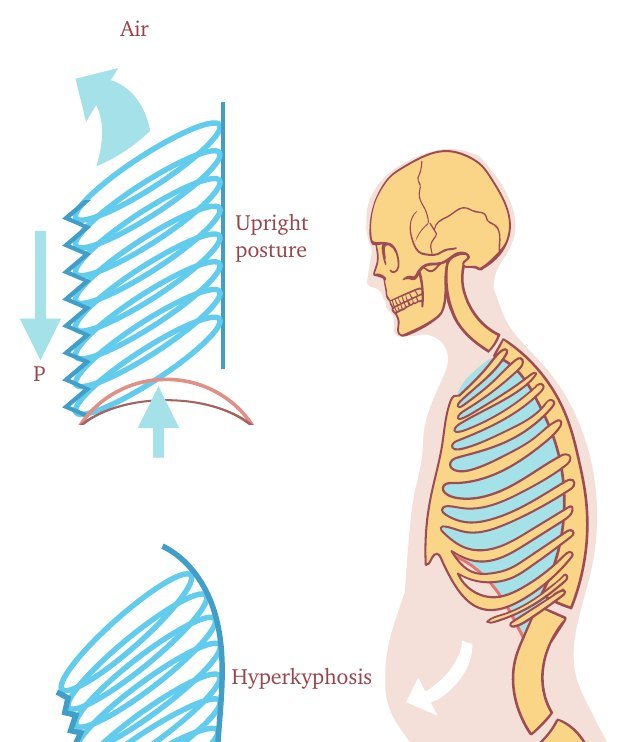
The Harvard course also teaches belly breathing. The explanation goes like this: look at a sleeping baby, whose belly rises and falls on its own, while adults have forgotten how and breathe with their chest. The diaphragm descends and air goes all the way to the bottom of the lungs. All true. But why exactly is this more efficient? That is where the explanation ends 👶
In the book, this is where everything begins. When we stand or sit, gravity fills the lower lobes of the lungs with more blood. Back in 1977 the physiologist John West showed that in an upright person, blood flow in the lower and upper parts of the lungs differs several-fold. The upper lobes are well ventilated but have little blood. The lower lobes are full of blood, but air reaches them less easily. So the air has to be brought down, to where most of the gas exchange takes place. Hence the ancient saying from the “Zhuangzi”: “the true man breathes with his heels”.
Next comes carbon dioxide. We are used to thinking of it as waste, but without it oxygen does not detach well from hemoglobin and does not reach the tissues. This is the Bohr effect. That is why frequent deep breathing without exertion does not “saturate you with oxygen” but makes you dizzy. Slow nasal breathing with a slight narrowing of the glottis (ujjayi) works for us, not against us.
There is also a difference in method. Harvard deliberately does not burden the beginner: breathe naturally, do not force a rhythm, “less can be more”, and at first do not even link breath and movement. In the book I teach trained breathing: through the nose, with an active exhale using the abdominal and pelvic floor muscles, linked to movement. The arms rise on the inhale and come down on the exhale, in nine cases out of ten. There is no contradiction here: these are two steps of the same ladder. First natural breathing, then trained breathing.
Posture: image versus instruction
The Harvard course talks about posture in images, and good ones. The head “floats” on the spine. The pelvis is soft, as if you were sitting in a baby bouncer. The spine hangs freely. The knee is over the foot.
In the book I build posture like a house, from the bottom up. Feet: the toes are active, the arches lifted. The pelvis is slightly tucked, the lumbar curve flattened. The thoracic spine moves slightly forward, the shoulder blades are drawn slightly together, the shoulders are down. Chin in, back of the head back, the crown reaching up, the tongue touching the palate. And then I explain why. Each vertebra works like a small seesaw lever on the intervertebral joint. The deep tonic muscles can hold the spine for hours without tiring. And tilting the torso by just two or three degrees forces the muscles to spend effort continuously to keep the body from falling forward.
My advice: build the posture from the book, then let go of everything extra the Harvard way. Let your head float 🙂

Qi, healing energy and the inner ocean
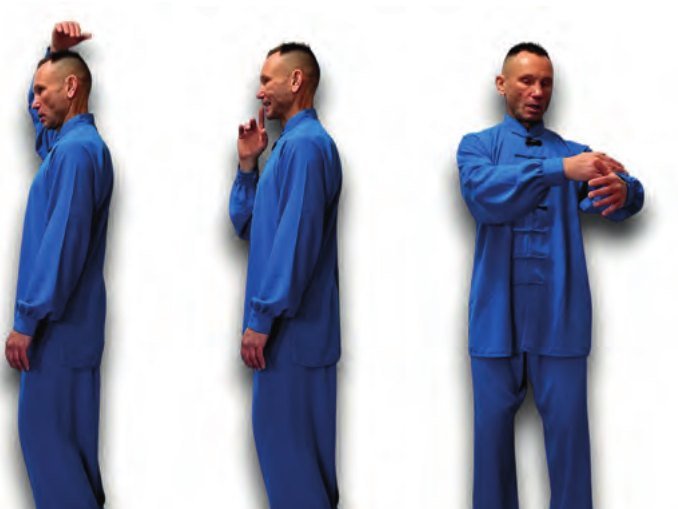
This is where a surprise awaited me. The Harvard course talks quite freely about “healing energy” and about qi “flowing more freely”. In the chair set you are invited to “bathe in the healing energy of nature” and to “release negative energy”. The course’s favorite image is the “inner ocean”: the body is 60-70 percent fluid, so imagine this ocean washing over your joints.
It is not a bad image, and you can use it. But the course hardly explains what lies behind the word “energy”. There is one cautious caveat: the very belief in an inflow of healing energy may trigger neurochemical changes.
In the book I take a different path. The Chinese “qi” originally meant air and breath, and European authors began translating it as “energy” only in the twentieth century. In the language of physiology, the famous “where attention goes, qi follows” means quite measurable things. Attention to the palms dilates the small blood vessels through the autonomic nervous system, and the hands get warmer. You can check it without any mysticism: touch your palms after practice 🔬
What is worth learning from Harvard
The course does not criticize the concepts of traditional Chinese medicine, but it relies on a scientific evidence base. The authors cite a review of more than 500 studies, especially on balance and fall prevention in older adults, and on pain and osteoarthritis. There is a clear list of warning signs that mean it is time to see a doctor: chest pain or pressure, feeling faint, severe shortness of breath, muscle pain lasting longer than one or two weeks. The chair exercise set for those who find it hard to stand is also good. And, of course, there are short, memorable rules like that same 70 percent rule.
Bottom line
The Harvard course is a good entry point into tai chi for beginners and older people, including those who have trouble standing. It has a convincing evidence base, and it motivates you to keep taking care of your health on your own.
Do I regret the 30 dollars I spent? 😊 Of course not. As a specialist in Eastern practices, I simply need to see from time to time how this art is promoted and presented around the world. And I do not mind adding useful things to my toolkit.
Still, I would advise a beginner to invest their money and time more effectively. For 19 euros you can get a complete basic course of qigong exercises and breathing, with the practices explained from a scientific point of view. As a bonus: yoga, pranayama and meditation. All of it in three formats: a book with photos and diagrams, an audiobook to listen to on the go, and video lessons in which the author breaks down the techniques in detail 🌿
More from the blog
All blog posts →
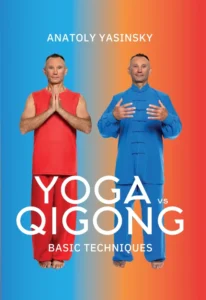
The foundations of yoga and qigong in six practices: 235 pages, over 200 photos and video lessons via QR codes. In English, Bulgarian and Russian. Printed book with the author’s autograph, in Russian →