Blog Articles
Books on Breathing: Technique from Iyengar, Mechanics from Calais-Germain
 Anatoly Yasinsky · physicist, qigong instructor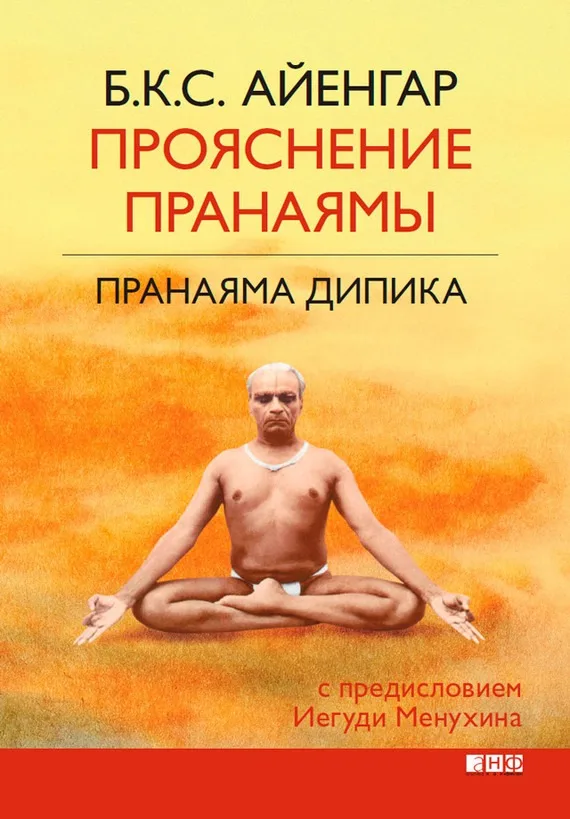
When I got serious about breathing practice, instructions like “just breathe deeper” stopped being enough. As a physicist, I wanted the mechanism: what actually moves, which muscles do the work, where the pressure goes. That is how two very different books on breathing ended up on my desk. I read both slowly, taking notes and testing everything on myself.
The first was written by a yoga master for practitioners: “Light on Pranayama” by B.K.S. Iyengar, first published in the early 1980s. The second was written by a movement specialist for people who want to understand the body: “Anatomy of Breathing” by Blandine Calais-Germain (the French original came out in 2005). Here is what each gave me and why I recommend reading them as a pair.
Iyengar: a thorough pranayama manual
Among yoga practitioners this book has long been considered one of the best guides to pranayama technique, and I agree. The list of techniques alone is impressive: ujjayi, viloma, bhramari, bhastrika, kapalabhati, shitali, anuloma and pratiloma, surya bhedana and chandra bhedana, nadi shodhana. Each one is taken apart down to the last detail.
Iyengar explains how to sit, where the chin goes, what the eyes and tongue are doing, how the fingers rest on the sides of the nose. All of it comes with photos. For every pranayama there are tables with stages of progression: first a simple rhythm, then retention after the inhale and after the exhale, then bandhas, then combinations of several techniques in one cycle. A separate chapter is devoted to shavasana, and rightly so: if you cannot relax, breathing practice turns into forcing yourself. There is even a short section on the anatomy of the respiratory system.
To be honest, I did not like everything. I had to push through the opening chapters, which are full of the Hindu worldview: five “secondary” types of prana (naga, kurma, krikara, devadatta and dhananjaya), kundalini and so on. This is part of the tradition, and Iyengar would not be Iyengar without it. For practical purposes, though, you can skim that layer without losing anything in technique.
Calais-Germain: breathing through an anatomist’s eyes
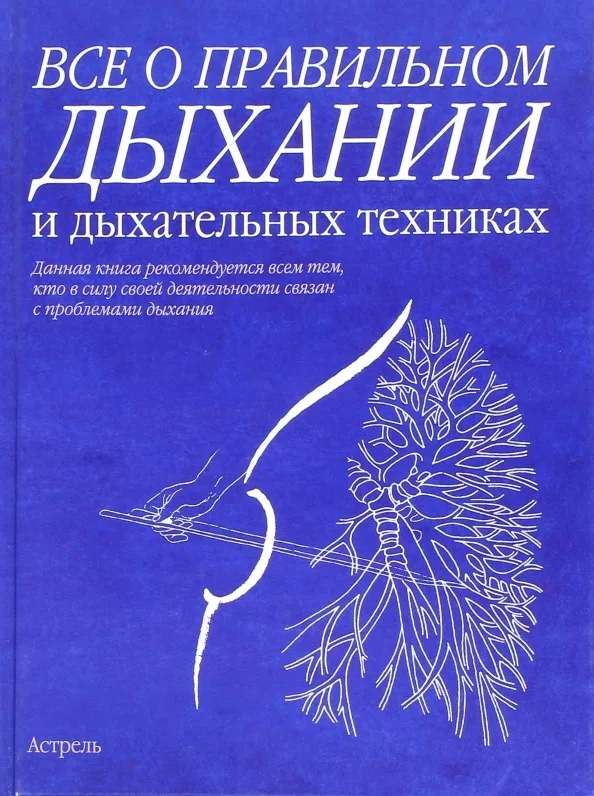
The second book is just as practical, but it contains nothing that science would argue with. Blandine Calais-Germain trained as a dancer and a physical therapist and is known for her atlases of movement anatomy. She presents the respiratory system not as a textbook illustration but as a working machine.
The most valuable idea for me was to see the torso as two linked elastic containers. On top are the lungs: an elastic bag filled with gas, and gas, as physics tells us, compresses and changes both its shape and its volume. Below is the abdominal cavity: a container of fluid and organs that easily change shape but hardly change volume, because water is incompressible. Between them sits the dome of the diaphragm, around them a flexible frame of ribs and spine, and over it all a great many muscles.
Practical conclusions follow right away. On the inhale the diaphragm descends and presses on the abdominal contents, which cannot disappear and have to shift somewhere. If you draw in the front wall of the belly at that moment, the pressure goes back toward the spine and down toward the pelvic floor. Release the belly, and the volume moves forward. This explains all the different types of breathing yoga people argue about: belly, chest, side, “into the back.”
Another discovery: far more muscles take part in breathing than I had thought. The diaphragm is the main one, of course. But the inhale is assisted by pectoralis major and minor, serratus anterior and serratus posterior superior, the levatores costarum, the spinal erectors, the sternocleidomastoid, the scalenes, the rhomboids and many small muscles. An active exhale recruits rectus abdominis, the obliques and transversus abdominis, the pelvic floor (levator ani and coccygeus), transversus thoracis, quadratus lumborum and serratus posterior inferior. The intercostals work in both phases.
Breathing as training for the deep muscles
Putting the two books together, I came to a simple conclusion. The human body has more than six hundred muscles, and a large share of them lie deep: on the back, for example, muscles are stacked in several layers you will never see in a mirror. As the lists above show, many of them are involved in breathing one way or another. I wonder how many bodybuilders could name even a third of them.
So when we work with the breath on purpose, we are training the muscular system, and specifically the part no machine at the gym can reach. The load is gentle and balanced, and no gym is needed. When the respiratory muscles work in a coordinated way, ventilation becomes more economical, you tire less, and a calm rhythm is easier to keep. You can explain all this without meridians or mysterious qi, with ordinary physiology.
Where qigong comes in
In qigong the respiratory muscles are engaged even more. In a dynamic set, the inhale and exhale are timed to the movement, and the deep muscles contract and lengthen together with the breath. The division into inner and outer layers is a convention anyway: muscles, ligaments and fascia are tightly interwoven and work as one tissue. A good example of this kind of work is the Yi Jin Jing qigong set.
I see the Taoist practice of the Microcosmic Orbit (the “Small Heavenly Circle”) through the same lens. In essence it is a sequence of tensing and releasing muscles in a loop: from the belly (the dantian area) down to the perineum, through the huiyin point, which corresponds to mula bandha in yoga, then up along the spine to the crown. Isn’t that strength training for the deepest muscles? Arnold might want to add a chapter to his encyclopedia.
Which book to read first
If you are just starting out, I would read Calais-Germain first. She gives you an understanding of what happens in the body, and after that every instruction makes sense. Then move on to Iyengar and take specific practice schemes from his tables. I collected the basic exercises that make a good starting point on my pranayama page.
Both books ask you to practice, not just read. I have been coming back to them for years, and each time I find something new.
I cover basic breathing techniques, along with asanas, qigong exercises and meditation, in my book “Yoga vs Qigong: Basic Techniques”.
More from the blog
All blog posts →
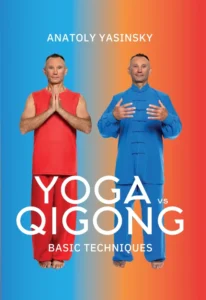
The foundations of yoga and qigong in six practices: 235 pages, over 200 photos and video lessons via QR codes. In English, Bulgarian and Russian.