Yi Jin Jing: A Shaolin Qigong Sequence for Beginners
Yi Jin Jing, “the canon of strengthening muscles and tendons”, is a qigong sequence of ten exercises that works the whole body in half an hour, with special attention to the spine, shoulders and legs. I have put together a version that people without much flexibility or strength can do, older people included, while leaving room to make it harder. On this page you will find the general principles that turn movements into qigong, a short description of all ten exercises and tips on how to learn the sequence. Each exercise is covered in detail, with photos, in my book “Yoga vs Qigong: Basic Techniques”, and on this page there is a video lesson with timecodes.
Audio & subtitles: EN · BG · RU (⚙ in the player)
Where the sequence comes from
Legend attributes Yi Jin Jing to Bodhidharma, the Indian monk who came to China, meditated for nine years in a cave near Shaolin and founded Chan Buddhism. There is no way to verify this. What is more interesting is that the exercises show clear parallels with the yoga Sun Salutation. The Indian and Chinese traditions influenced each other for centuries, and this sequence is a good example.
I learned Yi Jin Jing from different masters in Russia and China, including Shi Yan Bin, a 34th-generation Shaolin warrior monk. Every master performs it in their own way, and the performance changes over time even for the same person. That is normal: your version will also differ a little from mine.
Five principles that make it more than gymnastics
From the outside, qigong exercises look like ordinary morning exercises. The difference comes from a few rules that apply throughout the whole sequence.
Stepping out through the supporting leg
To step to the left, first load the right leg fully: smoothly shift almost all your weight onto it and sink a little, then lift the left heel, then the toes, and only then step the leg out. The weight moves onto it gradually, too. The wider the stance you need, the lower you sink on the supporting leg. The Chinese treatise “The Thirty-Six Stratagems” advises making a noise in the east in order to attack in the west. The same idea works here: root yourself firmly on the right so you can move reliably to the left.
Hands in a dense medium
The hands and fingers are neither limp nor wooden; they have tone. Imagine moving your hands through a thick liquid that pushes back.
Movement starts from the shoulder blade
The arm does not rise from the shoulder like a stick. First the shoulder blade works, then the shoulder, elbow, wrist and fingers, as if the arm were a flexible hose. The joints are almost never fully straightened, and the upper arm never rises straight up, so the shoulder joint does not get pinched.
Living feet
The toes feel the floor, the lengthwise and cross arches are supported, and the foot stays springy instead of slumping onto the heel.
The breath leads the movement
As a rule, the body grows and opens as you inhale, and sinks and gathers as you exhale. The pace of each exercise is set by the breath, not by counting.
Ten exercises in brief
Below is the main idea of each exercise and what to feel in it. The full technique is in the video and in the book.
1. “Wei Tuo Presents the Pestle”
Wei Tuo is a guardian of Buddhist temples. This is a long exercise in several phases: the palms join in front of the belly, reach forward as you rise onto your toes, the arms rise through the sides, “push the sky” and then press down with force. It builds the vertical axis and teaches balance on the toes. Repeat the whole exercise 2 to 3 times.
2. “Opening the Gate of Life”
Slow, powered twists of the torso. The pelvis stays almost still, and the turn travels up the spine from the bottom, all the way to the neck and eyes. Inhale as you turn and exhale just as long as you come back, with no momentum. It resembles the twists in the Eye of Revelation, but there they are quick and serve as a warm-up, while here they are slow and done with strength. 10 to 12 turns, gradually increasing the angle.
3. “Pulling Nine Oxen by Their Tails”
A wide stance similar to Warrior II in yoga. The fists close slowly, from the little finger to the thumb, then the whole body tenses and the torso turns, as if you were hauling a team of oxen behind you. This exercise uses reverse breathing. 4 to 5 times on each side.
4. “Showing the Claws, Spreading the Wings”
As you inhale, draw the shoulder blades together and bring the palms to the ribs. As you exhale, sink and push forward with the heels of the palms, fingers in a “tiger claw”, shoulder blades spreading apart. Breathe out through the mouth with the tongue out and the eyes wide open: you look fierce, like a lion. It opens and strengthens the shoulder girdle very well.
5. “Nine Ghosts Draw Their Sabers”
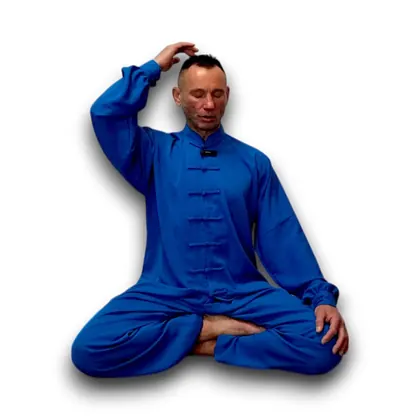
One hand wraps around the back of the head, and the elbow moves back to open the side as you inhale; then you bend sideways as you exhale, with the elbows reaching towards each other. It stretches the side muscles of the torso and the intercostal muscles. 4 to 5 times on each side.
6. “Squatting at Three Levels”
Squats in a wide stance with the arms out to the sides. The heels stay down but do not press into the floor, as if there were a sheet of paper under them. Go down on the exhale, no lower than a right angle at the knees, and come up slowly on a long inhale, as if lifting bowls of water in your palms. 8 to 10 times.
7. “Young Dragon Shows Its Claws”
The smoothest exercise of all: the weight flows from leg to leg, one arm draws a large circle, the torso twists and opens, and the palm “strokes the grass” near the floor. It is the only exercise in the sequence that starts with the right arm, and that is deliberate: it keeps the brain from running on a template. 2 to 3 times on each side.
8. “Beating the Heavenly Drum and Bowing”
First tap with your fingers just below the back of the head, then bend down slowly, letting your attention travel down the spine from top to bottom, and rise just as slowly from the bottom up. The knees are slightly bent. Three bows.
9. “Tiger Pounces on Its Prey”
The longest and most beautiful exercise, bringing together movements typical of qigong and tai chi. The weight travels in a circle: back and down, then up and forward, like a cat before it leaps. Then comes a balance on one leg and a deep stretch in a low stance. You can practise it on its own as a mini-sequence.
10. “Wagging the Tail, Shaking the Head”
A forward bend with the hands on the floor, knees bent if you need to. Turn the head and the pelvis towards each other, as if trying to see your own tail. 5 to 6 times on each side. To finish: palms on the belly, five slow breaths.
How to breathe
The main breathing in the sequence is low belly breathing with ujjayi, as in pranayama. The movement follows the breath, and the inhale and exhale are equally long.
Several exercises use reverse breathing, which is typical of qigong and the martial arts. As you inhale, the belly does not push out but draws in slightly: the diaphragm and the abdominal muscles work at the same time, and the pressure in the abdomen rises. As you exhale, the belly lets go. Yoga has no breathing of this kind, so take it gently at first.
How to learn the sequence
For the first few weeks, do all ten exercises smoothly, without holds, with a small range of movement and in high stances. That takes 15 to 20 minutes. Once you remember the order, add short holds at the end points and slower breathing. Leave breath holds and deep stances until the sequence feels familiar. The full version takes 25 to 30 minutes.
Three times a week or more is ideal. The best time is the morning, after a short joint warm-up: the sequence is energising, and late in the evening it can keep you awake. After practice you should feel a surge of energy. If you feel tired instead, or your shoulders ache, the load is too much.
If the exercises feel too easy, squat lower, step wider and move more slowly. If they feel hard, do the opposite.
Common mistakes
Jerking the step The leg moves before the weight has shifted onto the supporting leg. The step is unstable, and half the benefit is lost.
Limp hands A relaxed hand does not work in qigong: the resistance of the “dense medium” disappears and the exercise turns into arm swinging.
Lifting the arms with the shoulders The shoulders creep up to the ears and the neck tenses. Start the movement from the shoulder blades.
Snapping back from the twist In the second exercise, momentum pulls you back to the centre. The return should be as slow as the turn.
Bending at the waist with straight legs In the eighth and tenth exercises, fold at the hips and bend the knees. When you come up from the bend, sink a little as well.
Stances too low at the start You choose how high to stand. Deep lunges and squats can wait.
Precautions
During a flare-up of lumbar disc herniations or protrusions, do the bends with the knees bent and a small range of movement, and keep the twists gentle. With serious spinal problems, check the “bows” with your doctor first. With high blood pressure, do not hold your breath and shorten the holds. After spinal or joint surgery, start only with your doctor’s approval.
Questions and answers
Ba Duan Jin is simpler and gentler, which makes it a good first qigong sequence. Yi Jin Jing is longer and has more strength work, holds and stances, so people often learn it second.
Yes, if you go gradually: one or two new exercises at a time, repeating the rest from memory. The video gives you the overall picture, and the descriptions in the book help with the details.
The sequence is very popular, and every school, often every master, performs it in their own way. The number of exercises varies too, for example 12 instead of 10, because the first exercise is sometimes split into several parts. The essence stays the same.
Yes, this version was put together with people without much flexibility or strength in mind. High stances, a small range of movement, no breath holds, and a gradual increase in load.
Comfortable clothes that do not restrict movement, and soft shoes or bare feet. Your feet should be able to feel the floor.
The practice in the book
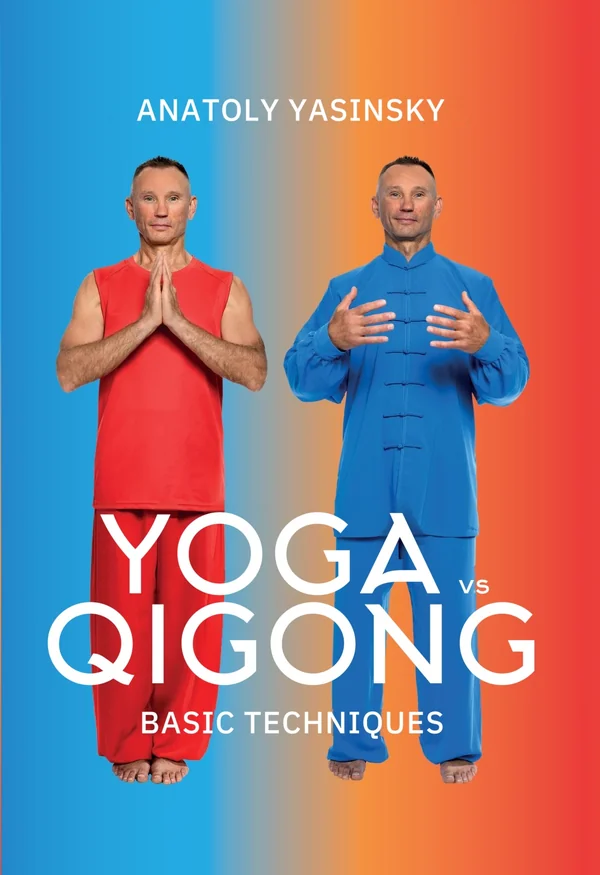
In “Yoga vs Qigong: Basic Techniques”, every Yi Jin Jing exercise is broken down phase by phase, with photos, breathing and variations for different levels. Next to it are chapters on Zhan Zhuang, pranayama and the yoga sequence Eye of Revelation, so you can compare yoga and qigong in practice. The book is available in English, Bulgarian and Russian, as a PDF e-book and as an audiobook.
More practices from the book