Zhan Zhuang, Standing Like a Tree: How to Stand Still and Relax
Zhan Zhuang, also called “the Tree”, is the standing meditation of qigong. The task sounds simple: stand still with an upright spine and let go of tension at the same time. This page brings together the technique from a chapter of my book “Yoga vs Qigong: Basic Techniques” and the video lesson that goes with it: how to build the stance from the feet up, how to breathe, and what to do with your attention while you stand.
Audio & subtitles: EN · BG · RU (⚙ in the player)
Pillar or tree: where the name comes from
In Chinese, zhan zhuang means “standing like a pillar” or “standing post”. I prefer the other name, “the Tree”. A post has no roots, a tree does, and its trunk is alive: it keeps making tiny adjustments to the wind. That is exactly what happens in a good stance.
The practice comes from Chinese martial arts, where there is no strike and no defence without stable legs. There is a story that some Wudang schools only accepted a student who could stand in the post for two hours. Martial styles also extend the Tree into long holds of low stances such as ma bu (horse stance) and xu bu, which build leg strength and “rootedness”. For health practice you need neither those stances nor those hours: the benefits start at five minutes.
Standing instead of sitting: the Tree and yoga meditation
The Tree has the same goal as seated meditation: learning to release unnecessary tension while keeping the spine vertical. The closer your body’s axis is to vertical, the fewer muscles you need to hold it. The work is taken over by the deep postural muscles, which are built for long, gentle effort, while the large surface muscles get a rest.
The difference lies in where each system comes from. Yoga grew out of work with the mind and emotions, so its meditation postures are seated: stable, but they ask for flexible hips and legs. Qigong grew out of the martial arts, where balance on your feet is everything, so the emphasis is on leg strength and balance.
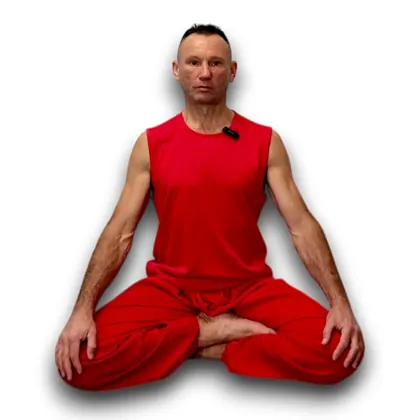
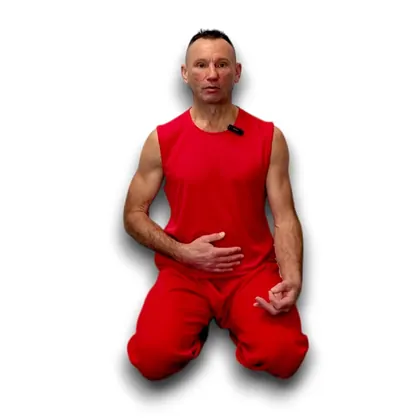
The practical conclusion: if your knees and hips do not yet let you sit comfortably in vajrasana or siddhasana, start with the Tree. No flexibility is required. If sitting upright on the floor is easy for you, relaxing on your feet may turn out to be harder. The legs carry a noticeable load in this stance, while the upper body, and above all the head, should unload.
How to stand: building the stance from the ground up
Build the stance from the support upwards. At first, go slowly, point by point, and say each step to yourself. Stand barefoot or in soft shoes without a stiff sole.
Feet
Place your feet parallel, somewhere between hip width and shoulder width. Rock gently forward and back, find the middle, then shift your weight slightly forward onto the front two thirds of the foot so the heels are a little lighter. Now switch on your toes: press all five softly into the floor as if you wanted to grip the mat. A lengthwise arch appears under the foot. Then find the cross arch: you rest on the base of the big toe and the base of the little toe at the same time, with the centre of the foot slightly drawn up.
It looks like a detail, but stability starts here. Stiff shoes have taught us to walk with our toes lifted and switched off, and the foot rolls inwards or outwards as a result. The human foot is not made for that: for thousands of years it adapted to stones, roots and sand, barefoot.
Knees and pelvis
Bend your knees. They point straight ahead and stay right above the feet, neither collapsing inwards nor splaying out. Once the knees are bent enough, the pelvis tucks slightly under by itself and the lower back straightens and lengthens. The front of the abdomen has light tone but is not clenched, because the belly needs to move freely as you breathe in.
Chest, neck and head
Widen the shoulders slightly and let them drop. Do not push the chest out; just let the upper back straighten without arching the lower back. Draw the chin in a little, move the back of the head back, and let the crown reach upwards as if you were hanging from a thread. The tongue touches the hard palate behind the upper teeth, the mouth is closed, the jaw is not clenched.
Arms: hugging the tree
First let the arms simply hang. Then raise them to chest height, starting the movement not from the hands but from the back, as if you were growing a little taller. The arms hug a thick trunk: seen from above, they form a circle, with every joint slightly bent. The fingers are extended and slightly apart, the palms have tone, and the index finger is a touch more active than the rest. Elbows point down, shoulders stay low.
Old masters say you should feel a pigeon’s egg under each armpit. Squeeze your arms in and you crush it; open them too wide and it falls. The image gives the right measure: the armpits are open, but not flung open.
Why hold the arms in front instead of by your sides? The human shoulder girdle is designed for the hands to work in front of the eyes. With the joints in their natural position, blood flows to the hands more easily, and after a few minutes many people feel a pulse in their fingers and warmth in their palms.
Breath and counting: a job for the attention
Once the stance is built, close your eyes and bring your attention to the breath. Breathe with the belly: it moves gently forward as you inhale and draws in as you exhale. Narrow the throat slightly, as in ujjayi breathing, so the breath has a barely audible hiss.
Now count. Inhale and say “one” to yourself, exhale and say “one” again, then “two” and “two”, and so on up to ten full cycles. It sounds childish, but try it. By the third or fourth cycle your mind will offer something more interesting: replaying a conversation, planning tomorrow, reliving an old grievance. That is normal, and there is no need to scold yourself. Notice that you have drifted and calmly return to the number where you left off. That is the training: attention learns to stop jumping from branch to branch.
For your first session, 10 to 20 breath cycles are enough.
The tree sways: exercises for finding balance
Standing like a pillar does not mean turning to stone. Any tall structure, whether a tower, a mast or an old tree, stays upright by constantly redistributing load inside itself. The body also finds balance through micro-movements, and you can make that search visible for a while. After the first cycles, try these four exercises in turn, 10 breaths each:
- As you inhale, straighten the knees slightly; as you exhale, sink slightly. The range is 2 to 3 centimetres (about an inch).
- Add the arms: as you inhale they open a little, following the expanding ribcage; as you exhale they return towards the centre. The fingertips do not touch.
- As you inhale, shift about 70% of your weight onto the left leg; as you exhale, onto the right.
- As you inhale, shift your weight slightly towards the toes; as you exhale, towards the heels.
Every movement is barely visible: from the outside, you should appear to be standing still. The point is to find the most economical position for your body and release the muscles that are not used to long static holds. Over time the movements get smaller and almost disappear from view, but they carry on inside.
How long and how often
Start with five, at most ten minutes. While you are learning the stance, a little every day is better than a long session once a week. Gradually build up to 20 to 30 minutes. That is already a serious level, and getting there takes several months of two or three sessions a week.
Come out of the stance gently: lower the arms, straighten the knees, walk around. Trembling legs in the first weeks are normal. It is simply fatigue in muscles that have never worked this way before. If the trembling is strong, shorten the time or stand a little higher.
What happens in the body, without the mysticism
Traditional texts explain the effects of the Tree through the flow of qi. I prefer the language of physiology: it describes the same sensations, but in a way you can check.
The legs do long, low-intensity isometric work. The muscles of the thighs, calves and feet hold your weight without moving, which is good endurance training, especially if you sit all day.
The posture is held by deep postural muscles rather than surface ones. Your nervous system has to track the body’s position constantly, so you train proprioception, your sense of your own body and balance.
Slow belly breathing shifts the autonomic nervous system towards its parasympathetic branch, which is responsible for recovery. That is where the warm palms, the slower breathing and the quiet head after the stance come from.
Counting the breath trains your ability to hold attention. It is essentially the same as meditation, only anchored in the body, and people with a restless mind often find it easier.
A word about the limits, too. There is not much research on Zhan Zhuang specifically; most studies look at qigong and tai chi in general. So I do not promise to cure anything. I describe what I see in my own practice and in my students: steadier legs, better posture, a calmer mind.
Where the skill of relaxed standing pays off
Queues, public transport, the kitchen, jobs where you are on your feet all day: usually these are hours of irritation and shifting from foot to foot. The skill you build in the Tree turns them into training. You simply stand upright, weight in your feet, shoulders down, and get on with what you are doing.
The same principle works in sport. Watch beginners at a climbing wall: strong young people storm the wall with every muscle tensed at once, and after fifteen minutes they cannot uncurl their fingers. An experienced climber gets through an overhang on tiny holds because they only switch on the muscles they need and relax over their support at every good moment. For a second, they are standing in the same Tree. Skiing and snowboarding work the same way.
Common mistakes
Knees collapsing inwards Usually together with the foot rolling onto the big toe. Check that each knee is above the second or third toe.
Locked knees Standing this way feels easier, but the load goes into the joints and the lower back, and blood returns from the legs less easily. The knees always stay at least slightly bent.
Switched-off toes The foot rests on the balls, the toes are lifted, the base gets narrow and the stance gets wobbly.
Holding the arms with the shoulders The shoulders creep up, the elbows drift out, the “pigeon’s eggs” are crushed or dropped. Lower the arms to belly height and raise them gradually as you get used to it.
Holding the breath While focusing on the posture, many people quietly stop breathing or switch to chest breathing. Counting solves both: as long as you are counting, the breath keeps going.
When to be careful
The Tree is a gentle practice, but a few situations need attention. With varicose veins or other vein problems in the legs, stand in short sets of 3 to 5 minutes and walk in between. With dizziness or balance problems, stand next to a wall or the back of a chair at first. With high blood pressure, keep the arms low and do not hold your breath: holding the arms up is itself enough to raise blood pressure. With knee pain, bend the knees less and shorten the time. If your vision darkens or you feel faint during the stance, sit down. If in doubt, talk to your doctor.
Questions and answers
Yes, but soft ones are better: plimsolls, gym shoes, Chinese kung fu slippers. In stiff shoes it is hard to engage the toes and arches. Best of all is barefoot, on a mat or on grass.
Closing the eyes makes it easier to count the breath. If you start to sway, keep them half open and look softly into the distance without focusing on anything.
Yes. While you are learning the stance, short daily sessions are more useful than long, infrequent ones.
If sitting on the floor with a straight back is painful or uncomfortable, start with the Tree. If sitting is easy for you, practise both: they complement each other.
Yes. A short Tree of 3 to 5 minutes works well before Ba Duan Jin or Yi Jin Jing: it sets up the body’s axis, and the moving exercises become more focused.
The practice in the book
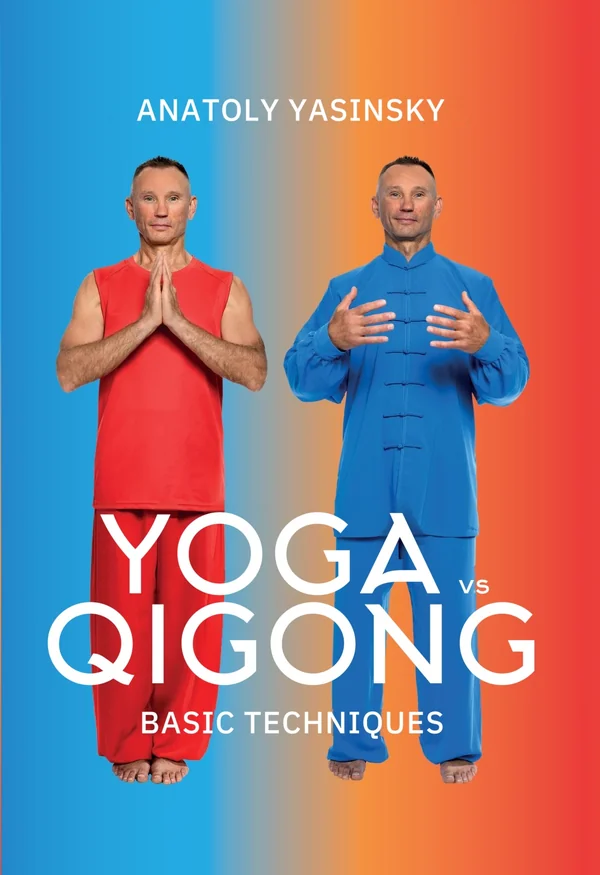
In “Yoga vs Qigong: Basic Techniques”, Zhan Zhuang sits next to the chapters on sitting posture, pranayama and meditation, and that is deliberate. The stance teaches you to relax with an upright spine, pranayama sets up the breath, and meditation brings the two together. The book is available in English, Bulgarian and Russian, as a PDF e-book and as an audiobook.
More practices from the book