Pranayama for Beginners: How to Learn to Breathe Slowly and Deeply
Pranayama is breath training, and getting started is easier than it seems. Four techniques are enough for your first year: ujjayi, belly breathing, kapalabhati and nadi shodhana. This guide to pranayama for beginners covers the order in which to learn them, each technique step by step, common mistakes and precautions. It is based on the “Pranayama” chapter of my book “Yoga vs Qigong: Basic Techniques”, and in the video lesson on this page I demonstrate every technique.
Audio & subtitles: EN · BG · RU (⚙ in the player)
What pranayama trains
At rest, breathing runs on its own, and it is usually quick and shallow. Pranayama teaches you to breathe less often but more deeply and smoothly. To do that, you need to develop not only the diaphragm but also the accessory muscles of inhalation and exhalation: the abdominal muscles, the intercostals, the neck muscles and even the small muscles of the nose.
Why breathe more slowly at all? Imagine cooling a hot glass under a stream of cold water. You can turn the tap up, but the glass will not cool any faster: it needs time to give off its heat, and the extra water simply runs away. The lungs work in a similar way. The alveoli need time to exchange carbon dioxide for oxygen. If you breathe too fast, most of the air passes through the lungs for nothing, while the respiratory muscles do extra work and use up oxygen themselves. Every situation has its own optimal pace, and pranayama teaches you to find it.
The second purpose of the training is a safety margin. When the load rises sharply, on a run, in the mountains or in an emotional storm, a person with trained breathing does not slip into hurried, shallow gasps but calmly increases lung ventilation several times over.
Before you start
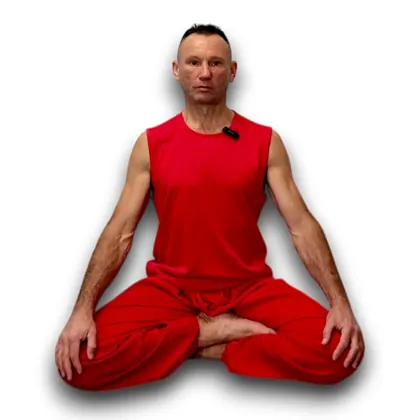
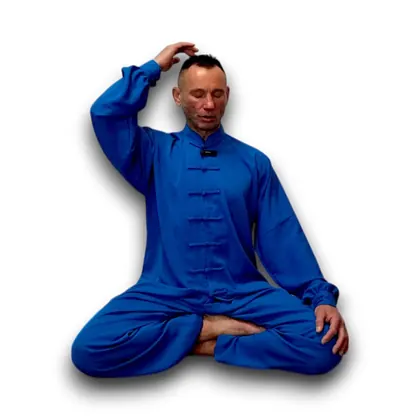
Sit in a stable posture with a straight back: vajrasana, sukhasana or siddhasana on a cushion. The page How to Sit Correctly explains how to do this in detail. Breathe through your nose. In pranayama you never inhale through the mouth; exhaling through the mouth is allowed only in a few specific exercises. It is best to practise on an empty stomach or no sooner than a couple of hours after a meal.
Learn the techniques in this order. First ujjayi and belly breathing: they are the foundation for everything else. Once you can do them together, add kapalabhati and nadi shodhana.
1. Ujjayi: breathing with a rustle
Ujjayi is called the victorious breath, and because of its characteristic hiss, also the snake breath. The idea is to narrow the glottis slightly. Through a narrow passage the same volume of air takes longer to flow, so the inhale and the exhale lengthen by themselves. This is the main tool for regulating the breath in both yoga and qigong.
Ujjayi is learned in three steps:
- With the mouth open, whisper “ma” on the inhale and “ma” on the exhale. The voice stays off; only the narrowing of the throat is working, just as in a whisper. Instead of “ma”, you can use “so” on the inhale and “ham” on the exhale.
- Aim for an even, long hissing sound, about 10 cycles.
- Now do the same with the mouth closed. The lips are lightly pressed together, and the air is drawn in noisily and leaves through the nose just as noisily. The sound is like the wind or the surf. For many people it is lower on the inhale, closer to “o”, and higher on the exhale, closer to “a”.
While you are learning, make the breath deliberately loud. With experience the sound gets quieter, while the length of the inhale and exhale stays the same. Draw the chin in a little, move the back of the head back and let the tongue touch the hard palate: this makes it easier for the throat to hold the narrowing, and the mouth stays closed.
A useful detail from practice. The habit of keeping the tongue on the palate helps under heavy exertion, for example on a run or in the mountains, when breathing through the nose does not bring in enough air. You can open your mouth slightly for a while, and the tongue on the palate will still partly filter and warm the air.
2. Belly breathing
Every inhale is made by the diaphragm, but in lower breathing the main movement shows in the belly. Place your palm on your lower belly. As you inhale, the belly gently expands; as you exhale, the abdominal muscles draw it in and help the diaphragm rise. The shoulders and chest stay still on the inhale.
Over time the inhale becomes three-dimensional: the belly expands not only forward but also to the sides, back towards the lower back and down towards the pelvic floor. On the exhale the pelvic floor muscles gradually join in as well. Take 10 breaths with your hand on your belly, then combine lower breathing with ujjayi. This combination is the basic breath for all yoga and qigong practices.
Why breathe low? In the upper parts of the lungs air exchange is good, but less blood flows there. In the lower parts blood flow is stronger, but without the diaphragm’s help air reaches them poorly. Belly breathing ventilates exactly the part of the lungs where gas exchange is most efficient. And since the abdominal cavity is filled with organs and fluid, which barely compresses, the movements of the belly gently massage the internal organs.
3. Kapalabhati: the sharp exhale
Only the exhale works here. Sharply draw your belly in, as if you wanted to push it inwards with your abdominal muscles, and the air will leave quickly through the nose. Then simply release the belly, and the inhale happens by itself. The mouth stays closed the whole time.
The pace is about one exhale per second, no faster. Do 20 exhales, then three calm belly breaths with ujjayi, then another 20. With practice, the number of exhales per set is gradually increased; experienced practitioners do 100 or more.
Kapalabhati is one of the cleansing techniques: the sharp exhale clears the nose, so keep a tissue handy. If you feel dizzy, it is a sign that you have breathed out too much carbon dioxide. Stop and breathe calmly; you can also do one or two short breath holds.
4. Nadi shodhana: alternate nostril breathing
Nadi shodhana evens out the breath through both nostrils. The thumb of the right hand closes the right nostril, the ring finger and little finger close the left, and the index and middle fingers rest between the eyebrows as a support.
One cycle looks like this:
- Exhale fully through the left nostril.
- Inhale through the left, close both nostrils for half a second, exhale through the right.
- Inhale through the right, close both, exhale through the left.
Do three cycles with the right hand, then three with the left, so that the load is spread symmetrically. After six to eight cycles you will usually feel how much easier it has become to breathe through the nose.
There is no need to squeeze the nostril hard. The passage is small, and a light touch is enough to stop the flow. The nose has its own muscles that widen and narrow the nostrils: think of a galloping horse. The fingers give these muscles a little resistance, so nadi shodhana trains them too. Athletes who wear nasal dilator strips in competitions are solving the same problem from the outside.
Once the sequence feels familiar, add belly breathing and ujjayi to it. The breath becomes deep and long at the same time.
What happens in the body
Slow breathing with ujjayi slightly reduces lung ventilation. The level of carbon dioxide in the blood rises a little, small blood vessels widen, and many people notice their palms and feet getting warmer during practice. A long, calm exhale shifts the nervous system towards recovery, which is why your head usually feels clear and calm after pranayama.
There are also simple mechanics at work. The respiratory muscles train like any others: regular work makes them stronger and more enduring, and the breath more economical. I write in detail about the physics of breathing, the role of carbon dioxide and why it pays to breathe through the nose in the theoretical part of the book. Here one point is enough: pranayama works without any mysticism.
When and how much to practise
At the start, 10 to 15 minutes a day is enough: five minutes of ujjayi with belly breathing, a couple of sets of kapalabhati and a few cycles of nadi shodhana. But most of the practice happens off the mat. You can practise ujjayi and belly breathing on a walk, at the computer or on public transport. Results come from regularity, from the number of hours you spend breathing correctly.
Pranayama combines well with other practices. In the Zhan Zhuang stance and in qigong routines you use the same lower breathing with ujjayi, and meditation uses a subtle, almost silent version of it.
Common mistakes
Inhaling through the mouth Even when preparing for ujjayi, you inhale through the mouth only at the first stage, the one with the sounds.
Lifting the shoulders on the inhale This switches on chest breathing instead of lower breathing. Put a hand on your belly and make sure it is the belly that moves, not the shoulders.
Loudness for its own sake The narrowing of the throat should be light. If your neck or face tenses up, you are overdoing it.
Rushing kapalabhati A fast pace does not make the technique more effective, but it quickly leads to dizziness.
Pinching the nose For nadi shodhana a light touch is enough; strong pressure gets in the way of breathing and breaks the rhythm.
Stretching the breath until you run out of air The length of the inhale and exhale grows gradually. If you start gasping, go back to a comfortable rhythm.
Precautions
Start gradually and pay attention to how you feel. Kapalabhati is not practised during pregnancy, with abdominal hernias, after recent abdominal surgery, with epilepsy or with uncontrolled high blood pressure. With raised intracranial pressure or high blood pressure, practise nadi shodhana carefully and without breath holds. If you have a chronic heart or lung condition, talk to your doctor before you start.
Questions and answers
Ujjayi and belly breathing. Kapalabhati and nadi shodhana build on them.
Ujjayi and belly breathing, yes: it is even a good way to feel the movement of the belly. Kapalabhati and nadi shodhana are better done sitting with a straight back.
Most often because the breathing is too fast or too deep, especially in kapalabhati. Take a break, breathe calmly and slow the pace next time.
That is common: the airflow naturally alternates between the nostrils during the day. Nadi shodhana helps to even it out. If your nose is badly blocked, start with kapalabhati: it clears the nose.
You can keep working on these four techniques for the whole first year. After that, what matters is not new exercises but the smoothness, depth and length of the breath in the ones you already know.
The practice in the book
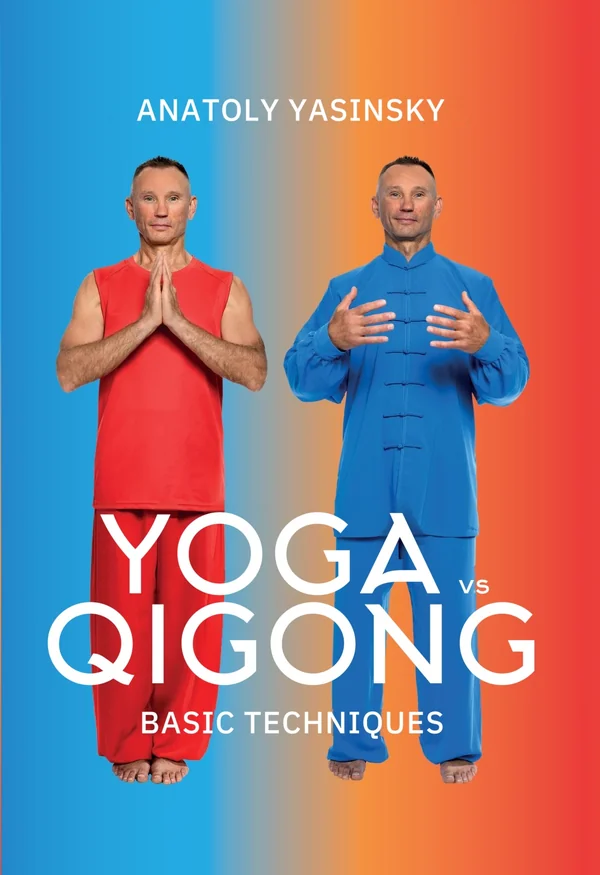
In “Yoga vs Qigong: Basic Techniques”, pranayama sits between the chapters on how to sit correctly and on meditation: the asana gives you a straight back, pranayama sets up the breath, and meditation uses both. The theoretical part explains how the respiratory system works, why carbon dioxide is useful and why you should breathe through the nose. The book is available in English, Bulgarian and Russian, as a PDF e-book and as an audiobook.
More practices from the book