Blog Notes
Breathing at Altitude: My Second Article for Yoga Journal
 Anatoly Yasinsky · physicist, qigong instructor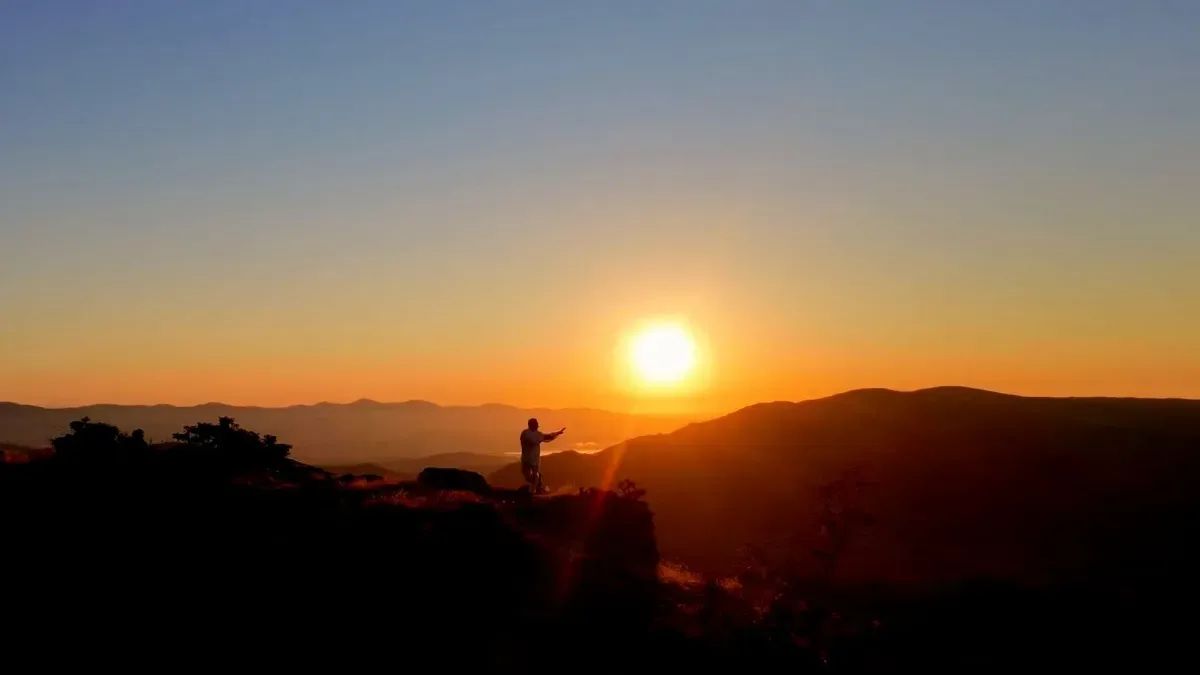
My second piece for Yoga Journal is out, and this time it’s about the mountains. More precisely, it’s about something anyone who has packed a mat for a hiking trip knows well. Down at home your sequence flows, your body remembers every pose, and then up high, by the third round, your breath falls apart and you can’t get enough air.
I was also pleased that the editors chose my own photo for the piece: a sunrise practice on a mountain ridge. A real photo always beats a stock image.
The main ideas
The first thing worth correcting is the familiar line “there’s less oxygen in the mountains.” Its share of the air is the same as at sea level, about 21%. What drops is the pressure, and with it the force that pushes oxygen from your lungs into your blood. So the task isn’t to breathe in more air, but to make sure your blood actually releases oxygen to the tissues.
The natural reaction to feeling short of breath is to breathe faster and deeper. Your body does this on its own, but overdoing it flushes carbon dioxide out of the blood. Without enough CO2, hemoglobin holds on to oxygen more tightly and delivers less of it to muscles and brain. That’s the Bohr effect. Hence the paradox: the harder you breathe, the more breathless you feel, and dizziness and tingling fingers join in.
There’s some simple arithmetic here, too. Part of every inhale stays in the trachea and bronchi and never reaches the alveoli; this is the so-called dead space. That’s why slow, deep breathing moves more air through gas exchange than fast, shallow breathing, even when the total volume per minute is the same. Yogis settled on this pattern long before physiologists could do the math.
What helps at altitude: a long exhale, roughly twice as long as the inhale, at about six breaths per minute. Nadi shodhana, because it slows the breath and keeps it in the nose, which warms and humidifies the cold, dry air. Ujjayi is fine at rest, but while moving or climbing it adds unnecessary resistance. Kapalabhati, bhastrika, and long holds after the exhale are best saved for when you’re back down, at least during the first days of acclimatization: they amplify exactly what your body is already struggling with. In your asana practice, slow the pace and cut back on vinyasas, skip inversions if you have a headache, and drink more than you feel like drinking. Ten minutes of calm breathing with a long exhale before bed also helps on those nights when your breath keeps stopping and speeding up in your sleep.
Then there’s a line I draw firmly in the article. Pranayama doesn’t replace acclimatization and doesn’t treat altitude sickness. If a headache keeps getting worse, or you notice nausea, unsteadiness, or confusion, go down right away. No debate.
As a physicist, one thing here delights me. Neither the yogis in the Himalayan foothills nor the Taoists on Mount Wudang knew about the Bohr effect or dead space, yet they found exactly the breathing pattern that works best in the mountains.Yoga JournalYoga at Altitude: Why What Works on the Mat Stops Working in the MountainsRead the full article ↗
Read next on this site
More from the blog
All blog posts →


The foundations of yoga and qigong in six practices: 235 pages, over 200 photos and video lessons via QR codes. In English, Bulgarian and Russian.