Qigong and yoga train the same few things: posture, breathing, attention and relaxed movement. The difference is in emphasis. Yoga works mainly through form: you take a position, hold it, and use it to stretch, strengthen and concentrate. Qigong works mainly through flow: you move slowly and continuously, or stand still in a simple stance, and let the body organise itself around the breath. Neither is better. They answer different questions, and they combine well.
I am a physicist by training and have taught both for 25 years, so this page compares them the way I would compare two measuring instruments: what each one actually does, where it is strong, and where it is not. It is a short version of the approach in my book “Yoga vs Qigong: Basic Techniques”.
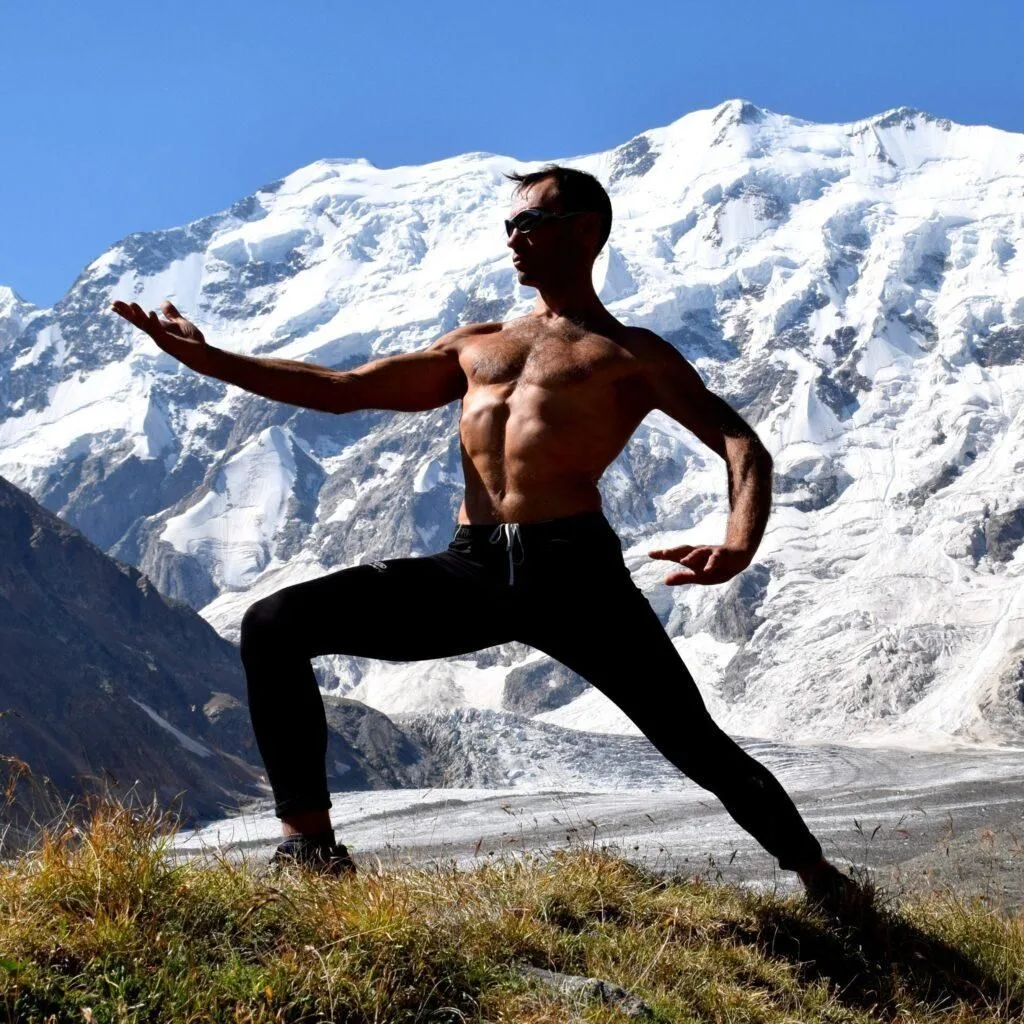
Qigong vs yoga at a glance
| Yoga | Qigong | |
|---|---|---|
| Where it comes from | India. Grew out of work with the mind; postures were built to prepare the body for long seated meditation | China. Grew out of health practice and the martial arts, where balance on your feet is everything |
| Main tool | Postures (asanas) that you enter and hold | Slow continuous movements and standing stances |
| Typical position | On the mat: seated, lying, kneeling, standing, inverted | Mostly standing; no mat needed |
| Breathing | A large toolkit of deliberate techniques (pranayama): ratios, holds, alternate nostrils | Usually quiet nasal breathing that follows the movement |
| What it asks of the body | More flexibility and strength, especially in hips, shoulders and wrists | More balance, leg endurance and coordination |
| Effort | From gentle to athletic, depending on the style | Low to moderate; easy to dose |
| Space and kit | A mat and room to lie down | Two square metres and soft shoes or bare feet |
| Traditional language | Prana, nadis, chakras | Qi, meridians, dantian |
The last row matters less than it seems. Prana and qi are two traditional names for the same family of sensations: warmth, pulsing, heaviness, lightness. You can practise both systems well without adopting either vocabulary. I explain the effects in terms of muscles, joints, breathing and the nervous system, because those can be checked.
Where the difference comes from
Yoga began as a discipline of the mind. Its classical goal is a quiet, steady attention, and the physical postures appeared as a way to prepare the body to sit still for a long time. That is why so much of yoga is about opening the hips, lengthening the spine and holding a shape without fidgeting.
Qigong has two roots. One is health practice: sets of movements designed to keep ordinary people mobile and well. The other is the martial arts, where there is no strike and no defence without stable legs. That is why qigong spends so much time on standing, weight shifting and turning the whole body as one piece.
Once you see the two starting points, most of the practical differences follow from them.
Breath: control versus following
Yoga treats breathing as a subject of its own. Pranayama includes slow breathing with a count, alternate-nostril breathing, breath holds and more forceful techniques. Most of them are active: you set a rhythm and keep to it.
In most beginner qigong you simply breathe through the nose, quietly, and let the movement set the rhythm: the arms rise as you inhale and sink as you exhale. Deliberate breath work comes later and in small doses.
What this means in practice: if you like clear techniques with a count, yoga breathing will suit you. Start with something simple, such as breathing in for four and out for six. If you tend to worry about “doing it right”, start with qigong, where the breath follows the movement and there is less to get wrong. The basics are on the pranayama page.
Posture: holding a shape versus standing like a tree
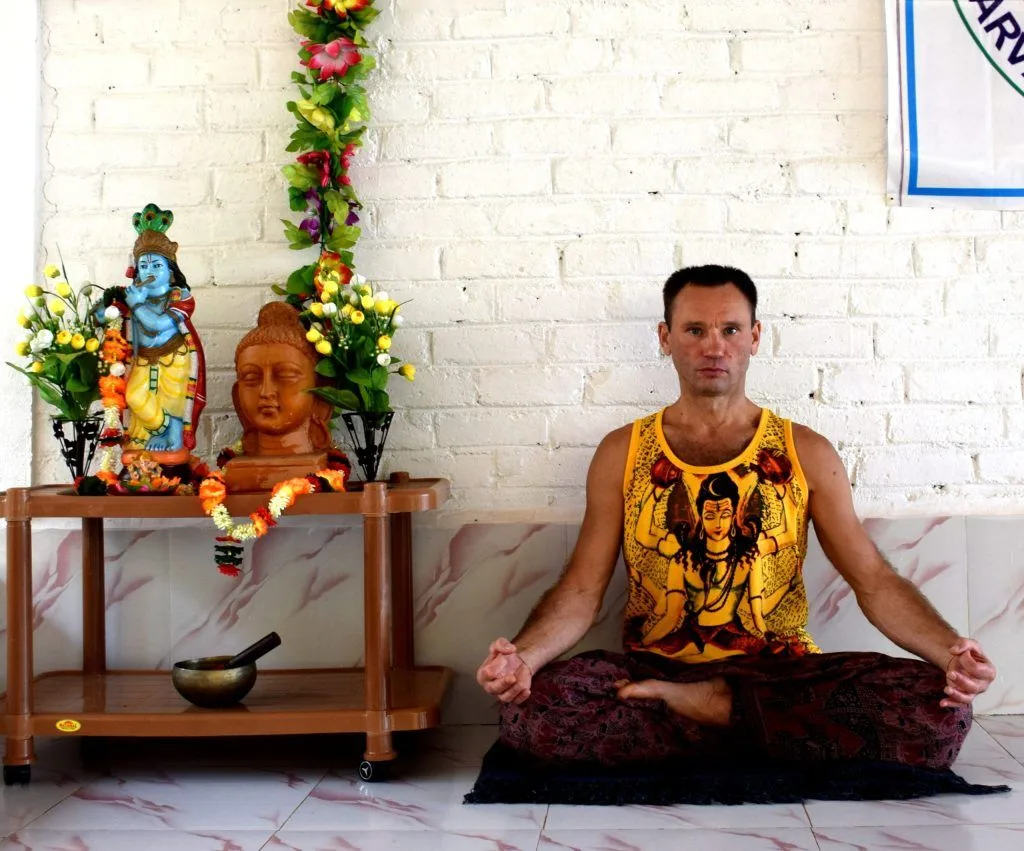
In yoga, posture is the main subject. Asanas are shapes with names, alignments and variations. You learn to place the pelvis, lengthen the spine and hold a position without gripping. Seated meditation postures are stable, but they ask for flexible hips and knees. See how to sit correctly.
In qigong, posture is a quieter business. The classical standing practice, Zhan Zhuang, looks almost like doing nothing: feet about shoulder width apart, knees soft, arms held as if around a large tree. Stand like that for five minutes and you will feel the legs, hips and back working continuously in small adjustments. For a physicist it is a nice example of a system holding an unstable balance through constant micro-corrections.
Both traditions agree on the essentials: a neutral pelvis, a long back of the neck, loose shoulders and unlocked knees. Learn them in one system and they carry over to the other.
Movement: positions versus flow
A yoga sequence links positions, often with the breath. Between them you work at the edge of your range: a deep forward bend, a twist, a long hold on the arms. That builds flexibility and strength, and it is the reason yoga can feel demanding in the first months.
A qigong set is slower and usually circular. The weight moves from one leg to the other, the arms follow, the spine turns as a unit. The movements are continuous and low in force, so a set is easy to do in the morning, in a small space, or on a day when you are stiff or tired. A classic example is Ba Duan Jin, eight exercises in about fifteen minutes.
What the research says, and what it does not
The most useful single source is a 2022 overview in the journal Behavioral Sciences, “Yoga and Qigong for Health: Two Sides of the Same Coin?” by Boaventura, Jaconiano and Ribeiro. Its conclusions are modest, and I think that is to its credit.
- The two practices “seem to have similar effects”, which is what you would expect from two mind-body methods built on slow movement, controlled breathing and a calm state of attention.
- Studies that compare yoga and qigong directly are scarce. The authors write that the choice between them “may only depend on patients’ preferences or practice availability”.
- Much of the research has the same weaknesses: small groups, different styles lumped together, short programmes and control groups that do nothing at all.
- Qigong is described as “particularly appropriate for older people due to its gentle and smooth movements”.
My reading as a physicist: there is reasonable evidence that both practices help with general wellbeing, balance, mood and sleep, and no good evidence that one beats the other. Anyone who tells you that yoga or qigong is scientifically proven to be superior is ahead of the data. Neither is a cure for disease, and neither replaces medical care.
Which should you choose?
There is no universal answer, but a few rules of thumb work well.
Start with qigong if
you want a calm, low-effort practice you can do every day for ten to fifteen minutes; you are stiff, tired or returning to movement after a long break; sitting on the floor is uncomfortable; you want better balance and steadier legs; or you have no space for a mat.
Start with yoga if
you want to build flexibility and strength and like clear positions to aim for; you enjoy structured breathing techniques; you want a seated meditation practice and are ready to prepare your hips and back for it; or you prefer a class with a defined sequence and visible progress.
Do both if
you can spare twenty minutes. Most of my long-term students end up here. Qigong warms up the joints and settles the breath, yoga adds range and strength, and a few minutes of quiet sitting or standing at the end ties it together.
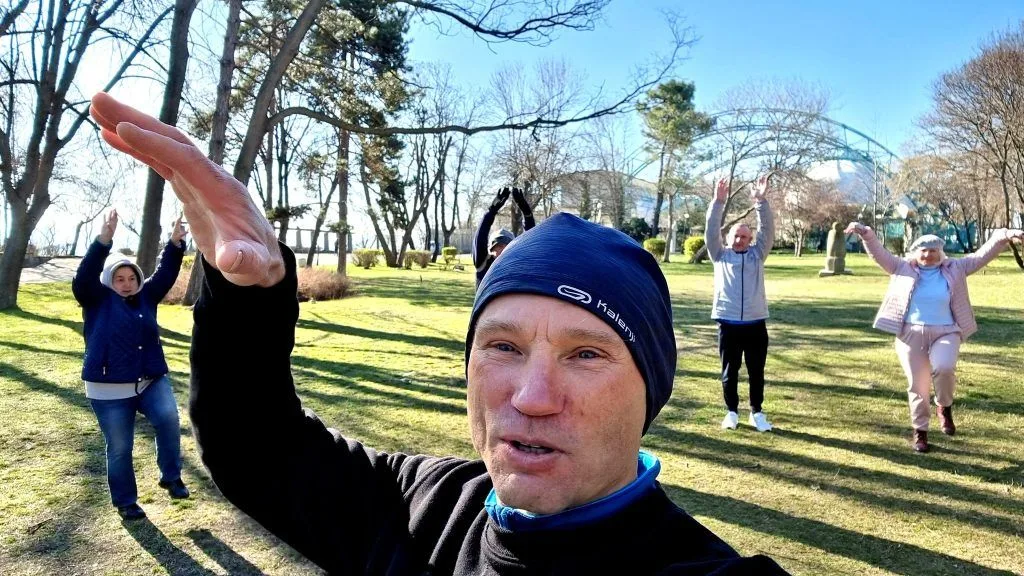
How to combine them: a simple 20-minute session
- Three to five minutes of standing: the Tree, with slow belly breathing and a count.
- Five to seven minutes of qigong movements, for example the first four exercises of Ba Duan Jin.
- Five to seven minutes of basic yoga postures: a forward bend, a gentle twist, a hip opener.
- Three minutes of quiet breathing, seated or standing.
Order matters less than regularity. A short session most days does more than a long one once a week.
Common myths
“Qigong is just slow yoga.” The two overlap, but the load is different. Yoga works at the end of your range; qigong works in the middle of it, with constant weight shifting. Your legs will tell you the difference after ten minutes of standing.
“Yoga is only for flexible people.” Flexibility is a result, not an entry requirement. But it is true that the first months of yoga ask more of the joints than qigong does.
“You have to believe in energy for it to work.” Be wary of anyone who needs you to believe something before an exercise works. A good exercise works if you do it carefully, whatever you believe about it.
“Gentle means useless.” Low intensity is not the same as no effect. Slow, controlled movement trains balance, joint control and attention, which fast exercise mostly skips.
When to be careful
Both practices can be done badly. Go slowly, stay within a comfortable range and treat pain as information. In yoga, be careful with deep forward bends and twists if you have back problems, and with inversions if you have high blood pressure or eye conditions. In qigong, long standing can be hard on varicose veins and sore knees: stand in short sets and bend the knees less. Any breathing exercise that makes you dizzy, tense or short of breath is too much. If you have a medical condition, talk to your doctor before starting.
Questions and answers
For most beginners, yes. Qigong movements are slower, stay in the middle of the joint range and need no flexibility. That does not make it trivial: long standing and slow weight shifting load the legs noticeably.
Yes. A common order is qigong first, to warm up the joints and settle the breath, then yoga postures, then a few minutes of quiet breathing.
Qigong is usually the easier start, because it is done standing and its movements are gentle. A research overview from 2022 describes it as particularly appropriate for older people. Gentle yoga is also an option if getting down to the floor is not a problem.
It is low to moderate intensity exercise. It trains balance, leg endurance, coordination and posture. It does not replace brisk walking or strength training, but it complements them well.
If sitting on the floor is uncomfortable or you are returning to movement after a break, start with qigong. If you already move well and want more range and strength, start with yoga. If you are not sure, try one session of each a week apart and notice which one you want to repeat.
Tai chi is a martial art built on the same principles, with long choreographed forms. Qigong sets are shorter and simpler to learn, which is why many people start with qigong.
Both systems in one book
“Yoga vs Qigong: Basic Techniques” puts the two side by side, technique by technique: how to sit, how to stand, how to breathe, how to hold attention, with more than 200 photographs and video lessons. No mysticism, just what to do and why it works. The book is available in English, Bulgarian and Russian, as a PDF e-book and as an audiobook.
Practices from the book: Zhan Zhuang · How to sit correctly · Pranayama · Meditation · Yi Jin Jing · Ba Duan Jin