Blog Notes
Slow, Low Breathing: A Physicist’s Explanation from the Kitchen and the Textbook
 Anatoly Yasinsky · physicist, qigong instructor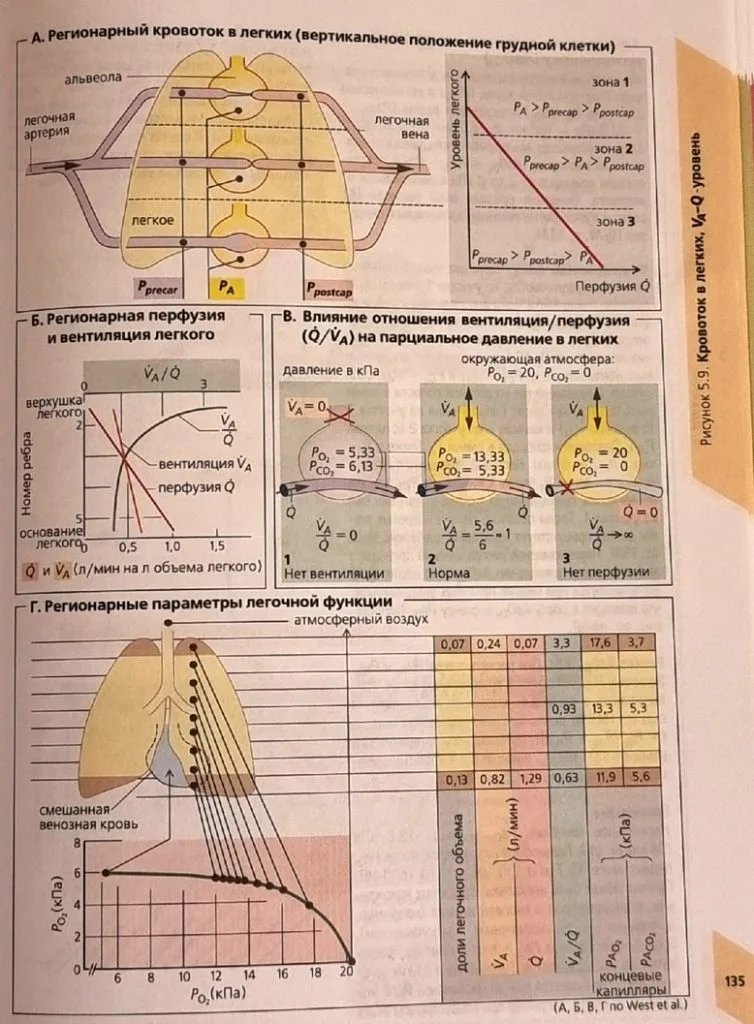
In yoga and qigong, when the body is at rest, we breathe slowly and low, “into the belly.” There are plenty of explanations for this rule, some of them quite mystical. I prefer two simple physical ones. One came to me in the kitchen, the other from a physiology textbook.
A lesson from two glasses
When my child was little, I often had to cool boiled water in a hurry. The method is simple: pour the hot water into a glass, after a minute pour it into a second glass, and put the first one, now warm, under the cold tap. Then back again, several times, until the water is lukewarm.
One day I noticed something curious. If you open the tap all the way, the glass cools almost as fast as under a gentle stream. The glass gives off heat at its own rate, and the cold water needs contact time. A stronger jet only means more water down the drain, with almost no time saved. For every task there is a sensible flow rate, and above it your effort just goes down the sink.
The same thing happens in the lungs
Breathing works in a very similar way. Airflow carries fresh air only as far as the smallest bronchi; beyond that, in the alveoli, oxygen and carbon dioxide move by diffusion. That process takes time too.
On top of that, part of every breath never takes part in gas exchange at all: it stays in the trachea and bronchi. This is the so-called dead space, about 150 ml in an adult. Let’s do the math. Twelve breaths of 500 ml give 6 liters per minute, and 12 × 350 = 4.2 liters reach the alveoli. Twenty-four breaths of 250 ml give the same 6 liters, but only 24 × 100 = 2.4 liters reach the alveoli. Roughly the same work, almost half the benefit.
The breathing muscles themselves consume oxygen, too. When we force ventilation, we burn part of what we are trying to take in, and we wash out extra carbon dioxide along the way. It becomes a vicious circle. For every state there is an optimal rhythm, where the cost of breathing matches how much oxygen the body can actually take up.
The top and bottom of the lungs work differently
The second idea came from Silbernagl and Despopoulos’s “Color Atlas of Physiology.” When we stand or sit, gravity distributes blood in the lungs unevenly: the lower lobes receive several times more of it than the apexes. Ventilation is also greater at the bottom, but it increases less steeply. As a result, the upper parts have plenty of air relative to blood flow, and some of that ventilation is wasted. In the lower parts there is plenty of blood, and gas exchange is limited by how much air gets there. Physiologists call this the ventilation-perfusion ratio.
This is what makes lower breathing sensible. When the diaphragm is working and the belly moves softly, air fills the lower lobes first, where the blood supply is richest. The cue “breathe into the dantian” (or in yoga, sometimes “down to muladhara”) is an image: physically, air does not go into the belly, but the direction of the diaphragm’s movement ventilates exactly the parts of the lungs best suited for gas exchange.
Under heavy exertion the picture changes. The heart pumps more blood, pressure in the pulmonary vessels rises, and blood fills even the apexes well. Gas exchange becomes efficient everywhere, and that is when full yogic breathing, using the belly, ribs and collarbones, makes sense.
What this means for practice
- At rest, in meditation, and in zhan zhuang standing, breathe slowly, softly and low.
- Slow does not mean holding your breath or straining. Breathing stays comfortable.
- During vigorous activity, don’t limit yourself to the belly; switch to full breathing.
Exercises that help you learn lower and full breathing are collected on my pranayama page. And at my morning qigong classes in Burgas, the first thing we do is calm the breathing rhythm.

More from the blog
All blog posts →



The foundations of yoga and qigong in six practices: 235 pages, over 200 photos and video lessons via QR codes. In English, Bulgarian and Russian.