Fair warning: this is a long read. If you’re lucky, it’s the only thing you need to read today. If you’re not, that last sentence is false, and we’ve landed right in the middle of the topic before we even started.
I want to talk about the most rigorous and the strangest result in twentieth-century mathematics, and about why it has everything to do with your yoga mat, with family arguments and with how you choose your morning practice. No advanced math required. A little patience will do.
What Gödel actually proved
In 1931 a young Austrian logician named Kurt Gödel, then about twenty-five, published a paper after which mathematicians could never look at their field the same way again. It contained what we now call the two incompleteness theorems.
Let me retell them without formulas, but also without cheating. Take a formal system: a precisely defined set of axioms and rules of inference, powerful enough to do ordinary arithmetic with whole numbers. The first theorem says that if such a system is consistent, its language must contain a statement that the system can neither prove nor disprove. And yet, looking at it from outside, from ordinary arithmetic, we can see that the statement is true. The second theorem adds that such a system cannot prove its own consistency using its own means.
The most elegant part is how Gödel pulled it off. He constructed a statement that, translated into plain English, says about itself: “I cannot be proved in this system.” If the system proves it, the system has proved something false and collapses. If it doesn’t, the statement turns out to be true, and the system simply can’t reach it. Gödel took the ancient liar paradox (“I am lying right now”) and turned it into a rigorous theorem, essentially by replacing the word “false” with “unprovable.”
One more detail that people often forget. You can take the unprovable statement and declare it a new axiom. But the extended system immediately gets an unprovable statement of its own. The hole can never be patched for good: it moves along with every patch.
Dry? Maybe. But behind the dryness is an idea that sages in many cultures voiced long before 1931, they just couldn’t prove it: a closed system cannot fully explain itself. To understand something about it, you have to step outside it.
Let me add a caveat, as a physicist. Strictly speaking, the theorem applies to formal systems in mathematics. Everything that follows is analogy. But in my view these analogies are remarkably precise, and in practice they are confirmed every day. They apply to physics, to every school of practice and to every doctrine about the right way to live, eat, breathe, love, raise children and brew tea.
Two pictures for those who don’t like axioms
The first. Imagine a legal code so detailed that it supposedly settles any dispute. Sooner or later life throws up a case the code never anticipated. It isn’t the lawyers’ fault: any set of rules works this way. Lawmakers add a new article, and after a while another unforeseen case appears. The cycle never ends.
The second. Try to prove to yourself that you’re of sound mind. “I’m perfectly fine” is worth nothing, since someone who really needs help will say it with exactly the same confidence. A real check requires an outside reference point: a specialist’s opinion (better yet, two), comparison with other people, feedback from those close to you and, in the end, life itself.
From the inside, a system can’t see its own boundaries. That holds for arithmetic, for a legal code and for us.
Every day we live inside something
Take an ordinary grudge or a bout of anxiety. While you’re in it, the world really does look bleak and there seems to be no way out. A week later you recall the same episode and wonder: did I really lose sleep over that? The situation itself didn’t change. Your position did: you stepped out of that state and finally saw it at its true size.
When a person is in a deeply low state, their reasoning about the pointlessness of everything can be logically flawless. Inside their picture of the world, the logic holds. What’s broken is not the logic but the vantage point, and you can’t change it from the inside. That’s why we need friends, mentors and doctors. They aren’t necessarily smarter. They simply stand outside.
A family argument flaring up for the tenth time over the same thing works the same way. He has his system, in which he is right without a single flaw. She has hers, in which she is right. You can argue inside two closed systems for years and get nowhere. What helps is a third perspective: a friend, a family therapist or simply a pause, after which both can look at the issue with fresh eyes.
With children it’s even clearer. For a child, the rules of the household, the parents’ tone of voice, the habits at the dinner table simply are how the world works. There’s nothing to compare them with. A child becomes themselves when other systems appear: school, books, trips, a friend’s home where everything is done differently. Each such encounter gives them a point from which to see their own.
The mat as a laboratory
In practice you can see all this almost literally. A student holds an asana or moves through a qigong form and is sure everything is right. I watch from the side and see that the right shoulder has crept up toward the ear, the pelvis has shifted, and the breath catches at every transition. The student won’t notice, and it has nothing to do with ability: they are inside their own body. They need an outside point: a mirror, a phone video, a teacher.
Which leads to a simple conclusion that, as the author of a book, I’m actually happy to admit: a book alone is not enough for practice. Text and photos define a formal system, and living movement lies beyond it. No description can replace an outside eye. That’s why the exercises in my book are linked to video lessons via QR codes: one more vantage point, even if an incomplete one. Where to begin, I’ve gathered in the section on basic yoga and qigong techniques. To my mind, a master is someone who has learned over time to be an outside observer of themselves.
Words that point beyond themselves
Laozi opens the Tao Te Ching with a warning: the Tao that can be spoken is not the eternal Tao. Then he goes on to write about five thousand characters. It makes me smile every time.
The saying “every spoken word is a lie” has the same problem. Apply it to itself and it falls apart: it’s a word too, so it must be a lie as well. It’s the same self-reference loop that Gödel turned into mathematics.
But a sage says such things not as a statement, rather as a gesture. A word is a finger pointing at the moon, and it’s best not to confuse the finger with the moon. The map is not the territory. The word “water” doesn’t quench thirst, a story about pain doesn’t hurt, and the word “love” keeps no one warm. Words “lie” not in the sense of deceiving, but because every description is inevitably incomplete. A book about health doesn’t replace health, a text about an asana doesn’t replace the asana, and a description of a state doesn’t replace the state itself.
There’s a joke usually attributed to Mark Twain: “Be careful about reading health books. You may die of a misprint.” I used it as the epigraph to my book “Yoga vs Qigong: Basic Techniques,” and I did so quite deliberately. I can be wrong too. My text is not dogma but an invitation to test everything on yourself. A book can point the way, share experience and warn you about common mistakes, but you still have to walk the path on your own feet. And everyone’s path is different.
Why yoga alone isn’t enough for me, and neither is qigong
Now something personal. I love yoga as a system: thousands of years old, deep, worked out down to the finest details. But I can’t stop there, because in qigong I find things that yoga barely has. And whenever I practice only qigong, I start missing yoga.
Yoga gives you static holds and stretching, careful work with the spine and joints, concentration through stillness, and a clear head. Classical yoga, however, has little fluidity, few spiral movements, little work with body weight in motion, and little of that softness which is itself a form of strength. Qigong has all of these. Qigong, in turn, has less deep stretching, less strength-building static work and less precise geometry of the body in space.
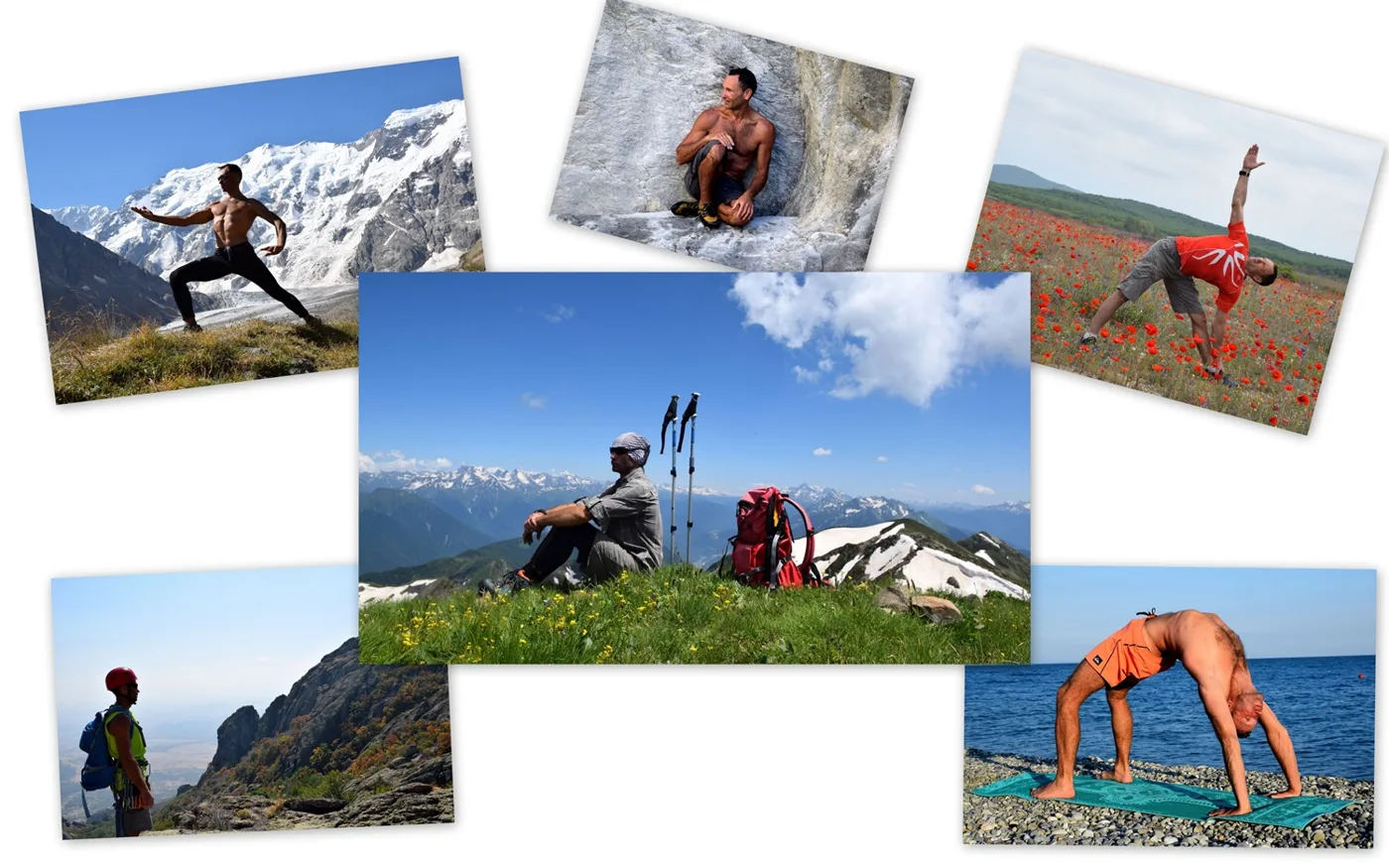
Then it turns out that even together these two systems don’t cover everything. Cold water gives a sharp, almost instant shift in how the nervous system works: first a powerful surge of sympathetic activation, then a marked calming. No asana can reproduce that. Rock climbing gives you real height and a real movement problem where a mistake has a cost. Strength training builds density in muscles, ligaments and bones that slow practices simply can’t provide. Freeriding gives freedom and a sense of oneness with the mountains, and long-distance running tests the whole body for endurance. Add intermittent fasting and mountain hiking, and you’ll see what my life outside the classroom is made of.
Each of these systems is complete within itself and incomplete with respect to the whole person. To me, that’s pure Gödel.
When loyalty to a school turns into blinders
I often hear: “I’ve found my thing, it’s all I do, I don’t need anything else.” Sometimes there’s real maturity behind it: the person has tried a lot and consciously narrowed the field. But far more often, to be blunt, those words hide fatigue from searching or a reluctance to climb out of a familiar rut.
Ten years of one discipline make a person a master of it and, often, blind to everything beyond it. A strong yogi may not manage a barbell of their own body weight. An experienced qigong master may not last three days without food. A powerlifter can’t always reach their shoelaces in a forward bend, and a marathon runner may be at a loss in icy water. Each is flawless inside their own system and doesn’t notice where it ends.
A pattern very similar to Gödel’s is at work here: the more a system claims to cover everything, the more certainly it contains questions it cannot answer itself.
The old masters were broader than their schools
Here is a subtle point that people rarely notice. Look at how the people we consider carriers of tradition actually lived. Taoist hermits practiced internal arts, martial arts, herbalism, calligraphy, poetry and meditation. Shaolin monks combined Buddhist meditation, qigong, fist fighting and medicine. An Indian yogi knew asanas, pranayama, Ayurveda, mantras and philosophy.
The “pure school” is largely an invention of the last hundred years, when ancient traditions began to be packaged into courses, certifications and brands. A living master of the past was always broader than any formalized version of their school. So a broad approach doesn’t dilute tradition. It brings us back to an older and more honest logic: you choose the tool for the task, not the task for the tool.
The body is not the ground floor, it’s the foundation
You often hear that bodywork is the “lower level” and that everything that really matters happens somewhere higher up. I think that hierarchy is wrong.
Cold water is not only about blood vessels and thermoregulation. Every plunge into icy water is a meeting with fear, a small dying and a small return. On the rock you train not only your fingers but also trust in yourself, decisions under load and a presence in the moment where distraction is simply impossible. The barbell teaches willpower: at your limit you discover that “I can’t” usually turns out to be untrue.
Any physical practice becomes a practice of the spirit if you do it with awareness. The reverse is also true: “spiritual” work cut off from the body easily slides into self-deception, fantasy and esoteric chatter. The body keeps us grounded, like an anchor. Through it pass our emotions and whatever some people call prana, others qi, and others still nervous regulation. The names are secondary.
Where’s the catch
A broad approach does carry a risk: you can pick up a little of everything and never reach depth anywhere, hopping from one interest to the next.
In my view, there is only one protection against that: a deep root. One or two systems you know for real, over years and decades, to the level of personal experience and teaching. On that foundation you can add anything without losing depth. A deep root and a wide crown, not the other way around. Wide roots with a thin trunk are unreliable, and a lush crown without a trunk isn’t a tree at all.
I’ve lived in several very different worlds myself: physics at MIPT, service in the airborne troops, a technology business, Eastern practices, teaching. From the outside it looks scattered. From the inside, it all rests on one axis: get to the essence, find the primary source, take nothing on faith and test it on myself. Each new field added a layer, while the habit of thinking stayed the same. I’ve written more about my path on the about the author page. Without such an axis, breadth quickly becomes superficiality. With it, you can calmly pick up any tool the task calls for.
So what follows from all this
If you put together Gödel, Laozi, the Buddha, the Eastern masters and my own years of practice, you get roughly this formula.
No system can contain a whole person. The honest path is to have a deep root in what matters most and not be afraid to take what you need from elsewhere. Shutting yourself inside one system isn’t loyalty, it’s ceasing to see. Breadth without a root doesn’t give you freedom, it gives you blur. Maturity appears where you have both.
And a practical tip. If you’re stuck in an emotion, a problem, a relationship or your practice, don’t try to get out using the same means that got you in. There’s no exit inside a closed system, and it’s not a lack of intelligence on your part. Take even a small step outside: talk to someone, change your surroundings, take a pause, show your asana to another person. A lot will become clear on its own.
Gödel proved this for formal systems. Sages knew it long before him. And in practice and in life, it may be the most useful thing to keep in mind.
If you’d like to look at yoga and qigong side by side through the lens of physiology and biomechanics, that’s what my book “Yoga vs Qigong: Basic Techniques” is about.