Bhramari is Sanskrit for “bee.” In this pranayama you exhale with an “mmm” sound, like a buzzing bumblebee. The technique looks almost childish, but it has a fascinating physiological explanation, which I came across while writing my yoga therapy thesis. I had to work through a pile of scientific papers on yoga techniques, and among them was a story about nitric oxide.
Where nitric oxide in the nose comes from
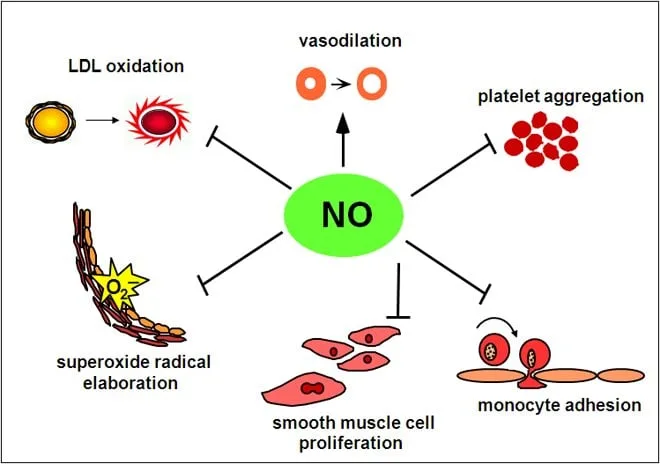
Nitric oxide (NO) is a small gas molecule the body makes on its own. One place where there is a lot of it is the paranasal sinuses. The sinus lining produces NO all the time, and the concentration inside is high. The sinuses connect to the nasal cavity through narrow openings, so during quiet breathing the air in them is renewed slowly, and only a small fraction of the gas gets out.
The experiment that explained it
In 2002 two Swedish physiologists, Eddie Weitzberg and Jon Lundberg, published a short paper with a telling title: “Humming greatly increases nasal nitric oxide.” In ten healthy volunteers they compared a quiet exhale through the nose with a humming one. During humming, the NO concentration in the air leaving the nose rose about fifteenfold.
As a physicist, what I like most is the mechanism. Sound makes the air in the nasal cavity oscillate, and those oscillations act like a pump: gas from the sinuses is actively mixed through the narrow openings with the air in the nose. The sinuses do not start producing more NO; they simply get ventilated better. The authors themselves suggested humming as a simple test of whether the sinus openings are clear and left possible therapeutic effects for future research.
What the body uses NO for
Thousands of papers have been written about this molecule, and more appear every year. In 1992 the journal Science named NO “Molecule of the Year,” and in 1998 Robert Furchgott, Louis Ignarro and Ferid Murad received the Nobel Prize in Physiology or Medicine for discovering nitric oxide as a signaling molecule in the cardiovascular system.
In short, here is what it does:
relaxes the smooth muscle of blood vessels, regulating vascular tone, blood flow and blood pressure;
helps immune cells destroy bacteria, fungi and other pathogens;
carries signals between neurons;
affects mitochondrial function and iron metabolism in cells;
is also behind the mechanism of erection, which is how some well-known drugs work.
Bhramari and viruses: where the facts end
In 2020 the Indian ENT specialist M. K. Taneja published a paper proposing a modified bhramari as a complementary measure for COVID-19. The logic went like this: in lab experiments with the 2003 SARS virus, nitric oxide suppressed viral replication in cell culture, and bhramari, according to Weitzberg and Lundberg, increases the amount of NO in the nose.
Here I want to be careful. Taneja’s paper is a hypothesis, not a clinical trial. The fact that NO suppresses a virus in a test tube does not mean a few minutes of humming will cure an infection. Bhramari does not replace your doctor or your treatment. What can honestly be said is this: the technique is safe for most people, it ventilates the sinuses well, and it lengthens the exhale, which calms the nervous system. That alone is a good reason to include it in your practice.
How I practice bhramari
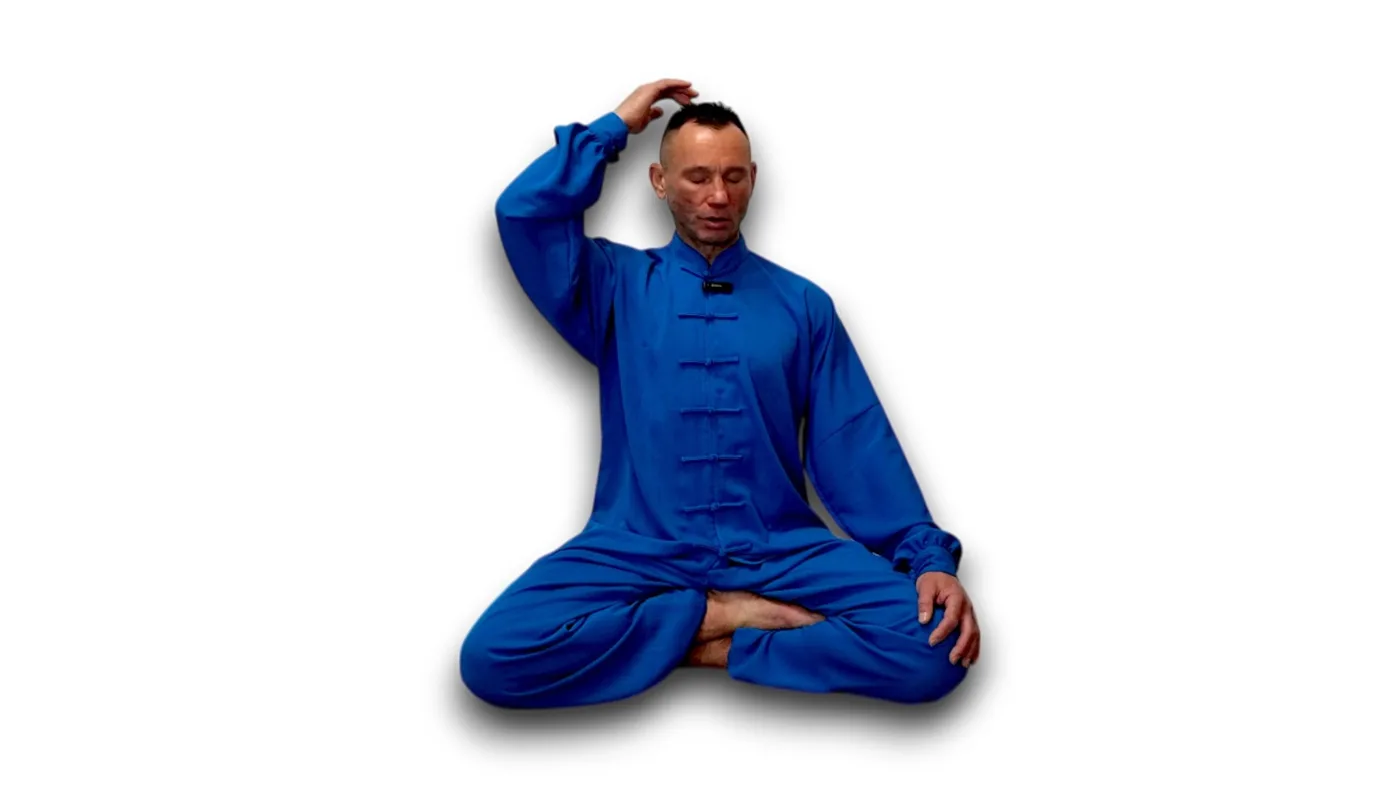
Sit comfortably with a straight back, as described in my article on how to sit correctly. Take a calm breath in through the nose. On the exhale, with your mouth closed, make a low, even “mmm” and try to feel the vibration in your nose, cheeks and forehead. The exhale is longer than the inhale, and the sound is effortless. Five to seven rounds are enough to start. You can close your ears with your thumbs so the sound resonates inside your head. If you feel dizzy, just return to normal breathing.
I demonstrate bhramari together with other exercises in a video on breathing recovery (in Russian); the technique starts at 6:05:
Ventilation and blood flow in the upper and lower lungs
In yoga and qigong, when the body is at rest, we breathe slowly and low, “into the belly.” There are plenty of explanations for this rule, some of them quite mystical. I prefer two simple physical ones. One came to me in the kitchen, the other from a physiology textbook.
A lesson from two glasses
When my child was little, I often had to cool boiled water in a hurry. The method is simple: pour the hot water into a glass, after a minute pour it into a second glass, and put the first one, now warm, under the cold tap. Then back again, several times, until the water is lukewarm.
One day I noticed something curious. If you open the tap all the way, the glass cools almost as fast as under a gentle stream. The glass gives off heat at its own rate, and the cold water needs contact time. A stronger jet only means more water down the drain, with almost no time saved. For every task there is a sensible flow rate, and above it your effort just goes down the sink.
The same thing happens in the lungs
Breathing works in a very similar way. Airflow carries fresh air only as far as the smallest bronchi; beyond that, in the alveoli, oxygen and carbon dioxide move by diffusion. That process takes time too.
On top of that, part of every breath never takes part in gas exchange at all: it stays in the trachea and bronchi. This is the so-called dead space, about 150 ml in an adult. Let’s do the math. Twelve breaths of 500 ml give 6 liters per minute, and 12 × 350 = 4.2 liters reach the alveoli. Twenty-four breaths of 250 ml give the same 6 liters, but only 24 × 100 = 2.4 liters reach the alveoli. Roughly the same work, almost half the benefit.
The breathing muscles themselves consume oxygen, too. When we force ventilation, we burn part of what we are trying to take in, and we wash out extra carbon dioxide along the way. It becomes a vicious circle. For every state there is an optimal rhythm, where the cost of breathing matches how much oxygen the body can actually take up.
The top and bottom of the lungs work differently
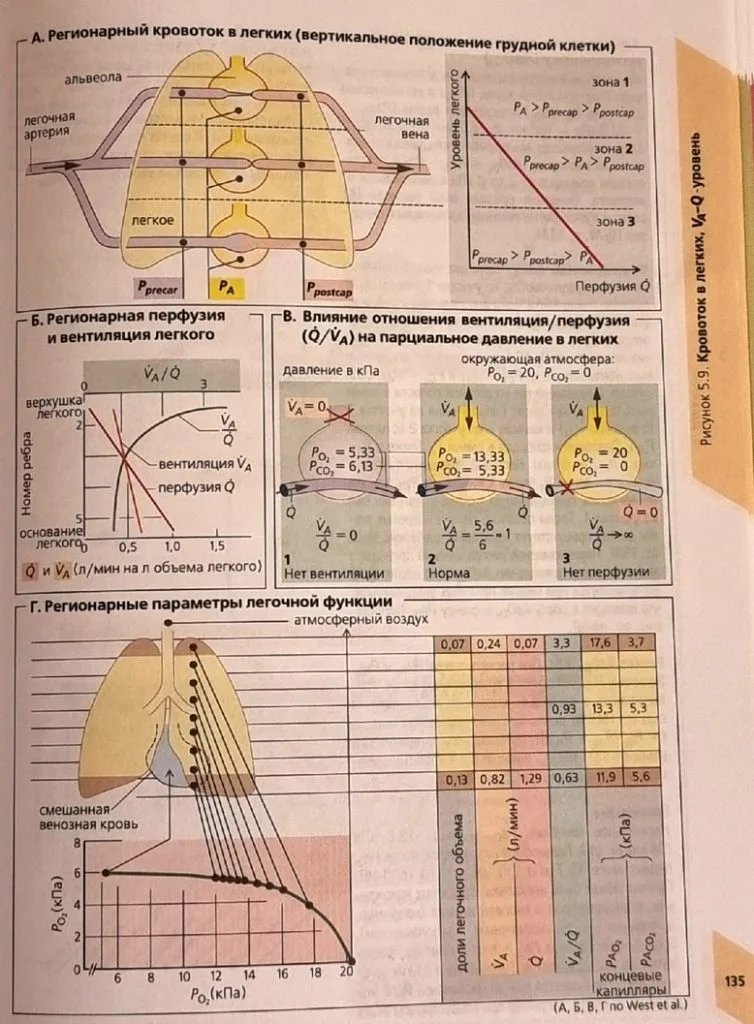
The second idea came from Silbernagl and Despopoulos’s “Color Atlas of Physiology.” When we stand or sit, gravity distributes blood in the lungs unevenly: the lower lobes receive several times more of it than the apexes. Ventilation is also greater at the bottom, but it increases less steeply. As a result, the upper parts have plenty of air relative to blood flow, and some of that ventilation is wasted. In the lower parts there is plenty of blood, and gas exchange is limited by how much air gets there. Physiologists call this the ventilation-perfusion ratio.
This is what makes lower breathing sensible. When the diaphragm is working and the belly moves softly, air fills the lower lobes first, where the blood supply is richest. The cue “breathe into the dantian” (or in yoga, sometimes “down to muladhara”) is an image: physically, air does not go into the belly, but the direction of the diaphragm’s movement ventilates exactly the parts of the lungs best suited for gas exchange.
Under heavy exertion the picture changes. The heart pumps more blood, pressure in the pulmonary vessels rises, and blood fills even the apexes well. Gas exchange becomes efficient everywhere, and that is when full yogic breathing, using the belly, ribs and collarbones, makes sense.
What this means for practice
At rest, in meditation, and in zhan zhuang standing, breathe slowly, softly and low.
Slow does not mean holding your breath or straining. Breathing stays comfortable.
During vigorous activity, don’t limit yourself to the belly; switch to full breathing.
Exercises that help you learn lower and full breathing are collected on my pranayama page. And at my morning qigong classes in Burgas, the first thing we do is calm the breathing rhythm.
A meditation posture: head, neck and spine stacked on one vertical line
In 2019 I completed a meditation teacher training course in India, at the Sarvaguna academy in Goa. Our teachers were Dr. Keshava and Praveen Reddy. When I got back, I wrote five short posts while the material was still fresh: what meditation is, how to prepare for it, how to sit, and how yoga explains the workings of the mind. Here I have pulled them together into one piece, cut the repetition, and added what I have learned from years of teaching since.
Meditation itself was nothing new to me. I have practiced it in one form or another for a long time, because neither serious yoga nor the traditional martial arts can do without it. I had also read plenty of books on its benefits. One that stuck with me is “Altered Traits” by Daniel Goleman and Richard Davidson: the authors collected studies that measure the effects of practice not in glowing adjectives but in markers of the brain and body. Still, the course gave me something books don’t: a coherent system for explaining meditation to other people.
What Is Meditation, in Plain Words
The course manual defines it roughly like this: meditation is a specific technique that quiets the mind and turns attention inward. It is not thinking things over, not dozing, and not daydreaming. During practice your awareness is clear and focused, while the body is as relaxed as it can be.
For most of the day our attention points outward: at a task, a person, a screen. Yet nobody teaches us how to turn it inward, toward sensations, the breath and the flow of our own thoughts. Not at school, not at university, not at work. The result is an odd imbalance: we use this instrument all the time and barely know how to control it.
Why Meditate
The first thing practice gives you is release. In the early stages you relax the body, but you do it consciously, without drifting off to sleep. That lets you notice and let go of the tension that builds up in the muscles over the years.
This shows most clearly with stress. Sometimes mental fatigue turns into physical fatigue: you feel sluggish and apathetic, your back or neck aches for no obvious reason. A pill often does little here, because the load comes from the head, not from the joint. Meditation does not replace a doctor, but it gives you a way to work with the source itself.
For people who work with their minds, practice has one more benefit: it frees up resources. After a few minutes of quiet, fresh ideas come more easily and intuition is easier to hear.
I also like a bit of linguistics we heard on the course: the words “meditation” and “medicine” are related. Both go back to Latin verbs sharing an ancient root connected with care and due measure.
Why You Can’t Just Switch Thoughts Off
A common beginner’s mistake is to think meditating means sitting with an empty head. Try it, and within ten seconds you will be thinking about your shopping list. The mind is like a computer with no off button. So the task is framed differently: not to chase thoughts away, but to give attention a single point to rest on.
When the mind gently holds one object, the processes that generate stress settle down: replaying worries, planning, solving imaginary problems. The anchor can be a sound or an image, external or internal: repeating a mantra, a candle flame, the feeling of the breath. There are dozens of methods. Just as many trails lead to a mountain summit, there are many ways to reach the meditative state. The goal is the same: inner quiet, collectedness, and that special state most simply called happiness.
Seen through a physicist’s eyes, a human being is an inertial system. Losing weight or building muscle takes months of routine and training. Habits of thinking and perception are no different: they don’t change overnight, so they have to be trained. Eastern traditions offer a helpful shift here: value the path itself, not only the result. If you learn to enjoy the process, you feel good all the time, not just in the brief moments when a goal is reached.
There is good news too. Relaxing the body and calming the mind come fairly quickly, and over time they kick in more and more easily. For many people that alone is enough.
What Meditation Is Not
The course spent a good deal of time separating meditation from things that resemble it.
First, it is not reflection. Thinking through ideas and concepts is useful, but meditation has no conclusions and no weighing of pros and cons. The practitioner drops below the level of concepts.
Second, it is not hypnosis or autosuggestion. Repeating an intention such as “I want to achieve this” can be useful at times, but it is a different tool. In meditation you don’t program the mind or give it orders. You observe it and let it come to rest. I would even call meditation anti-hypnosis: a state free from implanted suggestions and outside influence.
Third, it is not a religion. Practice does not ask you to change your faith or culture, and there is nothing alien about it. It is an investigation of yourself, and in essence it is closer to the scientific method than to ritual.
That gives us a training program. For meditation to work, you need to learn how to:
relax the body;
sit comfortably and still;
make the breath smooth and quiet;
calmly watch what goes on in your head;
notice helpful thoughts and cultivate them;
stay calm whatever the circumstances.
Preparation Matters More Than the Meditation
Our teacher liked to say: “Preparation is more important than actual meditation.” If you have prepared well, meditation simply happens. He had another comparison too: meditation is like a rocket launch, where all the real work is done on the ground long before liftoff.
Place and Time
Pick a quiet, clean corner away from your desk, the kitchen, the TV and your phone. The best time is early morning: get up an hour before everyone else in the house, and nobody will disturb you while your head is still fresh. Of course, that means going to bed earlier and skipping heavy late dinners. It helps to give practice a fixed slot in your daily routine. Habit is more reliable than willpower and saves you from the endless “I’ll start tomorrow.”
Body and Breath
Before you sit down, prepare the body: use the bathroom, take a shower or at least wash your face. Then do a little hatha yoga or a warm-up. You will be sitting still for a long time, so stretch your back and legs beforehand. Running and aerobics are not a good fit here: they drain the energy you need for practice.
Next come breathing exercises, pranayama. Then sit and link the breath with the So-Ham mantra: silently “So” on the inhale, “Ham” on the exhale. The mind stays calm and turned inward. Coming out of meditation also takes care: first bring your attention back to the body and breath, then open your eyes.
The Four Instincts
A separate chapter of the manual deals with four basic instincts: food, sleep, sex and self-preservation. A practitioner does not suppress them but learns to take them into account.
Food should be fresh, simple and natural. The way you eat matters too: don’t eat while irritated or argue at the table, chew thoroughly and taste your food, don’t eat until you feel heavy. Our teacher called a cheerful mood at meals one of the secrets of good health. Have your last meal at least four hours before sleep or meditation. Cut out alcohol.
Sleep follows the golden mean: too little is harmful, and so is too much. Many practitioners find that regular meditation lets them recover on less sleep. Self-preservation needs no explanation, and neither does sex: everything in moderation. Sadly, the manual says nothing more on that subject.
How to Sit for Meditation
The course formula is simple: straighten the spine, watch the breath, calm and gather the mind. These three steps gradually move attention from the outer, physical level to a subtler, inner one. After that, meditation happens by itself.
A meditation posture should be stable, upright, relaxed and comfortable. If your legs go numb, your back aches and you want to fidget, nothing will come of it. Many people believe you have to meditate in full lotus. You don’t. Three conditions are enough: head, neck and torso in one line, the spine perpendicular to the floor, and low, diaphragmatic breathing.
From a biomechanical point of view, the goal is to stack the spine so that the fewest possible muscles hold the posture. The body is in balance, and that balance is maintained by the deep postural muscles that control the position of the vertebrae relative to each other. It sounds easy, but learning to sit upright and relaxed at the same time takes years. In fact, all the asana work in hatha yoga leads to exactly this kind of alignment, which matters for meditation and for health in general. In qigong the same job is done by standing like a post, Zhan Zhuang: a vertical line without excess tension.
Every muscle not involved in holding the posture should let go: face, eyes, shoulders, arms, legs, belly. The face is a good place to start, and the face relaxes through the eyes. Lower the eyelids softly, without squeezing. Rest your hands on your knees with the thumb and index finger joined in chin mudra or jnana mudra.
Which Asana to Choose
Sukhasana, the easy cross-legged seat. A folded blanket under the pelvis makes it easier to straighten the spine and to sit on the floor for a long time.
Swastikasana is more stable but needs well-opened hip joints so the knees can drop closer to the floor.
Vajrasana, sitting on the heels, is very comfortable if your ankles are flexible enough.
Siddhasana suits people with years of practice behind them and gives a very secure base.
The main thing in every option is the same: a straight back. Knees set wide give stability. Only the deep muscles along the spine are working. The breath is soft, low and small in amplitude, with just the diaphragm moving. The accessory breathing muscles rest, which is the difference from pranayama, where they are exactly what we train. The body is relaxed, its oxygen demand drops, and it shifts into a mode of conservation and recovery. That is the state meditation grows out of.
How Yoga Describes the Mind
The last part of the course was the most interesting for me, as a physicist and someone with a background in the tech business. The manual opens with a strong claim: the mind is the best tool we have, but a disorganized mind scatters its energy and gets in the way of our goals. Yoga describes the mind as a system of four functional units: manas, chitta, ahamkara and buddhi. Once you see how they connect, it becomes clear what exactly we are training in meditation. Indian thinkers laid out this model thousands of years ago, and it is remarkably similar to computer architecture.
Manas: Input and Output
Manas is the lower level of the mind, the link to the outside world. The five senses are connected to it: hearing, touch, sight, taste and smell. It also runs the five organs of action: speech, hands, feet, and the reproductive and excretory organs. Manas can doubt and ask questions.
In a computer, this is the input/output controller: it receives signals from a camera or scanner, does some preprocessing, and sends an image to the monitor. The capacity to doubt resembles the interrupt system, where an urgent request pauses the current job. The manual compares manas to a foreman in a factory: not the owner, but the one who watches the process and gives the workers their tasks.
A foreman carries out orders well. But if the boss, buddhi, is clouded and makes no decisions, manas starts listening to the noise, chatter and desires rising up from chitta.
Chitta: Memory
Chitta is the storehouse of impressions and experience. It holds countless hidden traces of the past. They can be useful, but without oversight from above they act directly on manas and push their desires out into the world, including unconscious ones. The best way to work with chitta is observation: watch how thoughts, emotions and images surface from somewhere and go back there. That “somewhere” is chitta. No wonder Patanjali defines yoga as “yogas chitta vritti nirodhah,” the stilling of the fluctuations of chitta.
The computer analogy is especially apt here. Computer memory is hierarchical: data is copied from a slow disk into RAM, and from there into the processor’s multilevel cache. A sync failure at any level and the system starts behaving strangely. And the von Neumann architecture, on which most computers are built, keeps instructions and data in the same memory, where they look identical. Apply that to chitta, and it turns out that alongside impressions it also stores instructions: behavior patterns and ready-made reactions to different situations, formed by experience. With access to the processor, those programs can be rewritten. Chitta also has deeper layers, the subconscious and the unconscious, and they too can be worked with and cleared of clutter.
Ahamkara: the Ego
Ahamkara is the sense of “I am,” what lets us set ourselves apart from others. This function has a flip side: it is also a source of pain and alienation. When buddhi is clouded, ahamkara pulls hidden emotions out of chitta and makes manas respond to its whims, colored by the “personal.”
Interestingly, the ego’s profile is stored in chitta as well. What we like and dislike is basically a few bits of information, and they can be changed. Sometimes circumstances do it for us: someone who eats nothing but pineapples happily wolfs down bread with cured pork fat on a hike when supplies run out. Or a smoker sure he can’t live without a cigarette ends up somewhere with no tobacco and gets along fine. Or you can switch on buddhi and change yourself. That is harder, but possible.
One of the most effective tricks against compulsive desires, like midnight raids on the fridge, is to tell yourself not “I want” but “it wants.” This is the first step toward no longer identifying with ahamkara. A Ukrainian song captures it well: the narrator complains that late at night “a chunk of parasite” pushes him to take the first sip and then gambles his property away at the casino.
Buddhi: the Central Processor
Buddhi is the highest level of the mind, the gateway to inner wisdom. The root of the word is linked to awakening. This part of the mind makes decisions, assesses soberly and judges fairly. If buddhi is clouded, manas takes orders from chitta, where all our habits, good and bad, are stored along with every stereotype colored by the ego. A clear buddhi can always find a sensible way out, provided manas agrees to follow it. So the practitioner’s main work is clearing buddhi.
In the computer model, buddhi is the processor together with the operating system. A person is born like a new computer with no software. Then programs get installed, some useful and some not, documents, photos, music and movies get loaded, and viruses come along for the ride. Over time resources fill up, unneeded processes run in the background, and the main task runs slowly and with errors.
A Free Antivirus for the Mind
Understanding what the mind is made of and how its parts affect each other opens the way to a different way of thinking: more productive, gentler and brighter. The most accessible tool on that path is meditation. Our teacher joked that it is free antivirus software for the brain: a lifetime license with daily updates.
I explain where to start in practice on the meditation practice page. Below is a recording of an online meditation class I taught on Zoom in the spring of 2020 (in Russian).
Yoga vs Qigong
Audio & subtitles: EN · BG · RU (⚙ in the player)
More about my teachers and my path in practice is on the about the author page.
I cover breathing techniques, preparing the body and meditation in detail, with photos and video lessons, in my book “Yoga vs Qigong: Basic Techniques”
Eight hours at a laptop, an hour behind the wheel, then the couch. After a couple of years of that, plenty of people end up with a nagging neck, a rock-hard lower back and knees that crackle on the stairs. People who train hard and often have a similar story: lots of load, not enough recovery. Both groups usually get the same advice: buy a foam roller. It’s sound advice, but so much marketing has piled up around it that it’s worth separating what works from the fairy tales.
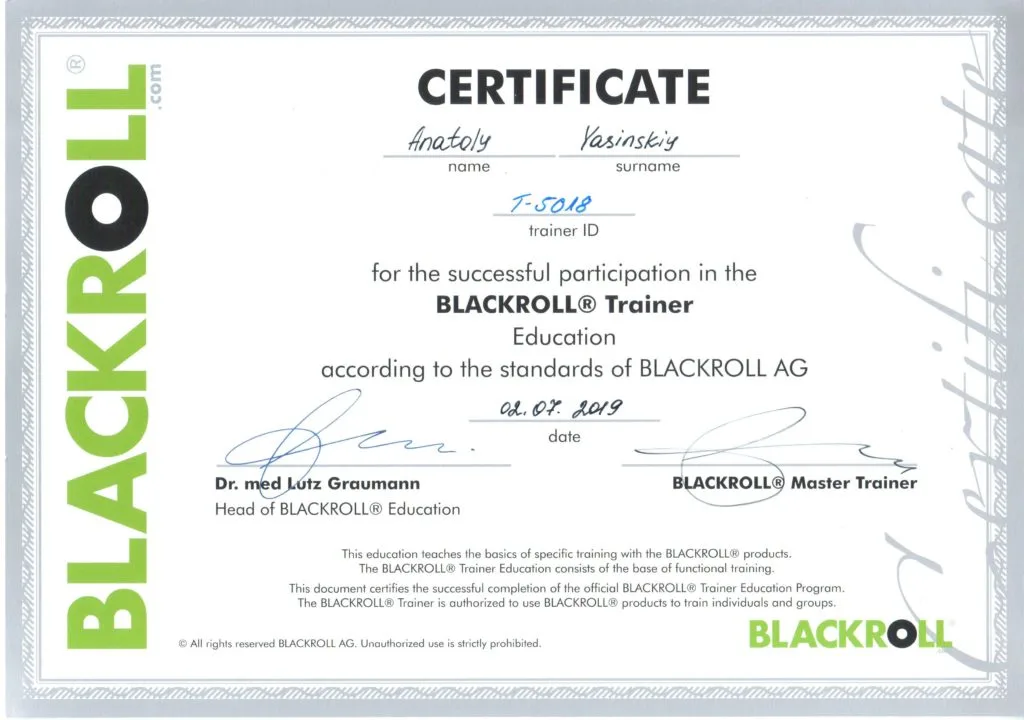
In 2019 I completed the BLACKROLL Trainer Education and was certified to teach with rollers and massage balls. What follows is what I took away from the course and tested on myself, plus what research since then has confirmed or called into question. You can read more about my background on the About the Author page.
What fascia is and why it only recently got attention
Fascia is connective tissue: collagen and elastin fibers embedded in a viscous, water-rich ground substance. It wraps every muscle, every bundle of fibers inside a muscle, and every vessel, nerve and organ. Cut an orange open, squeeze out the juice, and you’re left with the white membranes that hold the whole fruit together. Fascia holds the shape of the body in much the same way. That’s why specialists increasingly talk not about muscles and fascia separately but about a single myofascial system.
Anatomists have always known about connective tissue, but for centuries they studied it in cadavers, where it quickly loses its elasticity and glide. Serious research into how fascia behaves in a living, moving body only took off around the early 2000s. The push came from Thomas Myers’s book “Anatomy Trains” (2001) and from Robert Schleip’s group at Ulm University in Germany. Myers, by the way, studied with Ida Rolf, the founder of Structural Integration, so the idea of working with the body through its connective tissue is older than it looks.
Here’s what we can say with reasonable confidence today:
fascia transmits force between muscles and helps the body work like a spring when you walk, run and jump;
the layers of fascia need to glide over one another, and long periods of stillness make that glide worse;
fascia is densely innervated, it contributes to your sense of body position (proprioception) and can itself be a source of pain, for example in the lower back.
You’ll see the claim that “fascia has ten times more receptors than muscle” in lots of articles. I’d treat that number as an estimate rather than a precise measurement. For practical purposes it’s enough to know that fascia is sensitive and in constant conversation with the nervous system.
What a roller actually does
This is where it gets interesting, and where I’ll disappoint fans of tidy diagrams. A roller doesn’t “smooth out adhesions,” and it doesn’t stretch dense fascia like dough. To mechanically deform something like the fascia lata on the outside of the thigh, you’d need forces far beyond what your body weight on a roller can produce. Recent research points to a more modest and more honest picture:
after a few minutes of rolling, joint range of motion increases, and unlike a long static stretch, it doesn’t cost you strength;
perceived muscle soreness after a hard workout goes down;
the main mechanism is most likely neural: receptor sensitivity changes, protective muscle tone drops, and your tolerance to stretch goes up;
there’s also a sponge effect: pressure squeezes fluid out of the tissue, and when you release, blood and lymph flow back in (a hypothesis, but one that fits the sensations well).
The practical takeaway: the effect of a single session is temporary. On the course we were told that within a day very little of the change remains, and what does accumulate lives mainly in the nervous system, in how your brain regulates muscle tone. The connective tissue itself remodels slowly, over months of regular work. So a roller is useful as a habit, not as a one-time fix.
Anatomy Trains: it hurts here, but the cause is over there
Myers described lines along which muscles and fascia link up into continuous chains: the Superficial Back Line (from the sole of the foot, through the calves, hamstrings and back, up to the brow ridge), the Superficial Front Line, the Lateral Line, the Spiral Line and others. A 2016 systematic review found solid anatomical evidence for the back line and somewhat weaker evidence for the lateral and spiral lines. The model isn’t perfect, but it’s very handy in practice.
Here’s a typical desk-worker example. Long hours of sitting shorten the front chain: the hip flexors, the rectus abdominis, the chest muscles. The back has to pull constantly to keep you balanced, and eventually it starts to hurt. So people roll their lower back, when what they really need is to release the front of the thighs, the iliopsoas area, the diaphragm under the ribs, the pecs and the sternocleidomastoid on the side of the neck. If your lower back keeps flaring up, that’s where I’d start.
One more thing worth knowing. MRI scans very often show herniated or bulging discs in people whose backs don’t hurt at all. Most lower back pain has to do with muscle tone, posture and movement habits, not with irreversible changes in the spine. That’s good news: functional problems respond to movement.
Simple tests before you start
Before rolling, it helps to know which line is tight. These are the tests from the course that I still use myself:
Back line: bend forward with straight legs and note where your fingertips reach.
Lateral line: stand with your back to a wall and side-bend, sliding your hand down your thigh. Mark how far your fingers go and compare sides. After working this line, my difference was almost 10 centimeters (about 4 inches).
Thomas test: lie on your back, pull one knee to your chest and keep the other leg straight. If the straight thigh lifts off the floor, your hip flexors and the front of your thigh are short.
Ankle: stand facing a wall with your toes 10 cm (about 4 inches) away and drive your knee toward the wall without lifting your heel.
Wall angel: press your back against a wall, bend your arms to 90 degrees and try to get your elbows and the backs of your hands flat against the wall. This shows how mobile your upper back and shoulders are.
Balance: stand on one leg. If 15 seconds is easy, close your eyes or tilt your head back. Your sense of balance relies heavily on receptors in fascia, so balance training is fascia training too.
Repeat the tests after a session. The difference often shows up right away, and that’s the best motivation to keep going.
How to use a roller: techniques and ground rules
The basic rules are simple. The muscle on the roller has to be relaxed, otherwise you’re pressing on a tense shield and getting nothing. Keep the discomfort at no more than 7 out of 10: if you’re gritting your teeth and holding your breath, your body only guards harder. Breathe calmly, preferably through your nose. Move slowly, roughly half an inch to an inch per second.
The BLACKROLL course covered eight techniques. I’ve grouped them the way I actually use them:
Rolling along the fibers. A gentle entry, warming up and activating the tissue. I start every area this way.
Rolling across the fibers. More intense, good for old knots and chronic trouble spots. The tissue may feel a bit sore for a day or two afterward, which is normal, but never do this on a fresh injury.
Small circles over a limited area boost local blood flow.
Static pressure. Find a tender spot, hold for 15 to 30 seconds until the sensation changes and dulls, then release. This is the sponge effect in action.
Pressure plus stretch. For example, the roller under the front of your thigh while you slowly bend your knee. It ends up feeling like yoga on a roller.
Pressure plus twist. Pin the tissue with a ball and rotate slightly. It works well for scar mobility, but only on fully healed scars and with your doctor’s approval.
Compression and mobilization. Hold the pressure and move the joint above or below that spot.
Vibration. Vibrating rollers tend to relax tissue at lower frequencies and activate muscles at higher ones. Nice to have, not essential.
How long: 30 seconds to 2 minutes per area, 10 to 15 minutes for a full session. Before training, keep it shorter and quicker, as part of your warm-up. After training or in the evening, you can go slower and longer. I especially recommend rolling your foot on a small ball: from the heel to the toes and around the ankle, pausing on the tender spots. The foot is where the back line begins, and after this your forward bend often improves before your eyes.
Common mistakes
Rolling too fast, back and forth like a rolling pin. Your nervous system doesn’t have time to respond.
Pushing through intense pain. Bruises after rolling mean you overdid it.
Parking on one spot for several minutes.
Rolling a big roller directly over the lumbar vertebrae. For the lower back, it’s better to work through the glutes, the front line and the upper back.
Rolling a tensed muscle, for example working your calf while standing on your toes.
Expecting one session to fix a problem you’ve had for years.
Using the roller instead of movement. Rolling opens a window of mobility, and only exercise can lock it in.
A word about water. The course put a lot of emphasis on fascia needing water and recommended drinking plain water after training. Drinking water is sensible, of course. But the idea that half an hour of walking helps water “reach your fascia” is, in my view, an image rather than an established fact.
Contraindications and areas to avoid
Self-massage with a roller isn’t treatment, and there are situations where it can do harm. Don’t roll until you’ve talked to a doctor if you have:
a fresh injury, sprain, bruise or hematoma (the first few days);
deep vein thrombosis or a suspicion of it, or pronounced varicose veins in the area;
anticoagulant medication or a bleeding disorder;
osteoporosis, a recent fracture or surgery;
acute inflammation, a fever, or damaged or infected skin;
cancer;
pregnancy (especially work on the legs and abdomen);
numbness, tingling or shooting pain under pressure, which is a sign you’re pressing on a nerve.
Whatever your situation, don’t roll over bones and joints, the front and sides of the neck, the back of the knee, the groin and upper inner thigh, where large vessels and nerves run close to the surface, or the kidney area.
Rolling, yoga and qigong
For me, a roller isn’t a separate system but a way into movement. Roll out your feet and the backs of your legs, and forward bends in yoga come more easily. Release your chest and front line, and in qigong stances it’s easier to lengthen your spine without clenching your lower back. The biggest lesson of the course for me was that the body needs variety: we have more than six hundred muscles and hundreds of joints, and any repetitive load, whether it’s an office chair or only cycling, uses a small fraction of them. Yoga, qigong, swimming, walking, mountains: the more variety, the better. And don’t skip the cool-down after hard training.
If you’re in Burgas, join my morning qigong classes and ask your questions about self-massage in person. And finally, a great documentary about fascia (in Russian):
Yoga vs Qigong
Audio & subtitles: EN · BG · RU (⚙ in the player)
I cover how to align your spine, build good posture and set up a basic practice, so you need the roller less often, in detail in my book “Yoga vs Qigong: Basic Techniques”.
When I got serious about breathing practice, instructions like “just breathe deeper” stopped being enough. As a physicist, I wanted the mechanism: what actually moves, which muscles do the work, where the pressure goes. That is how two very different books on breathing ended up on my desk. I read both slowly, taking notes and testing everything on myself.
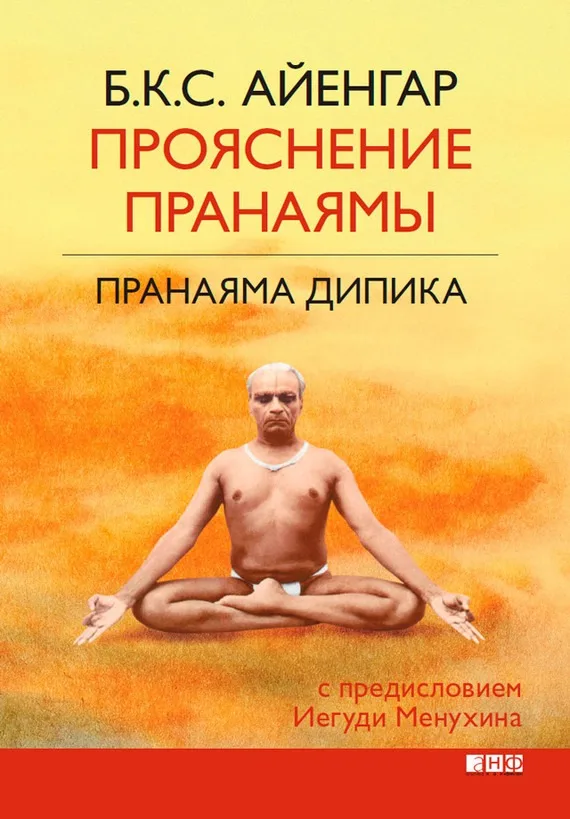
The first was written by a yoga master for practitioners: “Light on Pranayama” by B.K.S. Iyengar, first published in the early 1980s. The second was written by a movement specialist for people who want to understand the body: “Anatomy of Breathing” by Blandine Calais-Germain (the French original came out in 2005). Here is what each gave me and why I recommend reading them as a pair.
Iyengar: a thorough pranayama manual
Among yoga practitioners this book has long been considered one of the best guides to pranayama technique, and I agree. The list of techniques alone is impressive: ujjayi, viloma, bhramari, bhastrika, kapalabhati, shitali, anuloma and pratiloma, surya bhedana and chandra bhedana, nadi shodhana. Each one is taken apart down to the last detail.
Iyengar explains how to sit, where the chin goes, what the eyes and tongue are doing, how the fingers rest on the sides of the nose. All of it comes with photos. For every pranayama there are tables with stages of progression: first a simple rhythm, then retention after the inhale and after the exhale, then bandhas, then combinations of several techniques in one cycle. A separate chapter is devoted to shavasana, and rightly so: if you cannot relax, breathing practice turns into forcing yourself. There is even a short section on the anatomy of the respiratory system.
To be honest, I did not like everything. I had to push through the opening chapters, which are full of the Hindu worldview: five “secondary” types of prana (naga, kurma, krikara, devadatta and dhananjaya), kundalini and so on. This is part of the tradition, and Iyengar would not be Iyengar without it. For practical purposes, though, you can skim that layer without losing anything in technique.
Calais-Germain: breathing through an anatomist’s eyes
“Anatomy of Breathing” by Blandine Calais-Germain
The second book is just as practical, but it contains nothing that science would argue with. Blandine Calais-Germain trained as a dancer and a physical therapist and is known for her atlases of movement anatomy. She presents the respiratory system not as a textbook illustration but as a working machine.
The most valuable idea for me was to see the torso as two linked elastic containers. On top are the lungs: an elastic bag filled with gas, and gas, as physics tells us, compresses and changes both its shape and its volume. Below is the abdominal cavity: a container of fluid and organs that easily change shape but hardly change volume, because water is incompressible. Between them sits the dome of the diaphragm, around them a flexible frame of ribs and spine, and over it all a great many muscles.
Practical conclusions follow right away. On the inhale the diaphragm descends and presses on the abdominal contents, which cannot disappear and have to shift somewhere. If you draw in the front wall of the belly at that moment, the pressure goes back toward the spine and down toward the pelvic floor. Release the belly, and the volume moves forward. This explains all the different types of breathing yoga people argue about: belly, chest, side, “into the back.”
Another discovery: far more muscles take part in breathing than I had thought. The diaphragm is the main one, of course. But the inhale is assisted by pectoralis major and minor, serratus anterior and serratus posterior superior, the levatores costarum, the spinal erectors, the sternocleidomastoid, the scalenes, the rhomboids and many small muscles. An active exhale recruits rectus abdominis, the obliques and transversus abdominis, the pelvic floor (levator ani and coccygeus), transversus thoracis, quadratus lumborum and serratus posterior inferior. The intercostals work in both phases.
Breathing as training for the deep muscles
Putting the two books together, I came to a simple conclusion. The human body has more than six hundred muscles, and a large share of them lie deep: on the back, for example, muscles are stacked in several layers you will never see in a mirror. As the lists above show, many of them are involved in breathing one way or another. I wonder how many bodybuilders could name even a third of them.
So when we work with the breath on purpose, we are training the muscular system, and specifically the part no machine at the gym can reach. The load is gentle and balanced, and no gym is needed. When the respiratory muscles work in a coordinated way, ventilation becomes more economical, you tire less, and a calm rhythm is easier to keep. You can explain all this without meridians or mysterious qi, with ordinary physiology.
Where qigong comes in
In qigong the respiratory muscles are engaged even more. In a dynamic set, the inhale and exhale are timed to the movement, and the deep muscles contract and lengthen together with the breath. The division into inner and outer layers is a convention anyway: muscles, ligaments and fascia are tightly interwoven and work as one tissue. A good example of this kind of work is the Yi Jin Jing qigong set.
I see the Taoist practice of the Microcosmic Orbit (the “Small Heavenly Circle”) through the same lens. In essence it is a sequence of tensing and releasing muscles in a loop: from the belly (the dantian area) down to the perineum, through the huiyin point, which corresponds to mula bandha in yoga, then up along the spine to the crown. Isn’t that strength training for the deepest muscles? Arnold might want to add a chapter to his encyclopedia.
Which book to read first
If you are just starting out, I would read Calais-Germain first. She gives you an understanding of what happens in the body, and after that every instruction makes sense. Then move on to Iyengar and take specific practice schemes from his tables. I collected the basic exercises that make a good starting point on my pranayama page.
Both books ask you to practice, not just read. I have been coming back to them for years, and each time I find something new.
We use cookies for visit statistics (Google Analytics). They are switched on only if you agree.
Functional
Always active
The technical storage or access is strictly necessary for the legitimate purpose of enabling the use of a specific service explicitly requested by the subscriber or user, or for the sole purpose of carrying out the transmission of a communication over an electronic communications network.
Preferences
The technical storage or access is necessary for the legitimate purpose of storing preferences that are not requested by the subscriber or user.
Statistics
The technical storage or access that is used exclusively for statistical purposes.The technical storage or access that is used exclusively for anonymous statistical purposes. Without a subpoena, voluntary compliance on the part of your Internet Service Provider, or additional records from a third party, information stored or retrieved for this purpose alone cannot usually be used to identify you.
Marketing
The technical storage or access is required to create user profiles to send advertising, or to track the user on a website or across several websites for similar marketing purposes.