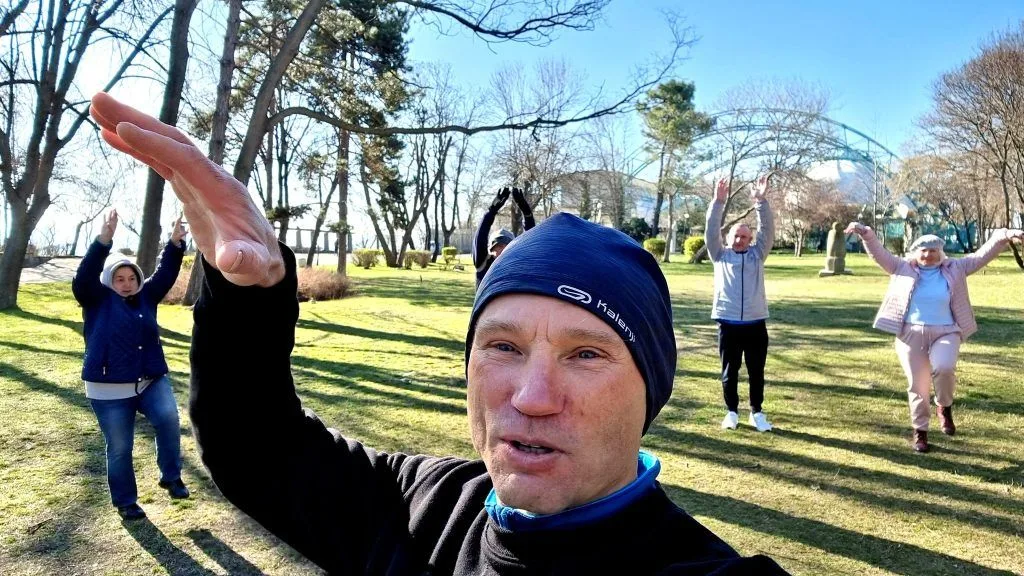
Since Monday, September 21, a new season of morning qigong classes has been running in Burgas. We practice in our favorite hall at the Amrita Center (Bratya Miladinovi district, 145), as usual on Mondays and Fridays at 8 a.m.
Qigong is especially well suited to mature adults who want to take good care of their health. This season we are learning qigong sets for back pain, correcting posture and learning to breathe properly. We also practice meditation in motion and at rest.
The first class is free. Come to see, try it and ask questions. If you like it, stay with us.
My second piece for Yoga Journal is out, and this time it’s about the mountains. More precisely, it’s about something anyone who has packed a mat for a hiking trip knows well. Down at home your sequence flows, your body remembers every pose, and then up high, by the third round, your breath falls apart and you can’t get enough air.
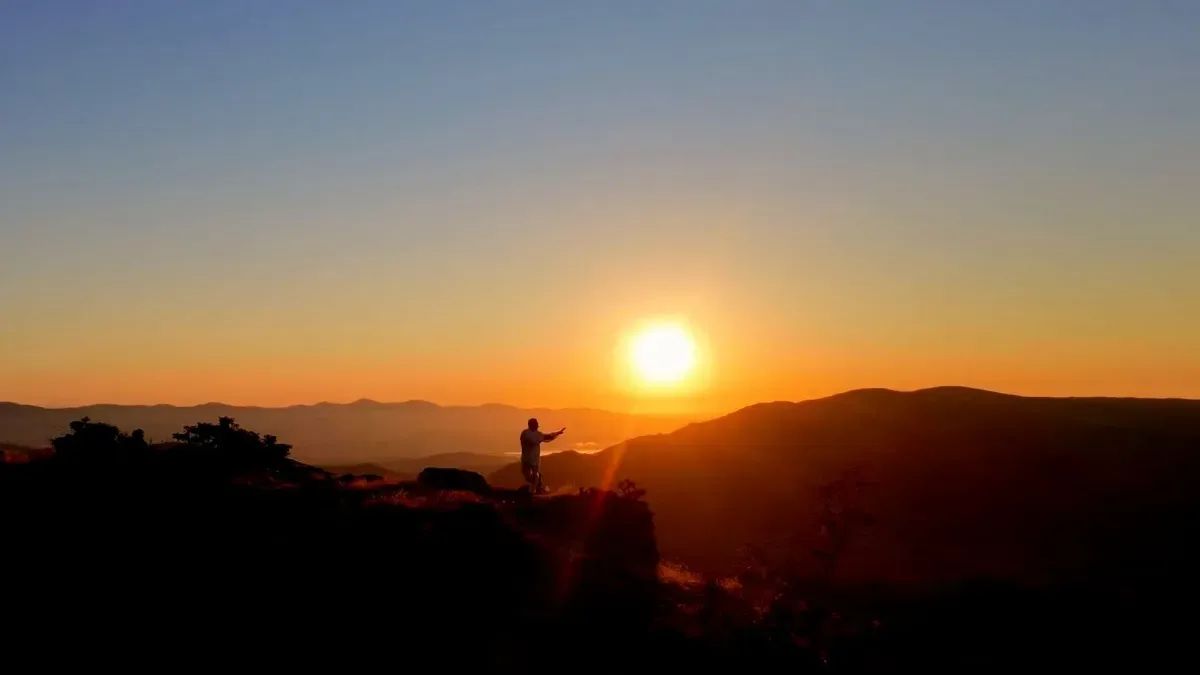
I was also pleased that the editors chose my own photo for the piece: a sunrise practice on a mountain ridge. A real photo always beats a stock image.
The main ideas
The first thing worth correcting is the familiar line “there’s less oxygen in the mountains.” Its share of the air is the same as at sea level, about 21%. What drops is the pressure, and with it the force that pushes oxygen from your lungs into your blood. So the task isn’t to breathe in more air, but to make sure your blood actually releases oxygen to the tissues.
The natural reaction to feeling short of breath is to breathe faster and deeper. Your body does this on its own, but overdoing it flushes carbon dioxide out of the blood. Without enough CO2, hemoglobin holds on to oxygen more tightly and delivers less of it to muscles and brain. That’s the Bohr effect. Hence the paradox: the harder you breathe, the more breathless you feel, and dizziness and tingling fingers join in.
There’s some simple arithmetic here, too. Part of every inhale stays in the trachea and bronchi and never reaches the alveoli; this is the so-called dead space. That’s why slow, deep breathing moves more air through gas exchange than fast, shallow breathing, even when the total volume per minute is the same. Yogis settled on this pattern long before physiologists could do the math.
What helps at altitude: a long exhale, roughly twice as long as the inhale, at about six breaths per minute. Nadi shodhana, because it slows the breath and keeps it in the nose, which warms and humidifies the cold, dry air. Ujjayi is fine at rest, but while moving or climbing it adds unnecessary resistance. Kapalabhati, bhastrika, and long holds after the exhale are best saved for when you’re back down, at least during the first days of acclimatization: they amplify exactly what your body is already struggling with. In your asana practice, slow the pace and cut back on vinyasas, skip inversions if you have a headache, and drink more than you feel like drinking. Ten minutes of calm breathing with a long exhale before bed also helps on those nights when your breath keeps stopping and speeding up in your sleep.
Then there’s a line I draw firmly in the article. Pranayama doesn’t replace acclimatization and doesn’t treat altitude sickness. If a headache keeps getting worse, or you notice nausea, unsteadiness, or confusion, go down right away. No debate.
As a physicist, one thing here delights me. Neither the yogis in the Himalayan foothills nor the Taoists on Mount Wudang knew about the Bohr effect or dead space, yet they found exactly the breathing pattern that works best in the mountains.
The basic breathing techniques, with video, are covered on the Pranayama page. If you’re curious who I am and where this approach to practice comes from, see the About the Author page. And for a detailed look at breathing principles and techniques, there’s my book “Yoga vs Qigong: Basic Techniques”.
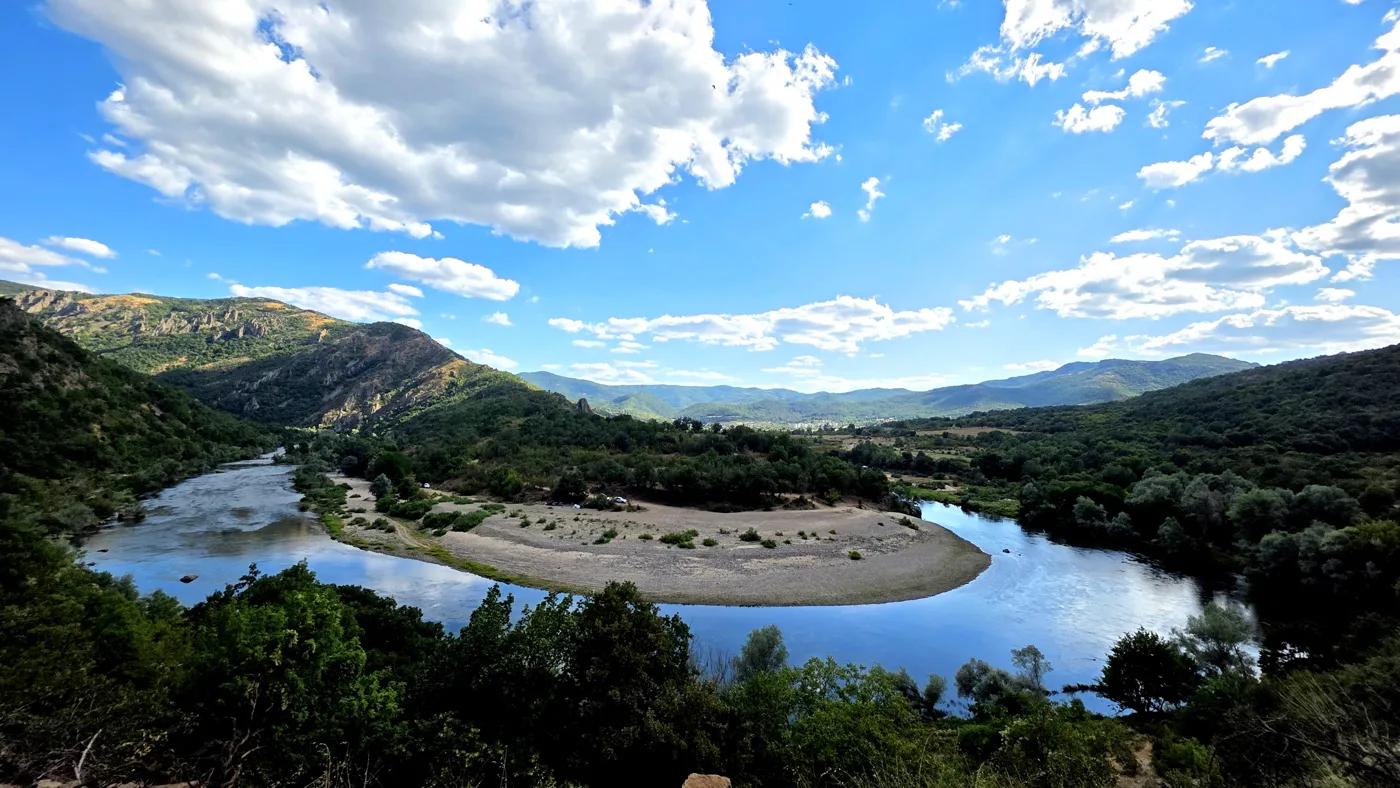
Join us for a weekend in the Eastern Rhodopes. From October 16 to 18, 2026, we are holding a yoga and qigong retreat in Madzharovo, Bulgaria. The town sits in the crater of an ancient volcano, the Arda River winds through the valley in its famous meanders, and griffon vultures circle above the house.
Where we stay
We stay at Staroto Gnezdo (“The Old Nest”), a two-hundred-year-old house with a yard of about one acre. There are outdoor spots for practice, a separate hall in case the weather turns cool, and a place for a big bonfire. The house is rated 9.6 on Booking.
The program
Four sessions over two days: two of qigong and two of yoga therapy. We work gently with the back and posture, breathe, and learn to meditate. No acrobatics: everything is manageable, suitable for any age and for complete beginners.
On Saturday we go on a long walk to the Pyramid and the Cross hills, a seven-kilometer loop starting right from the house. If you are not up for the climb, you can take a shorter route with a guide and come back earlier. In the evening we will walk up to the Tower to watch the sunset or sit by the fire.
Who leads it
I teach the qigong sessions. I am Anatoly Yasinsky, a physicist by my first degree and an instructor-methodologist in adaptive physical education, yoga therapist and qigong teacher by my second. I have been studying Eastern practices for more than 25 years and approach them with the scientific method. I recently wrote and published the book “Yoga vs Qigong: Basic Techniques”.
My wife, Anastasia Yasinskaya, will give a talk on nutrition and lead yoga sessions for the spine (yoga therapy). She holds a PhD in medical sciences and is a nutritionist, so there will be someone to answer your health questions.
Cost and how to join
Money matters are simple, with no prepayment. You book your room yourself on Booking, pay for meals on site to the host, and pay us 100 euros per person for the sessions and organization, also on site.
There are still free rooms in the house. If you would like to come, book right away, they go fast.
The full hour-by-hour program and the Booking link are in the Facebook event. Ask your questions there in the comments or write to us through the contact page.
Some good news: my first article has come out in Yoga Journal (the Russian-language edition), and I’m now one of the magazine’s contributors. I didn’t show up with yet another piece on asanas. I brought qigong, a topic yoga publications usually tiptoe around, so credit to the editors for taking it on.
The article looks at what actually happens in the body when you practice. No channels or subtle energies, just breathing, connective tissue, and the nervous system. Below is my own short summary of the main ideas. The full text is on the magazine’s website, in Russian.
What the article covers
The Indian and Chinese traditions each have their own map of the body. In one, prana flows through the nadis; in the other, qi moves along meridians and gathers in the dantian. Both maps were drawn centuries before anyone had an anatomy textbook. Strip away the vocabulary, though, and both practices ask you to do the same three things: control your breath, focus your attention, and consciously adjust muscle tension.
Take breathing first. A slow belly breath with a long exhale switches on the parasympathetic system through the vagus nerve, so the heart rate drops and arousal settles. Both schools pull that same lever. The difference is in how they deliver it. Pranayama tends to rely on counting and breath holds, while qigong ties each breath to a smooth movement of the arms and torso.
The biggest practical difference, in my view, is stillness versus motion. In an asana, the body holds a shape, the muscles work isometrically, and a joint stays at one range for a while. That builds strength and flexibility in that specific position. Qigong almost always flows: arcs, circles, and no pausing at the end of the range. It’s gentler on the joints, and what gets trained first is coordination and balance. That’s why older people and anyone with limited mobility are so often advised to start with qigong.
The story is similar for fascia and the nervous system. Long holds in yoga gradually make connective tissue more elastic. The soft, continuous movement of qigong barely stretches anything, but it helps the tissue layers glide over one another, which people recovering from injury or dealing with sore joints often tolerate better. A fast-paced yoga flow first revs up the sympathetic system and then swings back into relaxation, while the even tempo of qigong keeps you calm from start to finish. Neither is better. They simply load the body’s regulatory systems in different ways.
The takeaway is simple: don’t pick blindly, pick for the job. If you need strength, flexibility, and joint range, yoga is the closer fit. If you want to calm your nervous system, work on coordination, and go easy on your joints, qigong fits better. Many of my students end up combining the two, for example gentle qigong in the morning and a few held asanas in the evening.
Why a physicist finds this interesting
What grabs me most here is one observation. Two cultures that knew nothing about each other, or about modern anatomy, arrived at very similar principles through trial and error. That doesn’t prove anything mystical. What it does show is that the body runs on its own logic, shared by all of us, and that long, careful self-observation can uncover it.
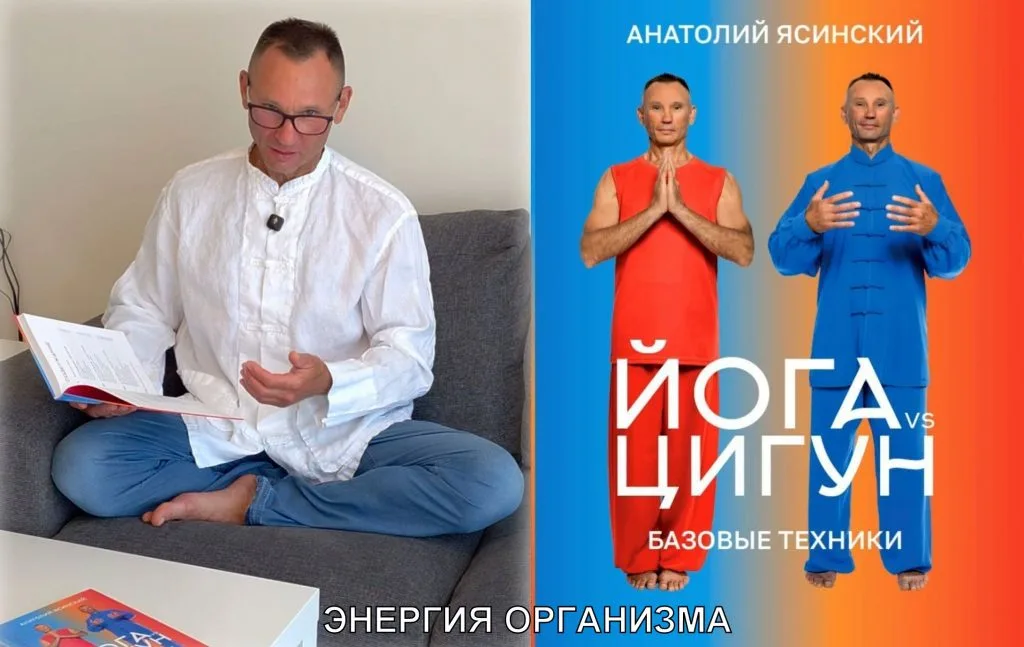
A still from the video project: the “Energy of the Body” episode
Two online publications have written about my video project. I’m glad the journalists picked up on the main point: this isn’t yet another “open your chakras” course, it’s an attempt to explain ancient practices in the language of physics and physiology.
What the project is
The format is simple. I read chapters of my book “Yoga vs Qigong: Basic Techniques” aloud and comment as I go: where a particular idea came from and what’s behind it in terms of biomechanics, respiratory physiology and the nervous system. Meanwhile the screen shows the book’s pages, diagrams and charts, so you can pause and take a closer look. And if you don’t have time to watch, an episode works just as well as a podcast, in the car or on a walk. Each episode runs about forty minutes.
The first topics: what “prana” and “qi” actually refer to, why it’s better to breathe slower and less often, where mitochondria come into it, and whether breathing practice can help protect your lower back from disc herniation. Coming up next: a close look at slouching, how meditation changes the brain, the physics of stress, and the biomechanics of basic qigong and yoga routines.
Why “without esotericism”? I’m a physicist by training, a graduate of the Moscow Institute of Physics and Technology (MIPT), and I’ve been practicing and teaching for more than twenty years. Over that time I’ve become convinced that almost everything old texts describe in terms of energies and channels can be explained by ordinary physiology. That doesn’t make practice any less interesting. Quite the opposite: you start to understand why you do things exactly this way. You can read more about my path on the About the Author page.
Publications (in Russian)
Era Zdorovya (Health Age): “A Scientist Explains Yoga and Qigong from the Standpoint of Modern Physics and Physiology”
The project started on the book’s Russian-language website, yoga-vs-qigong.ru. For readers outside Russia, the book is available in English, Bulgarian and Russian, as a PDF and as an audiobook, on the “Yoga vs Qigong: Basic Techniques” page.
Fair warning: this is a long read. If you’re lucky, it’s the only thing you need to read today. If you’re not, that last sentence is false, and we’ve landed right in the middle of the topic before we even started.
I want to talk about the most rigorous and the strangest result in twentieth-century mathematics, and about why it has everything to do with your yoga mat, with family arguments and with how you choose your morning practice. No advanced math required. A little patience will do.
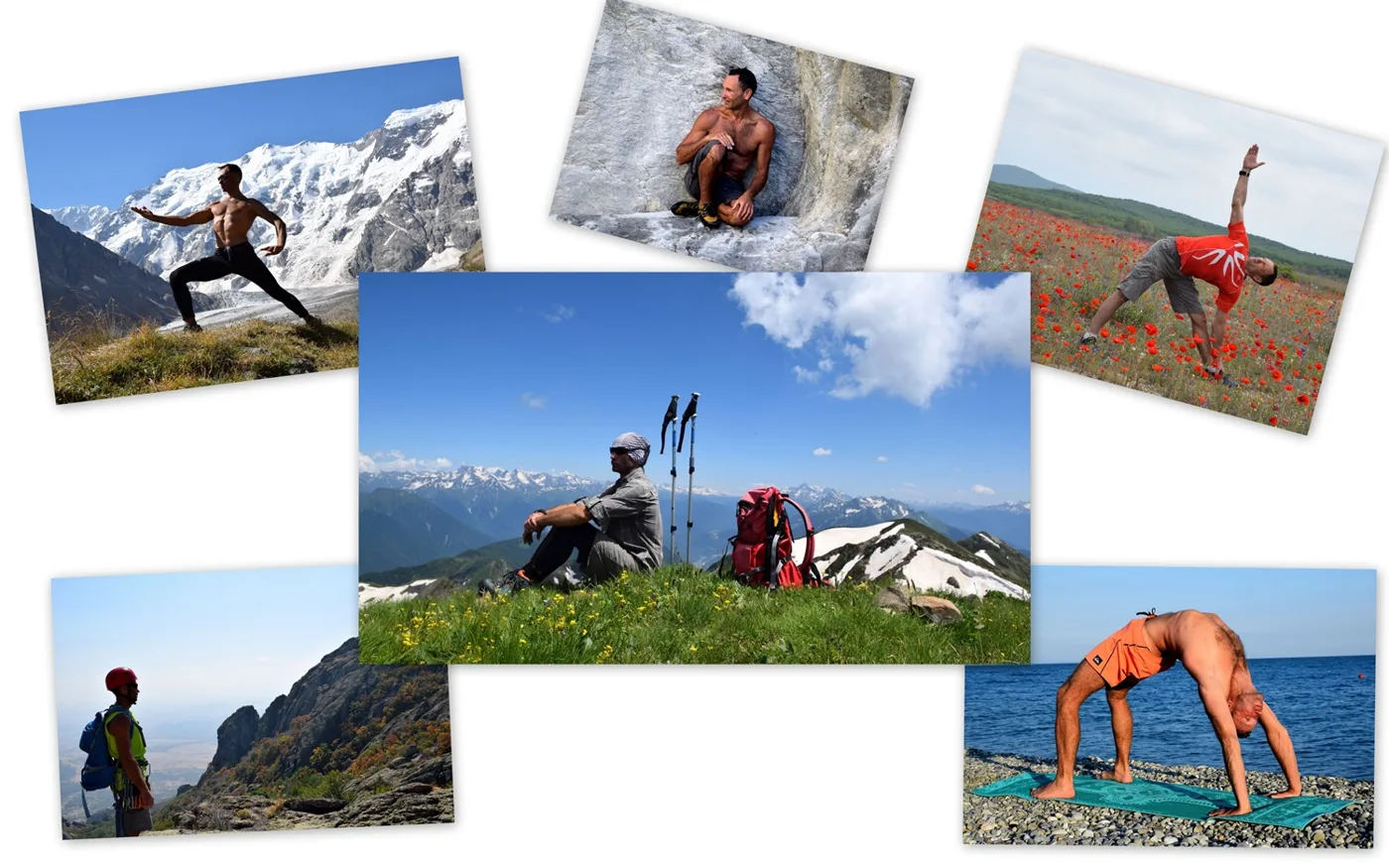
Different worlds of one life: practice, mountains, water, sport
What Gödel actually proved
In 1931 a young Austrian logician named Kurt Gödel, then about twenty-five, published a paper after which mathematicians could never look at their field the same way again. It contained what we now call the two incompleteness theorems.
Let me retell them without formulas, but also without cheating. Take a formal system: a precisely defined set of axioms and rules of inference, powerful enough to do ordinary arithmetic with whole numbers. The first theorem says that if such a system is consistent, its language must contain a statement that the system can neither prove nor disprove. And yet, looking at it from outside, from ordinary arithmetic, we can see that the statement is true. The second theorem adds that such a system cannot prove its own consistency using its own means.
The most elegant part is how Gödel pulled it off. He constructed a statement that, translated into plain English, says about itself: “I cannot be proved in this system.” If the system proves it, the system has proved something false and collapses. If it doesn’t, the statement turns out to be true, and the system simply can’t reach it. Gödel took the ancient liar paradox (“I am lying right now”) and turned it into a rigorous theorem, essentially by replacing the word “false” with “unprovable.”
One more detail that people often forget. You can take the unprovable statement and declare it a new axiom. But the extended system immediately gets an unprovable statement of its own. The hole can never be patched for good: it moves along with every patch.
Dry? Maybe. But behind the dryness is an idea that sages in many cultures voiced long before 1931, they just couldn’t prove it: a closed system cannot fully explain itself. To understand something about it, you have to step outside it.
Let me add a caveat, as a physicist. Strictly speaking, the theorem applies to formal systems in mathematics. Everything that follows is analogy. But in my view these analogies are remarkably precise, and in practice they are confirmed every day. They apply to physics, to every school of practice and to every doctrine about the right way to live, eat, breathe, love, raise children and brew tea.
Two pictures for those who don’t like axioms
The first. Imagine a legal code so detailed that it supposedly settles any dispute. Sooner or later life throws up a case the code never anticipated. It isn’t the lawyers’ fault: any set of rules works this way. Lawmakers add a new article, and after a while another unforeseen case appears. The cycle never ends.
The second. Try to prove to yourself that you’re of sound mind. “I’m perfectly fine” is worth nothing, since someone who really needs help will say it with exactly the same confidence. A real check requires an outside reference point: a specialist’s opinion (better yet, two), comparison with other people, feedback from those close to you and, in the end, life itself.
From the inside, a system can’t see its own boundaries. That holds for arithmetic, for a legal code and for us.
Every day we live inside something
Take an ordinary grudge or a bout of anxiety. While you’re in it, the world really does look bleak and there seems to be no way out. A week later you recall the same episode and wonder: did I really lose sleep over that? The situation itself didn’t change. Your position did: you stepped out of that state and finally saw it at its true size.
When a person is in a deeply low state, their reasoning about the pointlessness of everything can be logically flawless. Inside their picture of the world, the logic holds. What’s broken is not the logic but the vantage point, and you can’t change it from the inside. That’s why we need friends, mentors and doctors. They aren’t necessarily smarter. They simply stand outside.
A family argument flaring up for the tenth time over the same thing works the same way. He has his system, in which he is right without a single flaw. She has hers, in which she is right. You can argue inside two closed systems for years and get nowhere. What helps is a third perspective: a friend, a family therapist or simply a pause, after which both can look at the issue with fresh eyes.
With children it’s even clearer. For a child, the rules of the household, the parents’ tone of voice, the habits at the dinner table simply are how the world works. There’s nothing to compare them with. A child becomes themselves when other systems appear: school, books, trips, a friend’s home where everything is done differently. Each such encounter gives them a point from which to see their own.
The mat as a laboratory
In practice you can see all this almost literally. A student holds an asana or moves through a qigong form and is sure everything is right. I watch from the side and see that the right shoulder has crept up toward the ear, the pelvis has shifted, and the breath catches at every transition. The student won’t notice, and it has nothing to do with ability: they are inside their own body. They need an outside point: a mirror, a phone video, a teacher.
Which leads to a simple conclusion that, as the author of a book, I’m actually happy to admit: a book alone is not enough for practice. Text and photos define a formal system, and living movement lies beyond it. No description can replace an outside eye. That’s why the exercises in my book are linked to video lessons via QR codes: one more vantage point, even if an incomplete one. Where to begin, I’ve gathered in the section on basic yoga and qigong techniques. To my mind, a master is someone who has learned over time to be an outside observer of themselves.
Words that point beyond themselves
Laozi opens the Tao Te Ching with a warning: the Tao that can be spoken is not the eternal Tao. Then he goes on to write about five thousand characters. It makes me smile every time.
The saying “every spoken word is a lie” has the same problem. Apply it to itself and it falls apart: it’s a word too, so it must be a lie as well. It’s the same self-reference loop that Gödel turned into mathematics.
But a sage says such things not as a statement, rather as a gesture. A word is a finger pointing at the moon, and it’s best not to confuse the finger with the moon. The map is not the territory. The word “water” doesn’t quench thirst, a story about pain doesn’t hurt, and the word “love” keeps no one warm. Words “lie” not in the sense of deceiving, but because every description is inevitably incomplete. A book about health doesn’t replace health, a text about an asana doesn’t replace the asana, and a description of a state doesn’t replace the state itself.
There’s a joke usually attributed to Mark Twain: “Be careful about reading health books. You may die of a misprint.” I used it as the epigraph to my book “Yoga vs Qigong: Basic Techniques,” and I did so quite deliberately. I can be wrong too. My text is not dogma but an invitation to test everything on yourself. A book can point the way, share experience and warn you about common mistakes, but you still have to walk the path on your own feet. And everyone’s path is different.
Why yoga alone isn’t enough for me, and neither is qigong
Now something personal. I love yoga as a system: thousands of years old, deep, worked out down to the finest details. But I can’t stop there, because in qigong I find things that yoga barely has. And whenever I practice only qigong, I start missing yoga.
Yoga gives you static holds and stretching, careful work with the spine and joints, concentration through stillness, and a clear head. Classical yoga, however, has little fluidity, few spiral movements, little work with body weight in motion, and little of that softness which is itself a form of strength. Qigong has all of these. Qigong, in turn, has less deep stretching, less strength-building static work and less precise geometry of the body in space.
Then it turns out that even together these two systems don’t cover everything. Cold water gives a sharp, almost instant shift in how the nervous system works: first a powerful surge of sympathetic activation, then a marked calming. No asana can reproduce that. Rock climbing gives you real height and a real movement problem where a mistake has a cost. Strength training builds density in muscles, ligaments and bones that slow practices simply can’t provide. Freeriding gives freedom and a sense of oneness with the mountains, and long-distance running tests the whole body for endurance. Add intermittent fasting and mountain hiking, and you’ll see what my life outside the classroom is made of.
Each of these systems is complete within itself and incomplete with respect to the whole person. To me, that’s pure Gödel.
When loyalty to a school turns into blinders
I often hear: “I’ve found my thing, it’s all I do, I don’t need anything else.” Sometimes there’s real maturity behind it: the person has tried a lot and consciously narrowed the field. But far more often, to be blunt, those words hide fatigue from searching or a reluctance to climb out of a familiar rut.
Ten years of one discipline make a person a master of it and, often, blind to everything beyond it. A strong yogi may not manage a barbell of their own body weight. An experienced qigong master may not last three days without food. A powerlifter can’t always reach their shoelaces in a forward bend, and a marathon runner may be at a loss in icy water. Each is flawless inside their own system and doesn’t notice where it ends.
A pattern very similar to Gödel’s is at work here: the more a system claims to cover everything, the more certainly it contains questions it cannot answer itself.
The old masters were broader than their schools
Here is a subtle point that people rarely notice. Look at how the people we consider carriers of tradition actually lived. Taoist hermits practiced internal arts, martial arts, herbalism, calligraphy, poetry and meditation. Shaolin monks combined Buddhist meditation, qigong, fist fighting and medicine. An Indian yogi knew asanas, pranayama, Ayurveda, mantras and philosophy.
The “pure school” is largely an invention of the last hundred years, when ancient traditions began to be packaged into courses, certifications and brands. A living master of the past was always broader than any formalized version of their school. So a broad approach doesn’t dilute tradition. It brings us back to an older and more honest logic: you choose the tool for the task, not the task for the tool.
The body is not the ground floor, it’s the foundation
You often hear that bodywork is the “lower level” and that everything that really matters happens somewhere higher up. I think that hierarchy is wrong.
Cold water is not only about blood vessels and thermoregulation. Every plunge into icy water is a meeting with fear, a small dying and a small return. On the rock you train not only your fingers but also trust in yourself, decisions under load and a presence in the moment where distraction is simply impossible. The barbell teaches willpower: at your limit you discover that “I can’t” usually turns out to be untrue.
Any physical practice becomes a practice of the spirit if you do it with awareness. The reverse is also true: “spiritual” work cut off from the body easily slides into self-deception, fantasy and esoteric chatter. The body keeps us grounded, like an anchor. Through it pass our emotions and whatever some people call prana, others qi, and others still nervous regulation. The names are secondary.
Where’s the catch
A broad approach does carry a risk: you can pick up a little of everything and never reach depth anywhere, hopping from one interest to the next.
In my view, there is only one protection against that: a deep root. One or two systems you know for real, over years and decades, to the level of personal experience and teaching. On that foundation you can add anything without losing depth. A deep root and a wide crown, not the other way around. Wide roots with a thin trunk are unreliable, and a lush crown without a trunk isn’t a tree at all.
I’ve lived in several very different worlds myself: physics at MIPT, service in the airborne troops, a technology business, Eastern practices, teaching. From the outside it looks scattered. From the inside, it all rests on one axis: get to the essence, find the primary source, take nothing on faith and test it on myself. Each new field added a layer, while the habit of thinking stayed the same. I’ve written more about my path on the about the author page. Without such an axis, breadth quickly becomes superficiality. With it, you can calmly pick up any tool the task calls for.
So what follows from all this
If you put together Gödel, Laozi, the Buddha, the Eastern masters and my own years of practice, you get roughly this formula.
No system can contain a whole person. The honest path is to have a deep root in what matters most and not be afraid to take what you need from elsewhere. Shutting yourself inside one system isn’t loyalty, it’s ceasing to see. Breadth without a root doesn’t give you freedom, it gives you blur. Maturity appears where you have both.
And a practical tip. If you’re stuck in an emotion, a problem, a relationship or your practice, don’t try to get out using the same means that got you in. There’s no exit inside a closed system, and it’s not a lack of intelligence on your part. Take even a small step outside: talk to someone, change your surroundings, take a pause, show your asana to another person. A lot will become clear on its own.
Gödel proved this for formal systems. Sages knew it long before him. And in practice and in life, it may be the most useful thing to keep in mind.
If you’d like to look at yoga and qigong side by side through the lens of physiology and biomechanics, that’s what my book “Yoga vs Qigong: Basic Techniques” is about.
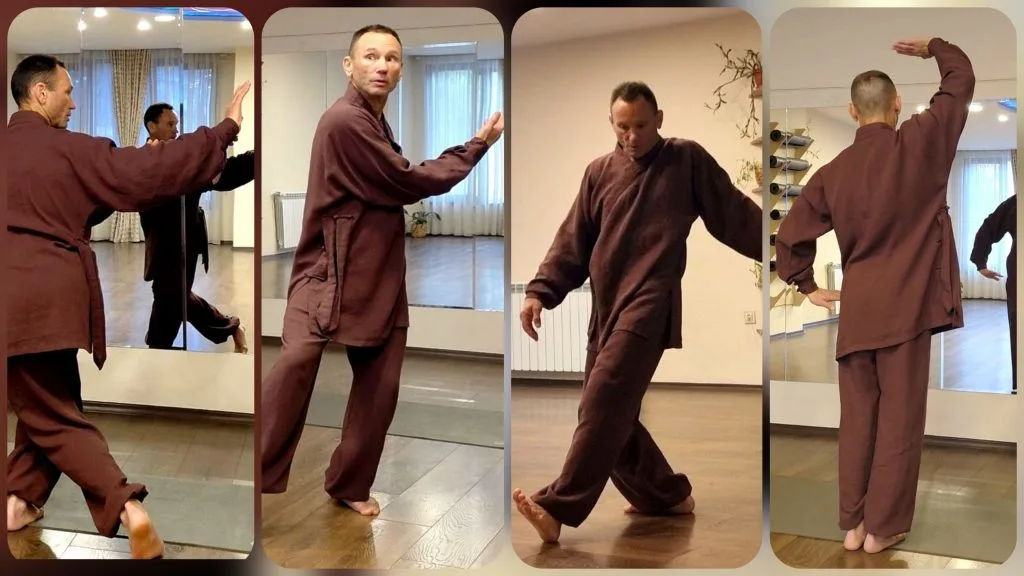
Four frames from the Qigong from Behind project: the camera watches the instructor from behind and from the side
If you have ever learned a routine from a video, you probably know the feeling. The person on the screen raises their right arm, you, standing opposite, raise your left, then you catch yourself, shift your foot, lose the tempo and your breath along with it. All your attention goes into flipping the picture in your head, and there is very little left for the practice itself.
For years I watched my students struggle with this when they practiced at home with online videos. At some point I decided I was done putting up with it and filmed my sets differently. That is how Qigong from Behind came about: six classic health qigong sets recorded so that following me is no harder than standing in a class right behind my shoulder.
One camera behind, one to the side
The main camera stands behind me. You look at my back and move the same way I do: my right arm stays your right arm. There is nothing to mirror, so your mind is free for what matters most, the sensations in your own body.
Of course, you can’t see everything from behind. You can’t tell how the pelvis is tucked, where the elbows point, or how long the spine is. So a second camera runs at the same time, filming from an angle, roughly three-quarters. In the edit the shots alternate: the wide view from behind helps you follow, the side view shows the shape. In a studio this is the job of the mirror or of me walking around the room; in the videos the second camera takes it over.
You can hear me breathe
Another part of the project is tiny: a lavalier mic hidden on my clothes near the chest. It picks up not only my explanations but my breathing too. In qigong this is essential, because the movement follows the rhythm of the inhale and exhale rather than a count. When you hear me inhale, your arms start rising with it, and after a couple of minutes your breathing settles into the shared pace on its own.
In the past all that survived in a video was a voice saying “inhale… exhale,” and the living rhythm was lost. Now the internal work that the tradition calls neigong can come through the screen almost the way it does in class, where students simply hear the teacher breathing next to them.
Which sets are already filmed
The project includes Baduanjin, Yi Jin Jing, Bao Jian, Wu Qin Xi, Shi Er Fa, and the standing practice Zhan Zhuang. For each set I write a detailed breakdown: which muscles engage, what happens to breathing and circulation, and which movement usually trips beginners up. There is also a comparison of the sets by technical difficulty, physical load, and duration. New videos keep coming out.
Yoga vs Qigong
Audio & subtitles: EN · BG · RU (⚙ in the player)
Why I took this on
I have been teaching groups for a long time, and not only in a studio. Since the pandemic, when classes had to move to Zoom, I have understood how differently you need to explain things through a screen. Over the years I have built up a whole collection of typical mistakes: where beginners lose their footing, which transition needs to be shown from two sides, where to slow down my speech. Almost every decision in the project grew out of those observations.
It helps me personally, too. When you talk through a technique on camera and then watch yourself from the outside, your own practice gets cleaner. Filming turned out to be a way to sort out everything I have learned over years of practicing and teaching.
A video shows how to move, but it has no time to explain why it works. Where the old sets came from, how the ideas of qi and meridians translate into the language of anatomy and neurophysiology, why the diaphragm acts as a pump for venous blood, how calm breathing switches on parasympathetic regulation: I cover all of this in detail in my book.
Where to watch
All lessons are free on my YouTube channel, with no sign-up or subscription required. These are not short clips but full sessions you can practice with on your own. Many of my students turn them into a 30-40 minute morning routine before work.
If you’d like to work on your technique in person, come to my morning qigong classes in Burgas. And if you practice at home, tell me in the comments under the videos which parts are unclear: that is how I decide what to film next.
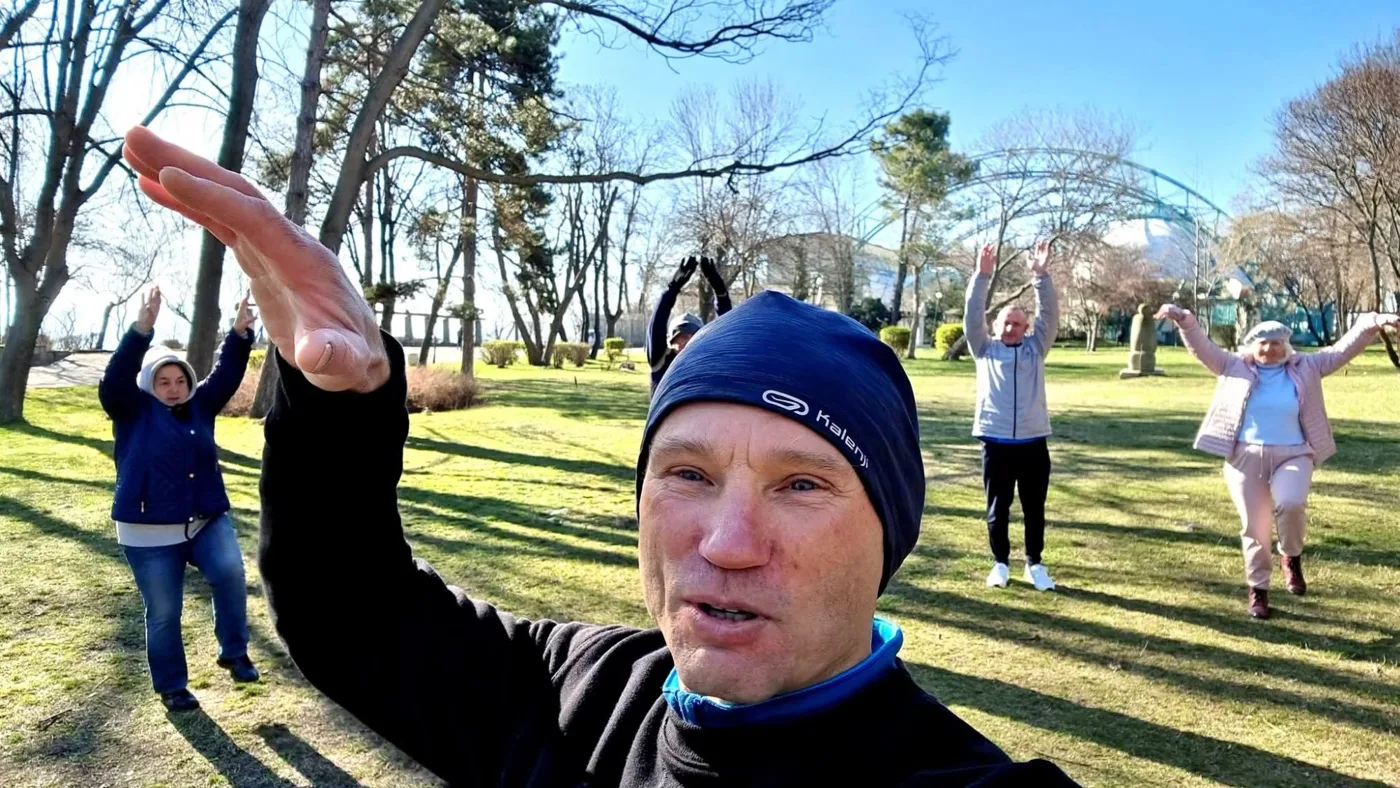
On Wednesdays I teach qigong in the park instead of a studio. We meet in the Sea Garden (Morska Gradina in Bulgarian), on the grassy lawn to the left of the Summer Theater. We start at 8:00 a.m. and finish at 9:00. No experience needed: both longtime practitioners and complete beginners come along.
Why the morning, and why outdoors
Practicing in the park feels completely different from practicing indoors. Sea air, birds in the trees, a light morning chill that wakes the body up faster than coffee. An hour of calm movement at the start of the day helps get your circulation going after sleep, loosen up the joints and clear your head before the day’s business piles up. Natural morning light also helps the body fully wake up and keep a steady daily rhythm.
Slow doesn’t mean easy
Many people assume that if the movements are smooth and unhurried, there’s hardly any effort involved. It’s actually the opposite. In slow movement, momentum doesn’t help you, so every phase has to be held and controlled. Your weight flows gradually from one leg to the other, while the legs, core, back and shoulders all work at once. The grass underfoot is uneven, which adds an extra balance challenge: the feet and ankles keep adjusting the whole time.
After a few weeks of regular practice, coordination usually improves, stiffness fades and the body starts moving noticeably more freely. If you’d like to get a sense of what the practice is made of beforehand, take a look at basic yoga and qigong techniques.
Qigong class on the lawn by the Summer Theater
In winter and bad weather
When it’s cold, raining or a strong wind is blowing in from the sea, we move indoors. At Tsentar Amrita (Bratya Miladinovi district, 145), classes take place on Mondays and Fridays. For the current season’s exact schedule and sign-up, see the qigong classes in Burgas page.
All you need to bring is comfortable clothing for the weather and a bottle of water. Regulars and newcomers are equally welcome.
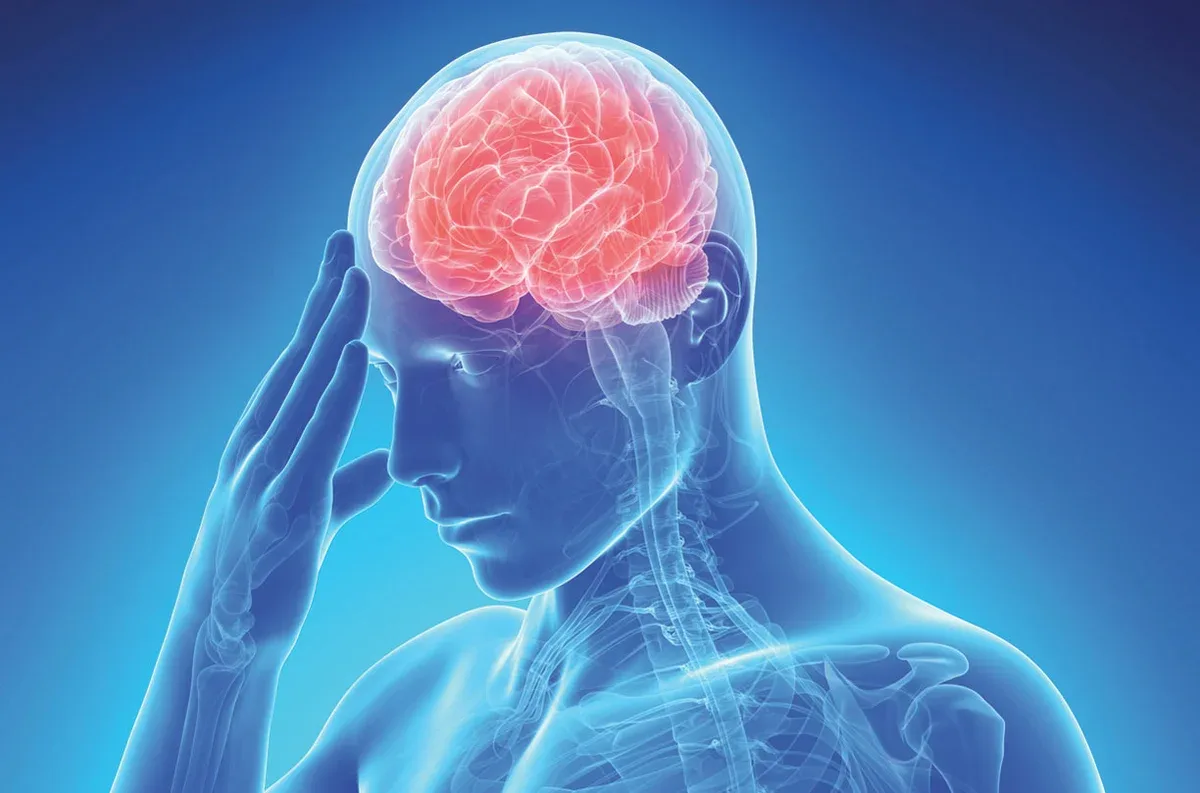
A tension headache often starts in the muscles of the neck and shoulders
A squeezing pain, as if someone had put a tight band around your head. It doesn’t throb or knock you off your feet, but it drags on for hours and by evening turns any task into a chore. That’s how people most often describe a tension-type headache, the most common kind of headache in adults.
I devoted my yoga therapy thesis to this topic and defended it in early 2022. It grew into a free video course of exercises, which I’ll tell you about at the end. But first, why exercise makes sense here at all.
See a doctor first, then get on the mat
Any recurring headache should be checked by a doctor first. This is especially true if the attacks are frequent or severe, came on suddenly, have changed in character, or come with numbness, vision or speech problems, or fever. Exercise does not replace diagnosis and treatment. It works as a complement once serious causes have been ruled out and your doctor has confirmed a tension-type headache. Migraine works differently, and a practice plan for it is also best discussed with a specialist.
What happens in the body
Tension headaches rarely come out of nowhere. Research links them to emotional stress, lack of sleep, and staying in the same position for a long time. Many people with this diagnosis have muscles around the skull, neck, and shoulders that are tender to the touch: they work for hours without a break.
Neck and shoulders
Your head weighs several kilograms. As long as it sits straight over the spine, the neck muscles hold it with almost no effort. Push your chin toward the screen, and the load on the back of the neck and the upper trapezius goes up many times over. An hour at the laptop in that position, and the muscles attached to the base of the skull are in constant tension. Meanwhile the shoulders creep up toward the ears, especially when we’re concentrating or anxious.
Posture
A slouch and a forward head go together. The upper back rounds, the chest sinks, and the neck has to compensate. That’s why working on the neck alone isn’t enough: the whole body needs its vertical line back, from the pelvis to the crown of the head. I covered how to set this up at a desk and on the floor in my article on how to sit correctly.
Breathing
This link is often overlooked. In calm breathing, the diaphragm does most of the work. Under stress, breathing becomes fast, shallow, and chest-based, and the accessory muscles kick in: the scalenes, the sternocleidomastoids, the upper trapezius. All of them are in the neck. Thousands of small breaths a day, and the neck gets as tired from breathing as from a bad chair. Slow breathing with a longer exhale, on the other hand, shifts the nervous system toward parasympathetic regulation, and muscle tone goes down.
Which exercises help
A sensible approach combines several directions. There is evidence in favor of regular moderate aerobic activity, exercises that strengthen and stretch the neck and shoulder muscles, relaxation, and mindfulness practices. Yoga and qigong are convenient because they bring all of this together in one session.
In practice it looks like this. Gentle stretching and strengthening of the neck and upper back, with no jerks or sharp head rolls. Posture work: learning to sit and stand upright without strain. Breathing exercises that lengthen and calm the breath and give the work back to the diaphragm; you can read more about them in my piece on pranayama. A dynamic sequence like Surya Namaskar that loads the whole body evenly. The standing practice Zhan Zhuang, where you learn to hold your vertical line while letting go of extra tension. And finally meditation, which lowers your overall stress level.
Regularity matters most: practice not only on days when your head already hurts. Muscles need weeks to adapt to a new routine, and a noticeable effect usually builds up gradually. If an exercise makes the pain worse, skip it.
A free video course
I developed the course from my thesis, drawing on clinical guidelines from Russian and international headache specialists. The exercises are grouped into six blocks: neck and upper back, posture, breathing, Surya Namaskar, Zhan Zhuang, and meditation. Each session is short and easy to fit into a normal day.
For a while the recordings just sat there. Then I put them in order and gathered them into a playlist. You can watch with no sign-up and completely free: the “Exercises for Headaches” video course on YouTube. The lessons are in Russian. Start with the introductory session:
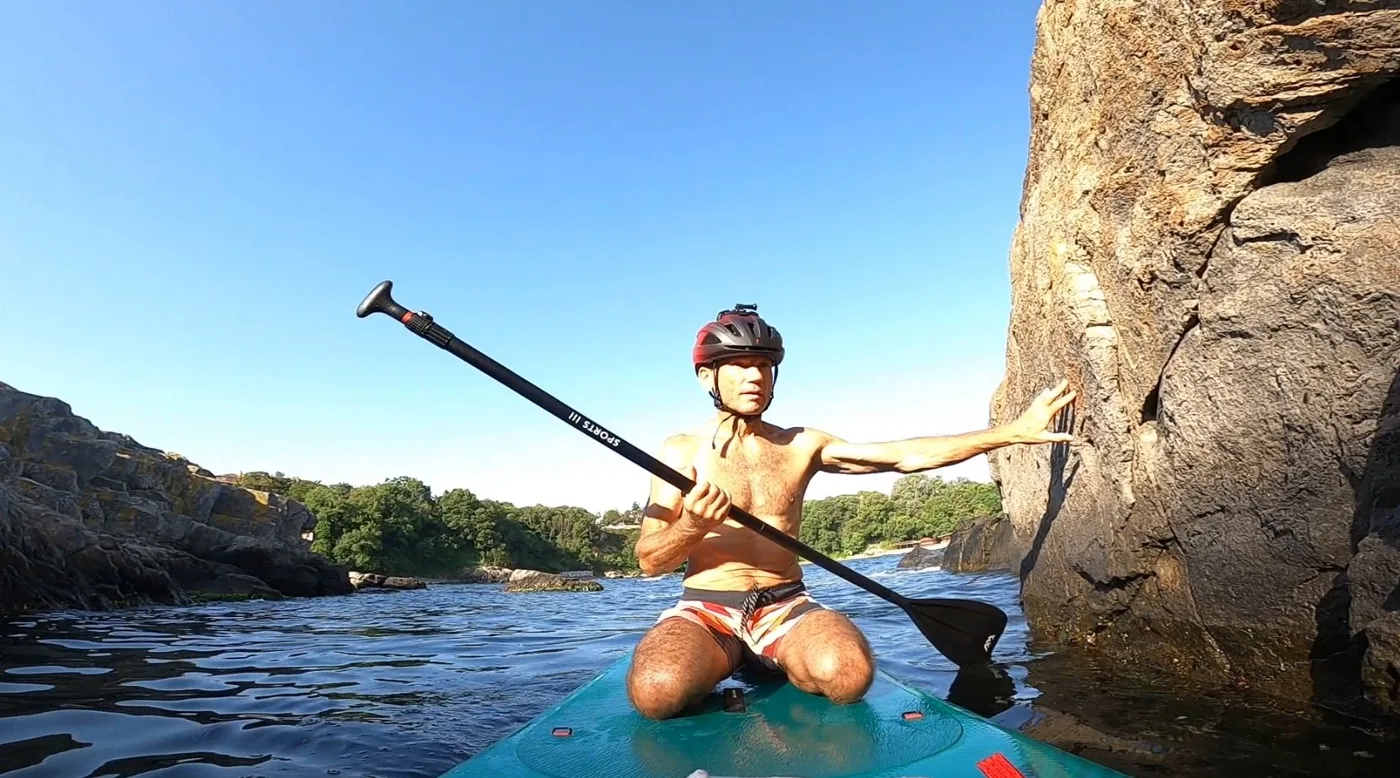
On the board next to a sea cliff: this is where the water leg begins
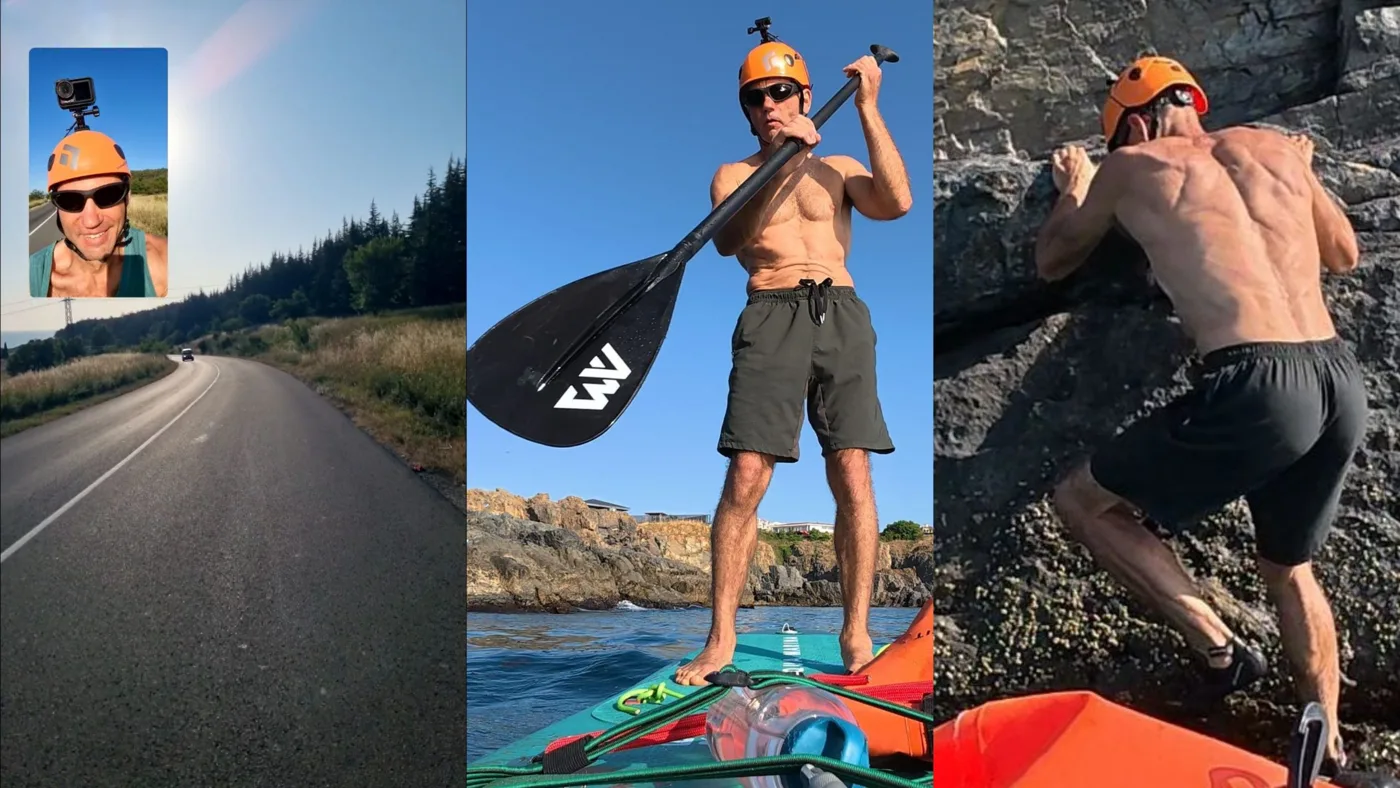
On June 21, 2024, half joking and half serious, I declared the birthday of a new sport. It’s called BIKE, SUP & DWS, and it has three legs: ride there by bike, paddle there on a board, and climb a cliff right above the sea.
The three legs in order
BIKE. An ordinary bicycle powered by nothing but your legs. Mine is a mountain hardtail, meaning a frame with no rear suspension and a suspension fork up front.
SUP. An inflatable board you stand on and paddle with a single-blade paddle, known as a stand up paddle board.
DWS. Deep water solo, climbing coastal rocks without a rope. The water itself is your protection, so there has to be enough depth under the route for a fall to end in a swim, not an injury.
Where the idea came from
It all started about two years before the “official” launch. I was climbing sea cliffs near Sozopol when I spotted a guy on a SUP calmly gliding along the rocks. I had seen paddle boards before, of course, but only at beaches. It had simply never occurred to me that you could take one into such wild spots.
That’s when the picture came together. The most interesting DWS lines can’t be seen from shore, and many can’t be reached on foot. From the water, the cliffs look completely different. You could drive the board to the sea, but that’s boring, and more to the point, I don’t own a car. So the way to the water had to be by bike. And the three activities merged into one on their own.
Yoga vs Qigong
Audio & subtitles: EN · BG · RU (⚙ in the player)
Why these three
This triathlon brings together almost everything I love and know how to do. Cycling, especially in hilly terrain, loads the legs, builds endurance, and is great training for your breathing. Climbing teaches balance, flexibility, precision, and focus; I have long called it yoga on the wall. And the board isn’t really new to me, quite the opposite: it has a bit of freeriding, ski touring, wakeboarding, and wakesurfing all in one. On my very first day on the waves I got the same feeling as riding a snowboard through fresh powder.
In a broader sense, for me this is the same practice as qigong and tai chi: movement joined with breath, and a person joined with nature. On a climb, the inhale and exhale set the pace, and once your breathing falls apart, you ride on stubbornness alone. Paddling quickly finds its own steady rhythm too, and the breath settles in with the strokes. On the rock, a couple of slow exhales before a hard move help the body stop tensing up. If you want to learn to control your breathing on purpose, the pranayama breathing practices are a good place to start.
What the first year showed
A year later I can say the triathlon turned out very well balanced in terms of load, and genuinely technical at the same time.
The bike is in charge of endurance. You usually ride over rough terrain and carry a load, since the board and gear travel with you.
The board gives you access to cliffs you can’t reach from shore. But that isn’t simple either: you have to fight the waves.
Climbing above the sea remains the highlight of the whole route. You have to pick a safe line, prepare a spot to start from, and remember that the rock can be wet, brittle, or sharp. There are plenty of small details like that, and your safety depends on them. So don’t try DWS without climbing experience and without checking the depth under the cliff.
All three legs in one day: the road by bike, the paddle board, and climbing a cliff above the water
Yoga vs Qigong
Audio & subtitles: EN · BG · RU (⚙ in the player)
Join in
Climbers, cyclists, paddlers, and anyone who loves moving outdoors: tell me what you think of the idea. The coast around Burgas, where I live and teach qigong classes, is perfect for it. Someday I’d love to gather like-minded people and hold a real BIKE, SUP & DWS festival.
Cookies
We use cookies for visit statistics (Google Analytics). They are switched on only if you agree.
Functional
Always active
The technical storage or access is strictly necessary for the legitimate purpose of enabling the use of a specific service explicitly requested by the subscriber or user, or for the sole purpose of carrying out the transmission of a communication over an electronic communications network.
Preferences
The technical storage or access is necessary for the legitimate purpose of storing preferences that are not requested by the subscriber or user.
Statistics
The technical storage or access that is used exclusively for statistical purposes.The technical storage or access that is used exclusively for anonymous statistical purposes. Without a subpoena, voluntary compliance on the part of your Internet Service Provider, or additional records from a third party, information stored or retrieved for this purpose alone cannot usually be used to identify you.
Marketing
The technical storage or access is required to create user profiles to send advertising, or to track the user on a website or across several websites for similar marketing purposes.