Category: Notes

  • Breathing at Altitude: My Second Article for Yoga Journal

    Breathing at Altitude: My Second Article for Yoga Journal

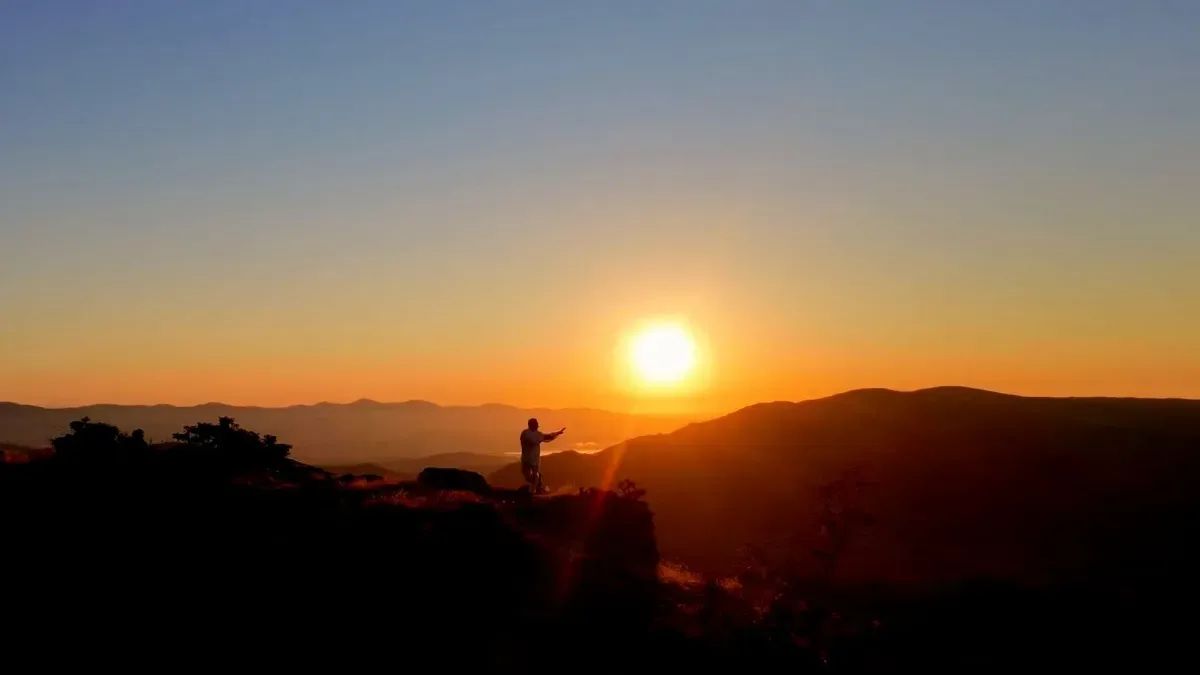
    Qigong at sunrise on a mountain ridge
    Qigong at sunrise on a mountain ridge

    My second piece for Yoga Journal is out, and this time it’s about the mountains. More precisely, it’s about something anyone who has packed a mat for a hiking trip knows well. Down at home your sequence flows, your body remembers every pose, and then up high, by the third round, your breath falls apart and you can’t get enough air.

    I was also pleased that the editors chose my own photo for the piece: a sunrise practice on a mountain ridge. A real photo always beats a stock image.

    The main ideas

    The first thing worth correcting is the familiar line “there’s less oxygen in the mountains.” Its share of the air is the same as at sea level, about 21%. What drops is the pressure, and with it the force that pushes oxygen from your lungs into your blood. So the task isn’t to breathe in more air, but to make sure your blood actually releases oxygen to the tissues.

    The natural reaction to feeling short of breath is to breathe faster and deeper. Your body does this on its own, but overdoing it flushes carbon dioxide out of the blood. Without enough CO2, hemoglobin holds on to oxygen more tightly and delivers less of it to muscles and brain. That’s the Bohr effect. Hence the paradox: the harder you breathe, the more breathless you feel, and dizziness and tingling fingers join in.

    There’s some simple arithmetic here, too. Part of every inhale stays in the trachea and bronchi and never reaches the alveoli; this is the so-called dead space. That’s why slow, deep breathing moves more air through gas exchange than fast, shallow breathing, even when the total volume per minute is the same. Yogis settled on this pattern long before physiologists could do the math.

    What helps at altitude: a long exhale, roughly twice as long as the inhale, at about six breaths per minute. Nadi shodhana, because it slows the breath and keeps it in the nose, which warms and humidifies the cold, dry air. Ujjayi is fine at rest, but while moving or climbing it adds unnecessary resistance. Kapalabhati, bhastrika, and long holds after the exhale are best saved for when you’re back down, at least during the first days of acclimatization: they amplify exactly what your body is already struggling with. In your asana practice, slow the pace and cut back on vinyasas, skip inversions if you have a headache, and drink more than you feel like drinking. Ten minutes of calm breathing with a long exhale before bed also helps on those nights when your breath keeps stopping and speeding up in your sleep.

    Then there’s a line I draw firmly in the article. Pranayama doesn’t replace acclimatization and doesn’t treat altitude sickness. If a headache keeps getting worse, or you notice nausea, unsteadiness, or confusion, go down right away. No debate.

    As a physicist, one thing here delights me. Neither the yogis in the Himalayan foothills nor the Taoists on Mount Wudang knew about the Bohr effect or dead space, yet they found exactly the breathing pattern that works best in the mountains.

    The basic breathing techniques, with video, are covered on the Pranayama page. If you’re curious who I am and where this approach to practice comes from, see the About the Author page. And for a detailed look at breathing principles and techniques, there’s my book “Yoga vs Qigong: Basic Techniques”.
  • Yoga and Qigong Through a Physicist’s Eyes: My First Yoga Journal Article

    Yoga and Qigong Through a Physicist’s Eyes: My First Yoga Journal Article

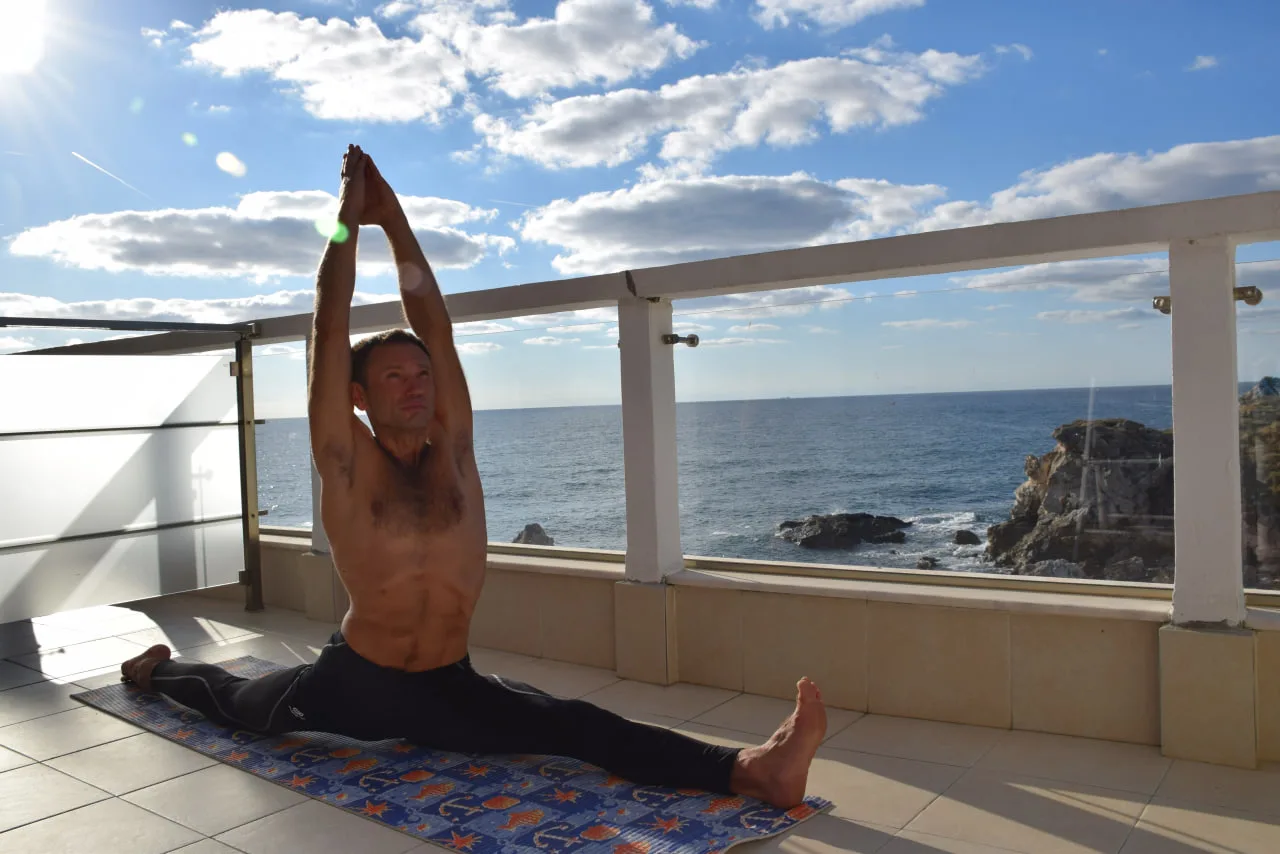
    Morning stretch on a balcony overlooking the sea
    Morning stretch on a balcony overlooking the sea

    Some good news: my first article has come out in Yoga Journal (the Russian-language edition), and I’m now one of the magazine’s contributors. I didn’t show up with yet another piece on asanas. I brought qigong, a topic yoga publications usually tiptoe around, so credit to the editors for taking it on.

    The article looks at what actually happens in the body when you practice. No channels or subtle energies, just breathing, connective tissue, and the nervous system. Below is my own short summary of the main ideas. The full text is on the magazine’s website, in Russian.

    What the article covers

    The Indian and Chinese traditions each have their own map of the body. In one, prana flows through the nadis; in the other, qi moves along meridians and gathers in the dantian. Both maps were drawn centuries before anyone had an anatomy textbook. Strip away the vocabulary, though, and both practices ask you to do the same three things: control your breath, focus your attention, and consciously adjust muscle tension.

    Take breathing first. A slow belly breath with a long exhale switches on the parasympathetic system through the vagus nerve, so the heart rate drops and arousal settles. Both schools pull that same lever. The difference is in how they deliver it. Pranayama tends to rely on counting and breath holds, while qigong ties each breath to a smooth movement of the arms and torso.

    The biggest practical difference, in my view, is stillness versus motion. In an asana, the body holds a shape, the muscles work isometrically, and a joint stays at one range for a while. That builds strength and flexibility in that specific position. Qigong almost always flows: arcs, circles, and no pausing at the end of the range. It’s gentler on the joints, and what gets trained first is coordination and balance. That’s why older people and anyone with limited mobility are so often advised to start with qigong.

    The story is similar for fascia and the nervous system. Long holds in yoga gradually make connective tissue more elastic. The soft, continuous movement of qigong barely stretches anything, but it helps the tissue layers glide over one another, which people recovering from injury or dealing with sore joints often tolerate better. A fast-paced yoga flow first revs up the sympathetic system and then swings back into relaxation, while the even tempo of qigong keeps you calm from start to finish. Neither is better. They simply load the body’s regulatory systems in different ways.

    The takeaway is simple: don’t pick blindly, pick for the job. If you need strength, flexibility, and joint range, yoga is the closer fit. If you want to calm your nervous system, work on coordination, and go easy on your joints, qigong fits better. Many of my students end up combining the two, for example gentle qigong in the morning and a few held asanas in the evening.

    Why a physicist finds this interesting

    What grabs me most here is one observation. Two cultures that knew nothing about each other, or about modern anatomy, arrived at very similar principles through trial and error. That doesn’t prove anything mystical. What it does show is that the body runs on its own logic, shared by all of us, and that long, careful self-observation can uncover it.

    You can read the full article here: Yoga and Qigong: Physiological Similarities and Differences (in Russian). All my pieces for the magazine are collected on my Yoga Journal author page.

    If you’d like to compare the two traditions in your own body, take a look at the basic techniques of yoga and qigong: six practices that make a good starting point. For a detailed walkthrough with photos and video lessons, see my book “Yoga vs Qigong: Basic Techniques”.
  • In the Press: the “Yoga and Qigong Without Esotericism” Project

    In the Press: the “Yoga and Qigong Without Esotericism” Project

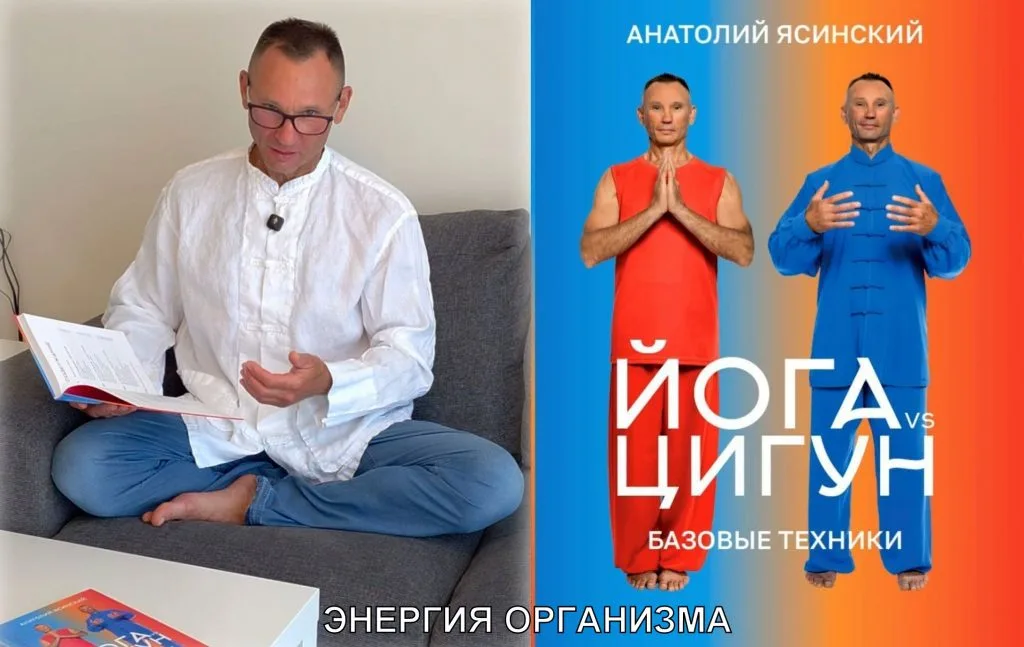
    A still from the video project: the “Energy of the Body” episode
    A still from the video project: the “Energy of the Body” episode

    Two online publications have written about my video project. I’m glad the journalists picked up on the main point: this isn’t yet another “open your chakras” course, it’s an attempt to explain ancient practices in the language of physics and physiology.

    What the project is

    The format is simple. I read chapters of my book “Yoga vs Qigong: Basic Techniques” aloud and comment as I go: where a particular idea came from and what’s behind it in terms of biomechanics, respiratory physiology and the nervous system. Meanwhile the screen shows the book’s pages, diagrams and charts, so you can pause and take a closer look. And if you don’t have time to watch, an episode works just as well as a podcast, in the car or on a walk. Each episode runs about forty minutes.

    The first topics: what “prana” and “qi” actually refer to, why it’s better to breathe slower and less often, where mitochondria come into it, and whether breathing practice can help protect your lower back from disc herniation. Coming up next: a close look at slouching, how meditation changes the brain, the physics of stress, and the biomechanics of basic qigong and yoga routines.

    Why “without esotericism”? I’m a physicist by training, a graduate of the Moscow Institute of Physics and Technology (MIPT), and I’ve been practicing and teaching for more than twenty years. Over that time I’ve become convinced that almost everything old texts describe in terms of energies and channels can be explained by ordinary physiology. That doesn’t make practice any less interesting. Quite the opposite: you start to understand why you do things exactly this way. You can read more about my path on the About the Author page.

    Publications (in Russian)

    Era Zdorovya (Health Age): “A Scientist Explains Yoga and Qigong from the Standpoint of Modern Physics and Physiology”

    https://healthage.ru/novosti/jogu-i-czigun/

    Moi Goda: “MIPT Physicist Launches a Video Project Offering a Scientific Breakdown of Yoga and Qigong Principles”

    https://moi-goda.ru/busnews/fizik-iz-mfti-zapustil-videoproekt-s-nauchnim-razborom-printsipov-yogi-i-tsigun

    The project started on the book’s Russian-language website, yoga-vs-qigong.ru. For readers outside Russia, the book is available in English, Bulgarian and Russian, as a PDF and as an audiobook, on the “Yoga vs Qigong: Basic Techniques” page.

  • “Qigong from Behind”: how I filmed qigong sets that are easy to follow

    “Qigong from Behind”: how I filmed qigong sets that are easy to follow

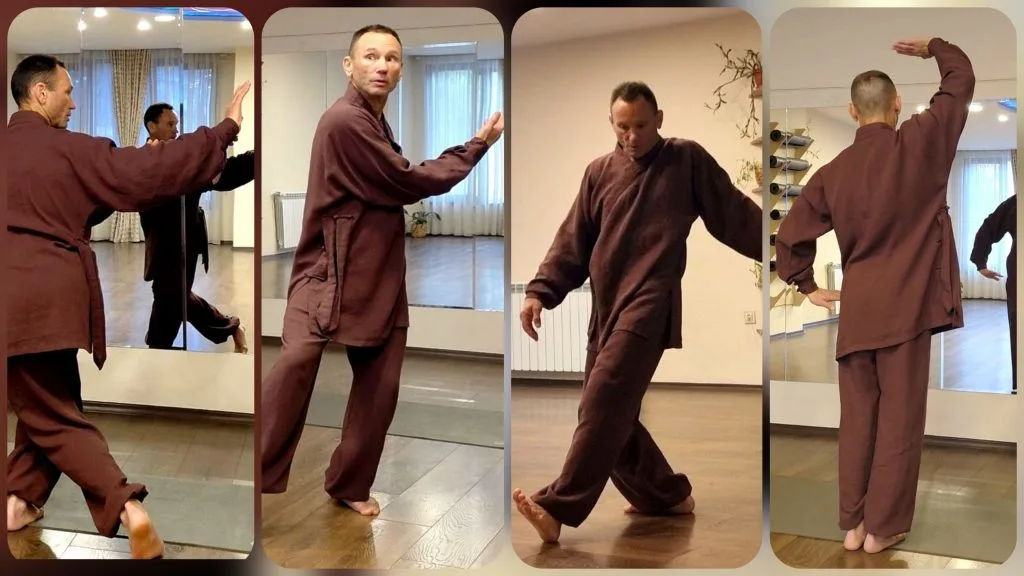
    Four frames from the Qigong from Behind project: the camera watches the instructor from behind and from the side
    Four frames from the Qigong from Behind project: the camera watches the instructor from behind and from the side

    If you have ever learned a routine from a video, you probably know the feeling. The person on the screen raises their right arm, you, standing opposite, raise your left, then you catch yourself, shift your foot, lose the tempo and your breath along with it. All your attention goes into flipping the picture in your head, and there is very little left for the practice itself.

    For years I watched my students struggle with this when they practiced at home with online videos. At some point I decided I was done putting up with it and filmed my sets differently. That is how Qigong from Behind came about: six classic health qigong sets recorded so that following me is no harder than standing in a class right behind my shoulder.

    One camera behind, one to the side

    The main camera stands behind me. You look at my back and move the same way I do: my right arm stays your right arm. There is nothing to mirror, so your mind is free for what matters most, the sensations in your own body.

    Of course, you can’t see everything from behind. You can’t tell how the pelvis is tucked, where the elbows point, or how long the spine is. So a second camera runs at the same time, filming from an angle, roughly three-quarters. In the edit the shots alternate: the wide view from behind helps you follow, the side view shows the shape. In a studio this is the job of the mirror or of me walking around the room; in the videos the second camera takes it over.

    You can hear me breathe

    Another part of the project is tiny: a lavalier mic hidden on my clothes near the chest. It picks up not only my explanations but my breathing too. In qigong this is essential, because the movement follows the rhythm of the inhale and exhale rather than a count. When you hear me inhale, your arms start rising with it, and after a couple of minutes your breathing settles into the shared pace on its own.

    In the past all that survived in a video was a voice saying “inhale… exhale,” and the living rhythm was lost. Now the internal work that the tradition calls neigong can come through the screen almost the way it does in class, where students simply hear the teacher breathing next to them.

    Which sets are already filmed

    The project includes Baduanjin, Yi Jin Jing, Bao Jian, Wu Qin Xi, Shi Er Fa, and the standing practice Zhan Zhuang. For each set I write a detailed breakdown: which muscles engage, what happens to breathing and circulation, and which movement usually trips beginners up. There is also a comparison of the sets by technical difficulty, physical load, and duration. New videos keep coming out.

    Audio & subtitles: EN · BG · RU (⚙ in the player)

    Why I took this on

    I have been teaching groups for a long time, and not only in a studio. Since the pandemic, when classes had to move to Zoom, I have understood how differently you need to explain things through a screen. Over the years I have built up a whole collection of typical mistakes: where beginners lose their footing, which transition needs to be shown from two sides, where to slow down my speech. Almost every decision in the project grew out of those observations.

    It helps me personally, too. When you talk through a technique on camera and then watch yourself from the outside, your own practice gets cleaner. Filming turned out to be a way to sort out everything I have learned over years of practicing and teaching.

    A video shows how to move, but it has no time to explain why it works. Where the old sets came from, how the ideas of qi and meridians translate into the language of anatomy and neurophysiology, why the diaphragm acts as a pump for venous blood, how calm breathing switches on parasympathetic regulation: I cover all of this in detail in my book.

    Where to watch

    All lessons are free on my YouTube channel, with no sign-up or subscription required. These are not short clips but full sessions you can practice with on your own. Many of my students turn them into a 30-40 minute morning routine before work.

    If you’d like to work on your technique in person, come to my morning qigong classes in Burgas. And if you practice at home, tell me in the comments under the videos which parts are unclear: that is how I decide what to film next.

    The theory that didn’t fit into the videos is collected in my book “Yoga vs Qigong: Basic Techniques”.
  • BIKE, SUP & DWS: how I invented my own triathlon and what came of it in a year

    BIKE, SUP & DWS: how I invented my own triathlon and what came of it in a year

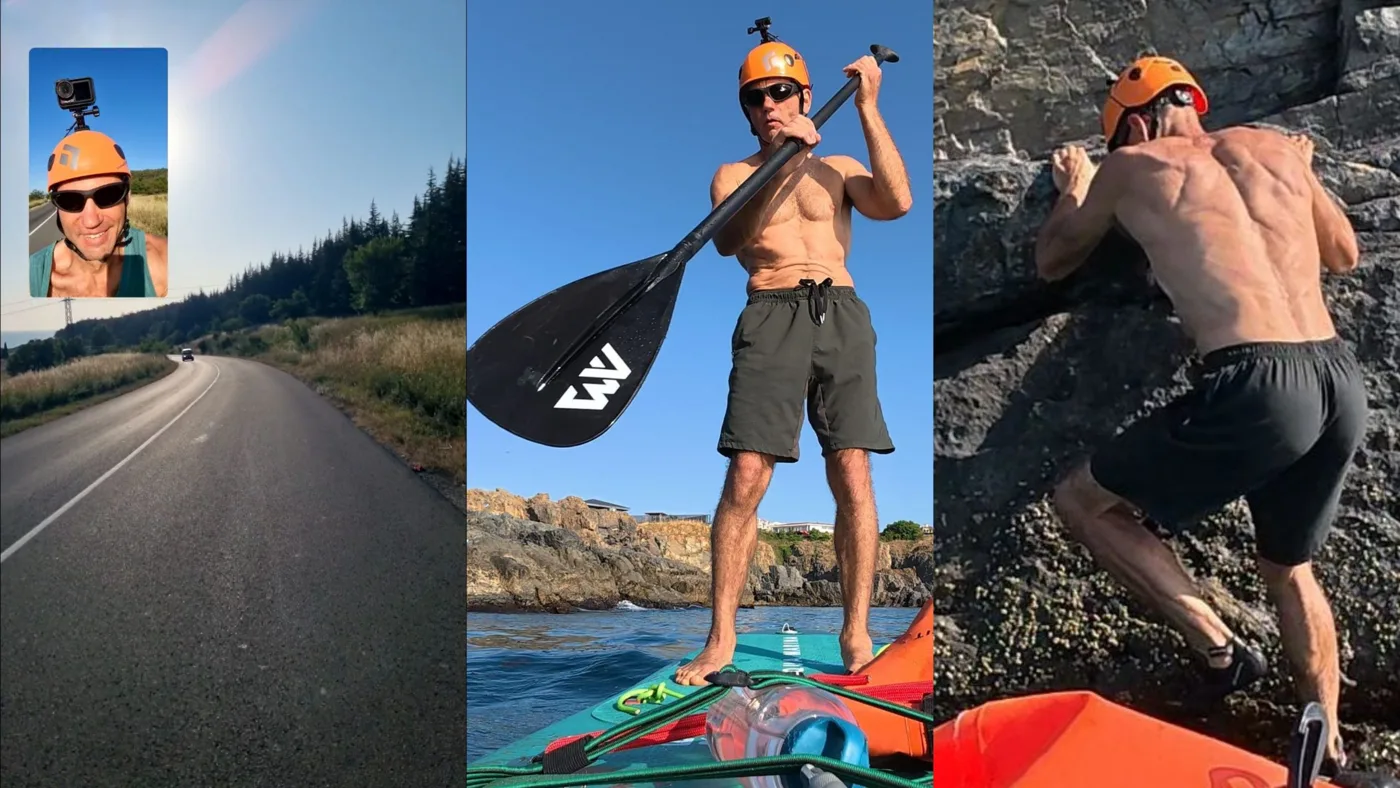
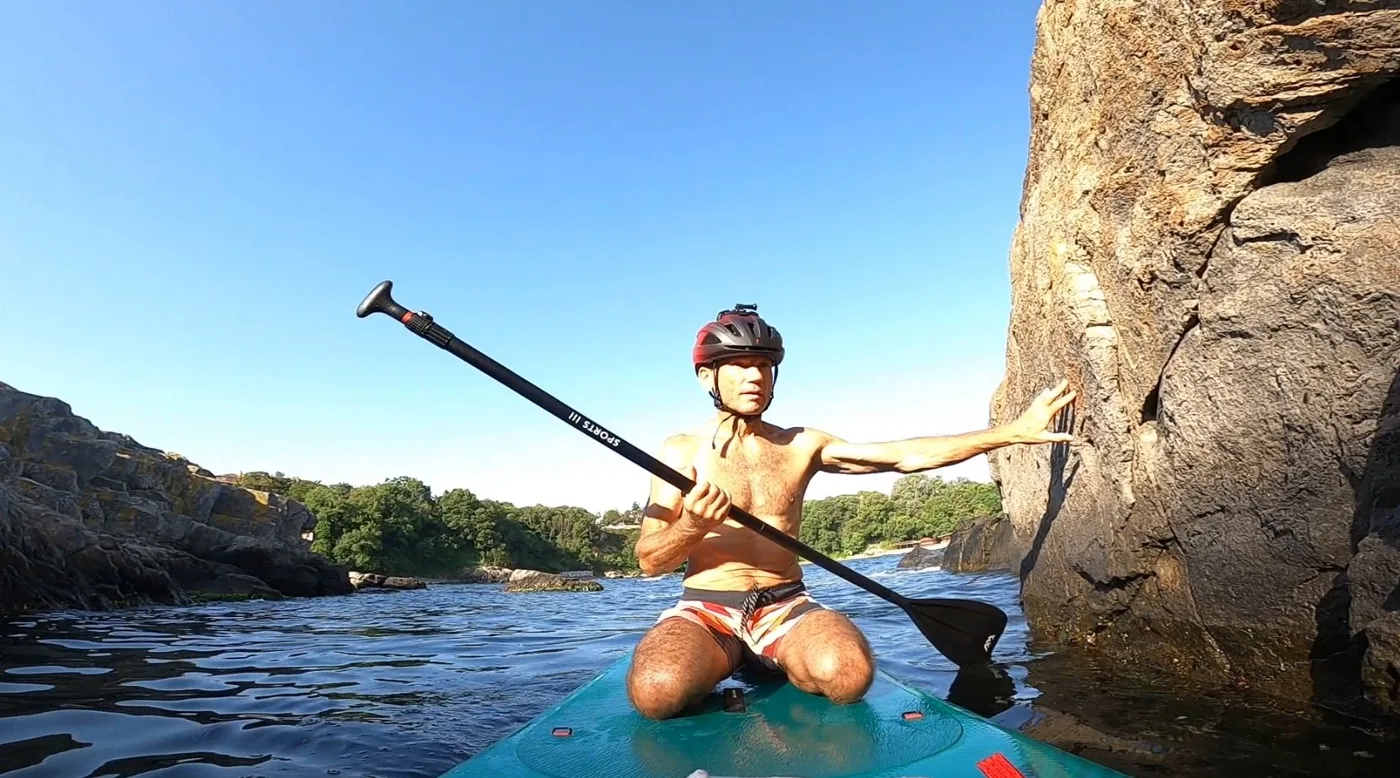
    On the board next to a sea cliff: this is where the water leg begins
    On the board next to a sea cliff: this is where the water leg begins

    On June 21, 2024, half joking and half serious, I declared the birthday of a new sport. It’s called BIKE, SUP & DWS, and it has three legs: ride there by bike, paddle there on a board, and climb a cliff right above the sea.

    The three legs in order

    BIKE. An ordinary bicycle powered by nothing but your legs. Mine is a mountain hardtail, meaning a frame with no rear suspension and a suspension fork up front.

    SUP. An inflatable board you stand on and paddle with a single-blade paddle, known as a stand up paddle board.

    DWS. Deep water solo, climbing coastal rocks without a rope. The water itself is your protection, so there has to be enough depth under the route for a fall to end in a swim, not an injury.

    Where the idea came from

    It all started about two years before the “official” launch. I was climbing sea cliffs near Sozopol when I spotted a guy on a SUP calmly gliding along the rocks. I had seen paddle boards before, of course, but only at beaches. It had simply never occurred to me that you could take one into such wild spots.

    That’s when the picture came together. The most interesting DWS lines can’t be seen from shore, and many can’t be reached on foot. From the water, the cliffs look completely different. You could drive the board to the sea, but that’s boring, and more to the point, I don’t own a car. So the way to the water had to be by bike. And the three activities merged into one on their own.

    Audio & subtitles: EN · BG · RU (⚙ in the player)

    Why these three

    This triathlon brings together almost everything I love and know how to do. Cycling, especially in hilly terrain, loads the legs, builds endurance, and is great training for your breathing. Climbing teaches balance, flexibility, precision, and focus; I have long called it yoga on the wall. And the board isn’t really new to me, quite the opposite: it has a bit of freeriding, ski touring, wakeboarding, and wakesurfing all in one. On my very first day on the waves I got the same feeling as riding a snowboard through fresh powder.

    In a broader sense, for me this is the same practice as qigong and tai chi: movement joined with breath, and a person joined with nature. On a climb, the inhale and exhale set the pace, and once your breathing falls apart, you ride on stubbornness alone. Paddling quickly finds its own steady rhythm too, and the breath settles in with the strokes. On the rock, a couple of slow exhales before a hard move help the body stop tensing up. If you want to learn to control your breathing on purpose, the pranayama breathing practices are a good place to start.

    What the first year showed

    A year later I can say the triathlon turned out very well balanced in terms of load, and genuinely technical at the same time.

    The bike is in charge of endurance. You usually ride over rough terrain and carry a load, since the board and gear travel with you.

    The board gives you access to cliffs you can’t reach from shore. But that isn’t simple either: you have to fight the waves.

    Climbing above the sea remains the highlight of the whole route. You have to pick a safe line, prepare a spot to start from, and remember that the rock can be wet, brittle, or sharp. There are plenty of small details like that, and your safety depends on them. So don’t try DWS without climbing experience and without checking the depth under the cliff.

    All three legs in one day: the road by bike, the paddle board, and climbing a cliff above the water
    All three legs in one day: the road by bike, the paddle board, and climbing a cliff above the water

    Audio & subtitles: EN · BG · RU (⚙ in the player)

    Join in

    Climbers, cyclists, paddlers, and anyone who loves moving outdoors: tell me what you think of the idea. The coast around Burgas, where I live and teach qigong classes, is perfect for it. Someday I’d love to gather like-minded people and hold a real BIKE, SUP & DWS festival.

  • Slow, Low Breathing: A Physicist’s Explanation from the Kitchen and the Textbook

    Slow, Low Breathing: A Physicist’s Explanation from the Kitchen and the Textbook

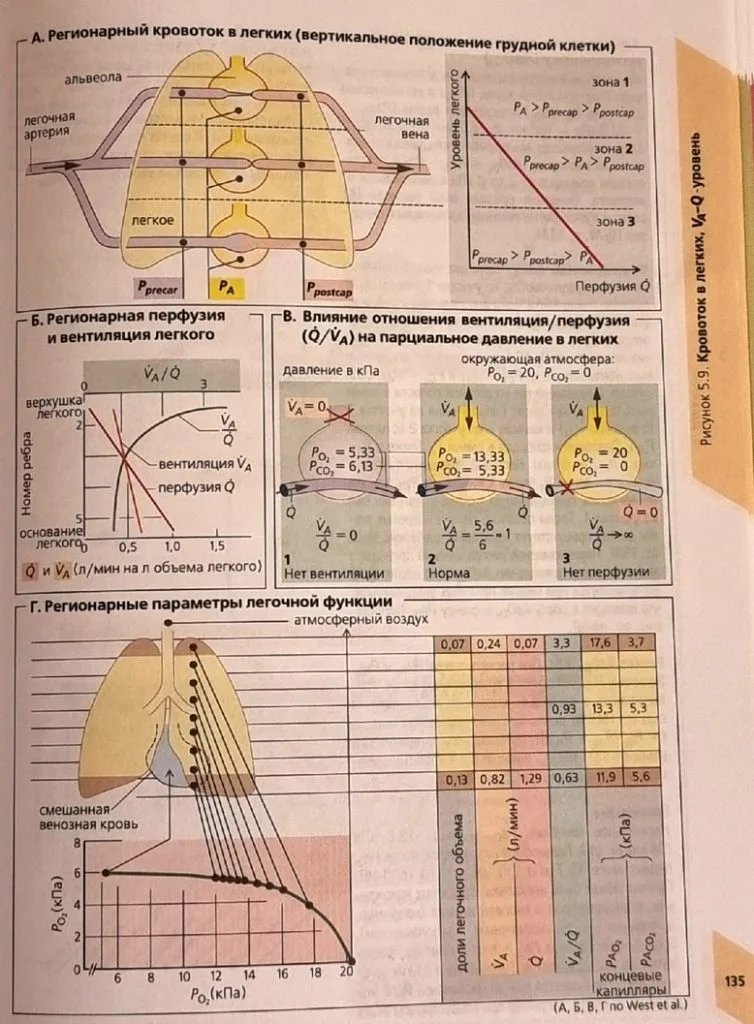
    Ventilation and blood flow in the upper and lower lungs
    Ventilation and blood flow in the upper and lower lungs

    In yoga and qigong, when the body is at rest, we breathe slowly and low, “into the belly.” There are plenty of explanations for this rule, some of them quite mystical. I prefer two simple physical ones. One came to me in the kitchen, the other from a physiology textbook.

    A lesson from two glasses

    When my child was little, I often had to cool boiled water in a hurry. The method is simple: pour the hot water into a glass, after a minute pour it into a second glass, and put the first one, now warm, under the cold tap. Then back again, several times, until the water is lukewarm.

    One day I noticed something curious. If you open the tap all the way, the glass cools almost as fast as under a gentle stream. The glass gives off heat at its own rate, and the cold water needs contact time. A stronger jet only means more water down the drain, with almost no time saved. For every task there is a sensible flow rate, and above it your effort just goes down the sink.

    The same thing happens in the lungs

    Breathing works in a very similar way. Airflow carries fresh air only as far as the smallest bronchi; beyond that, in the alveoli, oxygen and carbon dioxide move by diffusion. That process takes time too.

    On top of that, part of every breath never takes part in gas exchange at all: it stays in the trachea and bronchi. This is the so-called dead space, about 150 ml in an adult. Let’s do the math. Twelve breaths of 500 ml give 6 liters per minute, and 12 × 350 = 4.2 liters reach the alveoli. Twenty-four breaths of 250 ml give the same 6 liters, but only 24 × 100 = 2.4 liters reach the alveoli. Roughly the same work, almost half the benefit.

    The breathing muscles themselves consume oxygen, too. When we force ventilation, we burn part of what we are trying to take in, and we wash out extra carbon dioxide along the way. It becomes a vicious circle. For every state there is an optimal rhythm, where the cost of breathing matches how much oxygen the body can actually take up.

    The top and bottom of the lungs work differently

    The second idea came from Silbernagl and Despopoulos’s “Color Atlas of Physiology.” When we stand or sit, gravity distributes blood in the lungs unevenly: the lower lobes receive several times more of it than the apexes. Ventilation is also greater at the bottom, but it increases less steeply. As a result, the upper parts have plenty of air relative to blood flow, and some of that ventilation is wasted. In the lower parts there is plenty of blood, and gas exchange is limited by how much air gets there. Physiologists call this the ventilation-perfusion ratio.

    This is what makes lower breathing sensible. When the diaphragm is working and the belly moves softly, air fills the lower lobes first, where the blood supply is richest. The cue “breathe into the dantian” (or in yoga, sometimes “down to muladhara”) is an image: physically, air does not go into the belly, but the direction of the diaphragm’s movement ventilates exactly the parts of the lungs best suited for gas exchange.

    Under heavy exertion the picture changes. The heart pumps more blood, pressure in the pulmonary vessels rises, and blood fills even the apexes well. Gas exchange becomes efficient everywhere, and that is when full yogic breathing, using the belly, ribs and collarbones, makes sense.

    What this means for practice

    • At rest, in meditation, and in zhan zhuang standing, breathe slowly, softly and low.
    • Slow does not mean holding your breath or straining. Breathing stays comfortable.
    • During vigorous activity, don’t limit yourself to the belly; switch to full breathing.

    Exercises that help you learn lower and full breathing are collected on my pranayama page. And at my morning qigong classes in Burgas, the first thing we do is calm the breathing rhythm.